
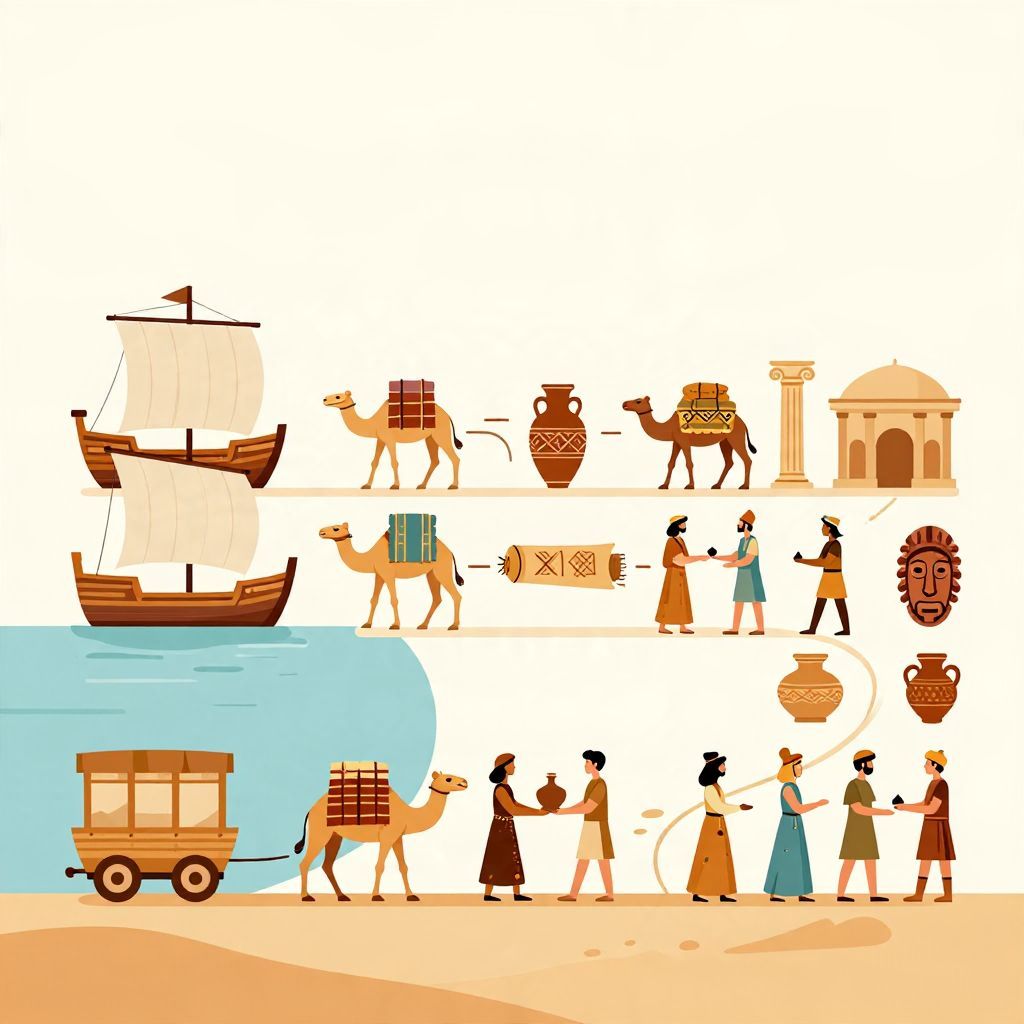
What is cultural diffusion? In history, it is the spread of ideas, beliefs, technologies, languages, foods, art, and customs from one society to another. It has shaped civilizations for thousands of years, from ancient trade routes to modern globalization.
Understanding cultural diffusion helps explain why cultures are never isolated for long. Peoples have always borrowed, adapted, resisted, and transformed outside influences, creating new traditions in the process.
What Is Cultural Diffusion?
Cultural diffusion is the historical process by which cultural traits move from one group or society to another. It can happen through trade, migration, conquest, religion, travel, intermarriage, education, or media. Diffusion does not mean one culture simply copies another; more often, people adapt outside influences to local needs and traditions.
How Cultural Diffusion Works in History
Cultural diffusion usually happens when people come into contact over time. Merchants carry goods and habits along trade routes, soldiers and rulers impose customs through empire, migrants bring languages and foods with them, and pilgrims or missionaries spread religious ideas. The result is often a blend of old and new practices rather than a complete replacement.
Major pathways of diffusion
- Trade: Exchange networks move objects and ideas across long distances.
- Migration: People relocate and bring their traditions with them.
- Conquest and empire: Political power can spread language, law, and religion.
- Religion: Missionaries, pilgrims, and sacred texts carry beliefs across regions.
- Technology and communication: Printing, railroads, radio, television, and the internet accelerate spread.
Origins of the Idea: When Did Historians Start Using the Term?
The phrase “cultural diffusion” is relatively modern, but the phenomenon itself is ancient. Scholars in the late 19th and early 20th centuries began using diffusion to explain how cultural traits spread between societies. Anthropologists and historians used the concept to challenge the idea that every culture developed in total isolation. Today, the term is widely used in history, anthropology, and cultural studies.
Examples of Cultural Diffusion Across History
Ancient trade and the spread of ideas
Long before modern globalization, ancient trade connected distant regions. The Silk Roads, a network of routes linking East Asia, Central Asia, the Middle East, and Europe, carried not only silk but also religions, artistic styles, scientific knowledge, and technologies. Buddhism spread from India into Central and East Asia in part through these networks, while papermaking eventually moved westward from China through contact and exchange.
The Mediterranean world
In the ancient Mediterranean, Greeks, Phoenicians, Egyptians, Persians, and Romans influenced one another through commerce, colonization, war, and diplomacy. Greek art and philosophy shaped Roman elite culture, while Roman law and urban life later influenced many regions of Europe and the Mediterranean basin. This was not a one-way process; local societies adapted imperial customs to their own traditions.
Islamic expansion and knowledge transfer
From the 7th century onward, the spread of Islam linked regions from Spain to South Asia. Along with religion came Arabic as a major language of scholarship, new architectural forms, legal traditions, and scientific learning. At the same time, Islamic civilization absorbed and preserved knowledge from Greek, Persian, Indian, and other sources. Cultural diffusion here worked in both directions: ideas traveled, but they were also translated, debated, and transformed.
The Columbian Exchange
After 1492, contact between the Americas, Europe, Africa, and Asia triggered one of the most dramatic episodes of cultural diffusion in history. Crops such as maize, potatoes, tomatoes, and cacao spread across continents, while horses, wheat, and sugarcane moved into the Americas. Languages, religions, and social customs also traveled with settlers, enslaved peoples, and missionaries. This exchange reshaped diets, economies, and societies worldwide, though it also accompanied violence, disease, and colonial domination.
Modern globalization
In the 19th and 20th centuries, steamships, railways, telegraphs, mass migration, and later film, radio, television, and the internet made cultural diffusion faster and more visible. Fashion, music, cuisine, political ideas, and consumer habits now cross borders in days or even seconds. Modern diffusion can be voluntary, commercial, or imposed, and it often produces both enthusiasm and anxiety about cultural loss.
What Cultural Diffusion Is Not
Cultural diffusion is sometimes confused with related terms, but they are not identical. It is not the same as simple imitation, and it does not always mean one culture dominates another. It also differs from assimilation, where a minority group gradually adopts the ways of a larger one, and from acculturation, where contact leads to selective borrowing and change.
Related concepts
- Acculturation: mutual cultural change through contact, often under unequal power relations.
- Assimilation: absorption into a dominant culture, often with loss of distinct identity.
- Cultural appropriation: borrowing elements from another culture, sometimes controversially or without respect.
- Syncretism: blending of beliefs or traditions into a new form, especially in religion.
Why Cultural Diffusion Matters
Cultural diffusion is one of the main reasons history is connected across regions. It explains how alphabets spread, why cuisines contain ingredients from faraway places, how religions became world religions, and how scientific and technical knowledge traveled across empires and oceans. It also shows that cultures are dynamic rather than fixed. What people call “traditional” is often the product of long contact, adaptation, and exchange.
Benefits and Tensions of Cultural Diffusion
Cultural diffusion can enrich societies by expanding knowledge, creating new art forms, improving agriculture, and encouraging communication between peoples. At the same time, it can accompany conquest, forced conversion, slavery, and the erosion of local languages or customs. Historians therefore study diffusion carefully, paying attention to power as well as exchange.
Positive outcomes often included
- New crops and foods that improved diets
- Technologies that increased productivity
- Shared artistic and intellectual traditions
- Broader communication across regions
Negative outcomes often included
- Loss of languages and traditions
- Forced cultural change under empire or colonization
- Unequal exchange shaped by power imbalances
- Conflict over identity and belonging
How Historians Study Cultural Diffusion
Historians look for evidence in trade records, archaeological remains, linguistic patterns, religious texts, art, architecture, and travel accounts. They ask where a practice first appears, how it changes as it moves, and which groups benefited or resisted it. Because cultural exchange is rarely simple, scholars often compare multiple sources before drawing conclusions.
Questions historians ask
- What cultural trait is being studied?
- Where and when did it first appear?
- Through what routes did it spread?
- Who adopted it, adapted it, or resisted it?
- What political, economic, or religious conditions made diffusion possible?
Conclusion: The Historical Meaning of Cultural Diffusion
Cultural diffusion is the spread of cultural elements across societies, and it is one of the most important forces in world history. From ancient trade routes to digital media, it has connected peoples, reshaped traditions, and created new hybrid cultures. To understand it fully, it helps to compare it with related processes such as acculturation and the efforts involved in cultural preservation in architecture. In the end, diffusion reminds us that cultures develop through contact as much as through continuity.