
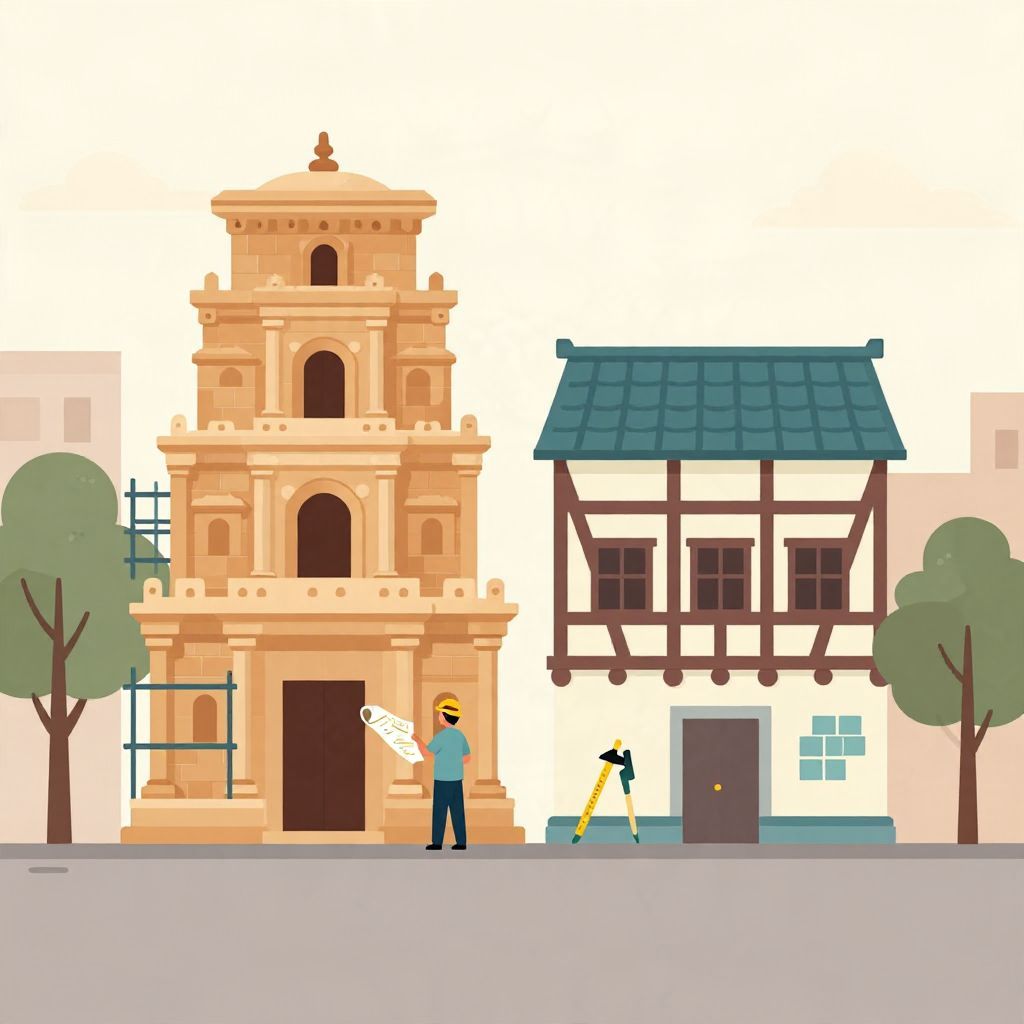
What is cultural preservation architecture? It is the practice of designing, repairing, adapting, and protecting buildings and places that carry historical, artistic, religious, or social meaning. Rather than treating old structures as disposable, it aims to keep their material fabric and cultural significance alive for future generations.
This field sits at the intersection of architecture, history, archaeology, conservation, and public memory. Its meaning has changed over time, but the central idea is old: societies have long tried to save important monuments, sacred sites, and historic districts from decay, war, neglect, and redevelopment.
What Is Cultural Preservation Architecture?
Cultural preservation architecture is the architectural care of places valued for their cultural heritage. It includes restoration, conservation, adaptive reuse, stabilization, and sometimes reconstruction. The goal is not to make the old look brand new, but to preserve authenticity, historical evidence, and the stories embedded in buildings, landscapes, and urban fabric.
Origins and Historical Roots
The idea did not begin with a single inventor or date. People in many ancient societies protected temples, tombs, palaces, and civic monuments because they were sacred, politically symbolic, or tied to collective identity. What changed over time was the scale and theory of preservation: from reverence and repair to a modern discipline guided by documentation, ethics, and law.
Ancient precedents
In the ancient world, rulers often repaired older monuments to associate themselves with the prestige of the past. In Egypt, Mesopotamia, Greece, and Rome, rebuilding and reusing older sacred or civic structures was common. These acts were not always “preservation” in the modern sense, but they show an early recognition that some buildings mattered beyond their immediate utility.
Religious traditions also encouraged care for inherited places. Temples, shrines, churches, mosques, and pilgrimage sites were often maintained because they anchored ritual life. In many cases, preservation was inseparable from worship, memory, and legitimacy.
Medieval and early modern continuity
During the medieval period, older buildings were frequently altered rather than preserved intact. Cathedrals were expanded over centuries; fortifications were repaired for defense; and reused materials were common. Yet this was still a form of continuity. Communities often valued the age of a structure, even when they changed its style or function.
In Europe, the Renaissance and later antiquarian movements helped shift attitudes. Scholars, collectors, and artists began studying ancient ruins as historical evidence. This interest did not immediately create preservation policy, but it laid intellectual groundwork for later conservation practices by treating the past as something to document and interpret, not merely reuse.
How the Modern Idea Developed
The modern field of cultural preservation architecture emerged in the 18th and 19th centuries, especially in Europe, as industrialization, urban expansion, and nationalist politics transformed cities and landscapes. As old districts were demolished or remodeled, critics began arguing that historic buildings were irreplaceable records of collective memory.
Romanticism, nationalism, and the value of ruins
Romantic-era thinkers and artists helped popularize the emotional and historical value of ruins and ancient monuments. At the same time, emerging nation-states increasingly used historic architecture to shape identity. Castles, cathedrals, palaces, and medieval town centers became symbols of national continuity, even when that continuity was selectively interpreted.
This period also produced a tension that still exists today: should historic buildings be restored to an imagined original state, or should their accumulated changes be respected as part of their history? Different countries and scholars answered differently, and those debates shaped the profession.
19th-century restoration debates
Two influential approaches often associated with this era were linked to the French architect Eugène Viollet-le-Duc and the English writer John Ruskin. Viollet-le-Duc favored restoring buildings to a coherent historical ideal, sometimes completing them in ways they may never have originally existed. Ruskin, by contrast, argued that repair should be minimal, because heavy restoration could erase the authenticity of age and use.
These positions were not absolute rules, but they framed a lasting debate: preservation versus restoration, authenticity versus completeness. Modern cultural preservation architecture still works within that tension.
What Cultural Preservation Architecture Includes
The field covers several related practices. Each responds to a different kind of historical need, and each involves different levels of intervention.
- Conservation: slowing decay and preserving existing material with minimal change.
- Restoration: returning a building to a documented earlier appearance or condition.
- Rehabilitation: upgrading a historic structure for continued use while retaining important features.
- Adaptive reuse: converting an old building for a new function, such as a warehouse becoming housing or a church becoming a museum.
- Reconstruction: rebuilding a lost structure, usually when strong evidence exists and the cultural need is compelling.
These terms are related but not identical. A preservation architect must balance historical accuracy, structural safety, modern code requirements, cost, and community values. The best solution is often not the most visually dramatic one, but the one that protects meaning while allowing the building to survive.
Why It Matters Historically
Cultural preservation architecture matters because buildings are historical sources. They reveal how people lived, worshipped, governed, worked, and organized space. A preserved street, market hall, mosque, temple, fort, or house can tell us as much about a society as written records can, and sometimes more.
It also matters because destruction can be intentional. Wars, colonialism, political revolutions, and urban redevelopment have often targeted historic sites. The loss of a building can mean the loss of memory, identity, and evidence. Preservation is therefore not just an aesthetic choice; it can be a form of cultural survival.
War, damage, and recovery
Modern preservation became especially urgent after the destruction caused by the 20th century’s world wars. Bombing, occupation, and ideological violence damaged historic cities across Europe and beyond. In the aftermath, many societies faced hard questions: should ruined monuments be left as memorials, faithfully rebuilt, or replaced with modern architecture?
Different answers produced different outcomes. Some sites were reconstructed to restore civic identity; others were conserved as ruins to mark loss. These choices show that preservation is never purely technical. It is shaped by politics, grief, memory, and public debate.
Key Principles in Cultural Preservation Architecture
Although methods vary, the field is guided by several broad principles that developed over time through professional practice and international heritage policy.
- Authenticity: preserve genuine historic material whenever possible.
- Minimum intervention: change only what is necessary for stability and use.
- Reversibility: when possible, make additions that can be removed later without major damage.
- Documentation: record what exists, what is changed, and why.
- Respect for context: protect not only a single building but also its setting, neighborhood, and cultural landscape.
These principles are not always easy to apply. A building may be unsafe, inaccessible, or too damaged to remain untouched. Preservation architecture therefore requires judgment, not just rules.
Global Expansion in the 20th Century
By the 20th century, preservation had become an international concern. Organizations, governments, and professional bodies began creating legal frameworks to protect monuments and historic districts. After major conflicts and rapid modernization, many countries recognized that heritage could vanish quickly without public policy.
International charters and heritage organizations helped standardize ideas about conservation, though not all regions adopted them in the same way. In practice, preservation has always reflected local history. A colonial-era building, an indigenous sacred site, a medieval church, and a modern industrial complex may each require different ethical and architectural responses.
From monuments to everyday heritage
Early preservation efforts often focused on elite monuments: palaces, cathedrals, temples, and state buildings. Over time, the field broadened to include ordinary streetscapes, workers’ housing, industrial sites, vernacular architecture, and places associated with marginalized communities. This shift recognized that history is not only made in grand buildings.
That broader view changed the profession. Preservation architects now study social history, community memory, and intangible heritage alongside structure and style. A place may be culturally important not because it is architecturally magnificent, but because it carries meaning for the people who use it.
Common Challenges Today
Cultural preservation architecture faces persistent challenges in the modern world. Urban growth can put pressure on historic districts. Climate change increases flooding, heat stress, storms, and erosion. Tourism can bring money but also wear, commercialization, and loss of local life. Political conflict can still endanger sites deliberately or incidentally.
Another challenge is deciding whose heritage is being preserved. Historic buildings may reflect colonial power, religious conflict, or social inequality. Preserving them does not mean endorsing everything they represent. Instead, responsible preservation tries to interpret difficult histories honestly while protecting the physical evidence of the past.
The Historical Significance of the Field
Cultural preservation architecture is historically significant because it shows how modern societies understand time, memory, and identity. It grew from older habits of repair and reuse, but it became a distinct discipline when people realized that historic places could be studied, protected, and ethically managed as cultural evidence.
Its history also reveals a broader truth: preservation is never just about old buildings. It is about the relationship between present and past, and about which stories a society chooses to keep visible. When done well, preservation architecture helps communities live with history rather than erase it.
In short, cultural preservation architecture is the historically informed care of meaningful places, from ancient monuments to modern heritage districts. If you are interested in related topics, you may also want to explore the history of architectural conservation or the development of historic preservation movements.