
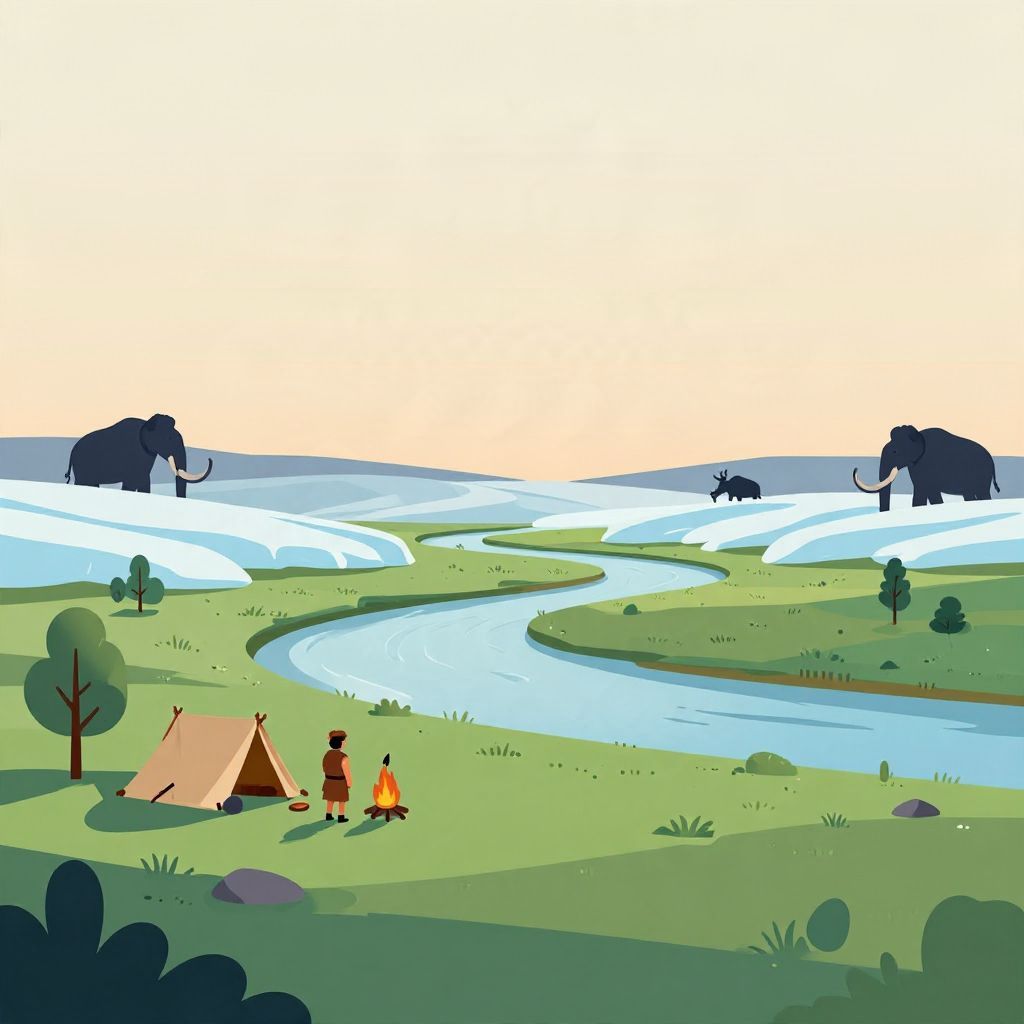
The Holocene began at the end of the last Ice Age, when Earth’s climate shifted into the warmer, more stable conditions we live in today. The accepted start date is 11,700 years before present, which places it at about 9700 BCE.
This boundary matters because it marks a major turning point in climate history and in human history. As glaciers retreated, landscapes changed, sea levels rose, and farming societies eventually emerged in several parts of the world.
When did the Holocene start?
The Holocene officially started 11,700 years before present, or roughly 9700 BCE. Scientists define the beginning of the epoch by a climate transition at the end of the Younger Dryas, a sudden cold snap that interrupted the warming trend after the last glacial period. The date is based on ice-core evidence and is now the standard geological boundary.
What the Holocene is and why its start matters
The Holocene is the current geological epoch of the Quaternary Period. It followed the Pleistocene, the long Ice Age epoch that included repeated glacial advances and retreats. The start of the Holocene is important because it marks a relatively stable climate interval that made agriculture, permanent settlements, and complex civilizations far more likely to develop.
A geological boundary, not a single dramatic event
The beginning of the Holocene was not a one-day transformation. Climate change unfolded over decades and centuries, though the official boundary is fixed to a specific point for scientific consistency. In geological terms, epochs are defined by evidence in rock and ice records, not by a single calendar date chosen for convenience.
The date of the Holocene start: the scientific timeline
Geologists place the start of the Holocene at 11,700 years before 1950, the reference point used in radiocarbon dating. That equals about 9,700 BCE. The date was formally ratified by the International Commission on Stratigraphy after analysis of Greenland ice-core data showed a sharp shift in temperature and atmospheric conditions around that time.
- Before 11,700 years ago: Late Pleistocene conditions, including the final stages of the last Ice Age
- 11,700 years ago: Official start of the Holocene
- Afterward: Rapid warming, glacier retreat, rising sea levels, and ecological change
Why 1950 is used as the reference year
“Before present” in geology and archaeology is standardized to 1950 because radiocarbon dating became widely used around that time and because nuclear testing after 1950 complicated atmospheric carbon measurements. So when scientists say 11,700 years before present, they mean 11,700 years before 1950—not before today.
How the Holocene was identified by scientists
The Holocene boundary was not guessed from a single observation. It was established through climate records preserved in Greenland ice cores, especially changes in oxygen isotopes and trapped gases that reflect temperature shifts. These records showed the end of the Younger Dryas, a brief return to near-glacial conditions before the climate stabilized.
The Younger Dryas and the end of the Ice Age
The Younger Dryas lasted roughly from 12,900 to 11,700 years ago. It was a sudden cooling event that interrupted the broader warming trend after the last glacial maximum. When it ended, temperatures rose relatively quickly, marking the transition into the Holocene. This is why the Holocene is often described as the “post-Ice Age” epoch, even though some ice sheets and glaciers still remained.
What changed when the Holocene began?
The start of the Holocene brought a warmer and more stable climate, but not a perfectly uniform one. Regional conditions still varied, and there were later fluctuations, including droughts, wet phases, and cooler intervals. Still, the overall pattern was much more stable than during the Pleistocene, and that stability had profound consequences for human societies.
Environmental changes
- Glaciers retreated in many parts of the world
- Sea levels rose as ice sheets melted
- Forests expanded into areas once dominated by tundra or steppe
- Animals and plants shifted ranges in response to changing temperatures
- Coastlines changed, altering migration routes and habitats
These changes reshaped the planet’s geography. Land bridges disappeared as sea levels rose, including the connection between Britain and continental Europe and the wider Bering land region over time. Coastal communities had to adapt, while inland environments became more suitable for some forms of plant cultivation and settled life.
Why the Holocene matters for human history
The Holocene is the environmental backdrop for most of recorded human history. It did not directly cause civilization, but it created conditions that made farming, village life, population growth, and eventually cities more sustainable in several regions. The earliest agricultural developments appeared in different places independently, rather than from one single origin.
Early farming and settlement
In the Near East, especially the Fertile Crescent, communities began domesticating plants such as wheat and barley and managing animals over time. Similar long-term processes occurred elsewhere, including parts of China, New Guinea, Africa, and the Americas. Stable climate conditions helped people experiment with cultivation, storage, and permanent habitation.
That said, agriculture was not an automatic outcome of the Holocene. Human groups continued to hunt, gather, fish, and move seasonally in many regions for thousands of years. The transition to farming was gradual, uneven, and shaped by local ecology and culture.
Did the Holocene start at the same time everywhere?
No. The official geological start date is global, but the environmental effects were not identical everywhere. Climate shifts occurred at different speeds and with different local consequences. Some regions warmed quickly, while others experienced delayed changes in rainfall, vegetation, or sea level. The epoch boundary is therefore a scientific standard, not proof that every place on Earth changed simultaneously.
Global date, local experience
This distinction is important. A geological epoch is defined by a globally useful marker in Earth systems, but human communities experienced the transition in highly local ways. One region might see expanding forests and improved growing seasons, while another faced flooding, shifting rivers, or changing animal populations.
How the Holocene is different from the Anthropocene debate
In recent years, some scientists and historians have discussed whether human activity has altered Earth so much that a new geological epoch should be recognized. This proposed epoch is often called the Anthropocene. However, the Holocene remains the official epoch in the geological timescale, and the Anthropocene has not been formally adopted as a standard epoch.
The debate itself shows how significant the Holocene has been. For thousands of years, Earth’s climate was relatively stable compared with the Ice Age world before it. Human societies developed within that stability, and modern industrial activity now raises questions about whether that long interval is ending.
A simple Holocene timeline
- Before 11,700 years ago: The late Pleistocene, with major ice sheets still present
- 12,900–11,700 years ago: The Younger Dryas cooling event
- 11,700 years ago: The Holocene begins
- After 11,700 years ago: Climate stabilizes enough for widespread agricultural development in several regions
- Historic era: Cities, states, writing, and empires develop within the Holocene climate system
Historical facts that help put the Holocene in context
Although the Holocene is a geological term, it is deeply connected to history because nearly all known human civilization unfolded within it. The first cities, writing systems, and states emerged long after the epoch began, but they depended on environmental conditions that were very different from those of the Ice Age.
In that sense, the Holocene is not just a scientific label. It is the long environmental stage on which agriculture, trade, empires, religions, and modern societies eventually appeared.
So, when did the Holocene start?
The Holocene started 11,700 years ago, or about 9700 BCE, at the end of the Younger Dryas and the close of the last Ice Age. That date is the accepted scientific boundary used by geologists today. It marks the beginning of the warm, relatively stable epoch in which human civilization took shape.
If you want to explore the human side of this transition, related topics like the Fertile Crescent and how humans survived the Ice Age show how climate change shaped early settlement and survival.