
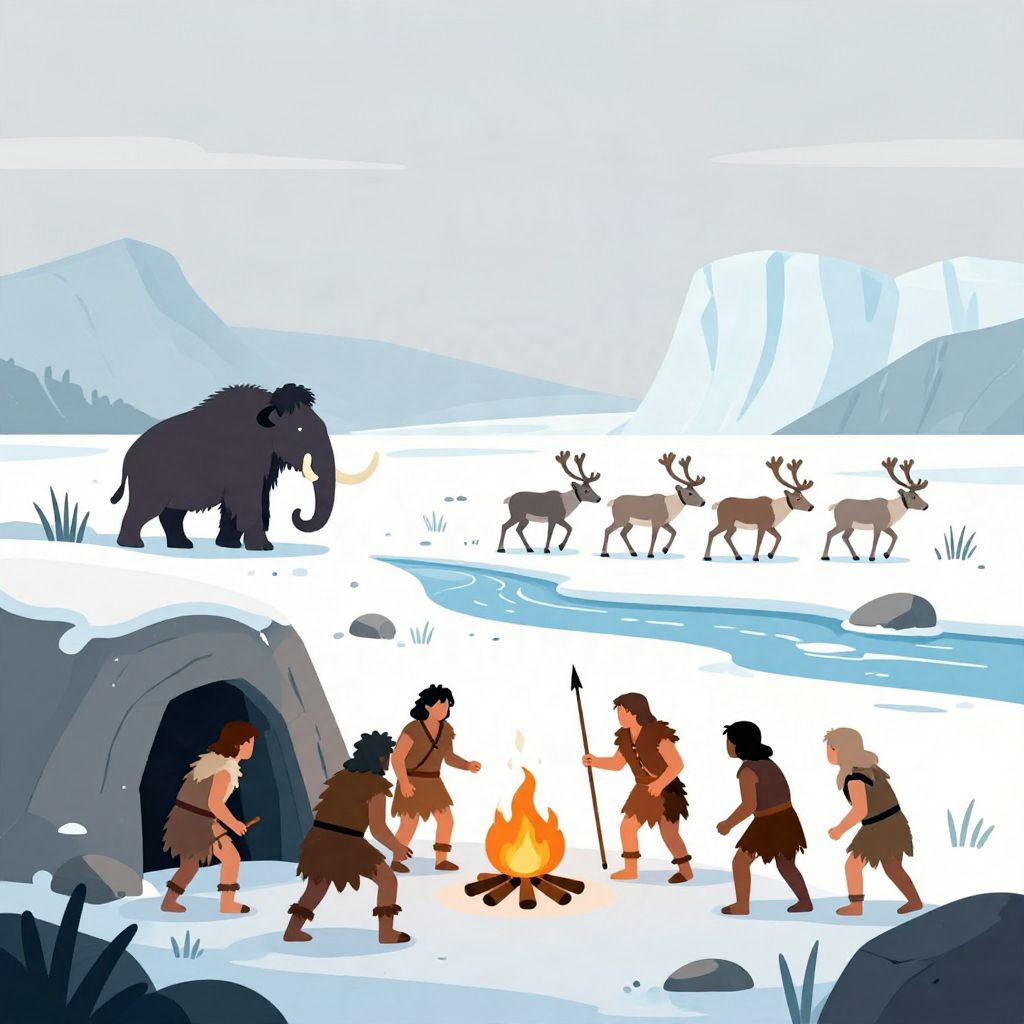
How did humans survive the Ice Age? The short answer is that they survived by adapting—physically, technologically, and socially—to extreme cold, changing landscapes, and unpredictable food supplies. They were not helpless victims of the climate. Instead, Ice Age humans used fire, clothing, shelters, cooperation, migration, and flexible diets to live through harsh glacial conditions.
This survival story spans tens of thousands of years, especially during the last Ice Age, when cold phases repeatedly reshaped Europe, Asia, and North America. It is also a story of ingenuity: humans did not simply endure the Ice Age, they learned how to live in it.
How did humans survive the Ice Age?
Humans survived the Ice Age by combining technology, cooperation, and mobility. They controlled fire, made warm clothing from animal skins, built shelters, hunted large and small animals, gathered plants when available, and moved seasonally or migrated when environments changed. Survival depended less on strength than on adaptability and shared knowledge.
What the Ice Age was like for humans
The term “Ice Age” can be misleading. It does not mean the entire planet was frozen solid. During the last Ice Age, which ended about 11,700 years ago, colder glacial periods alternated with warmer interglacial phases. Vast ice sheets covered parts of northern Europe, Asia, and North America, while other regions remained habitable but difficult.
For humans, the challenge was not only cold. Food sources shifted, sea levels fell, habitats changed, and storms and droughts could become more severe. In many places, survival meant living at the edge of what was possible.
Humans were already adaptable before the coldest phases
By the time modern humans spread widely across Eurasia, they had already developed tools, language, and social cooperation. Earlier human species, including Neanderthals in Europe and western Asia, also adapted to cold environments. Evidence from archaeology shows that different human groups used different strategies, but all relied on innovation and flexibility.
The main survival strategies
1. Fire provided heat, light, and safety
Fire was one of the most important technologies of Ice Age survival. It offered warmth, allowed people to cook food, extended working hours after dark, and helped protect camps from predators. Cooking also made some foods easier to digest and may have improved calorie intake, which mattered greatly in cold climates where energy demands were high.
2. Clothing made a huge difference
Humans survived freezing temperatures by wearing fitted clothing made from animal hides, fur, sinew, and bone tools. Sewing needles made from bone, found at some Upper Paleolithic sites, show that people were not simply wrapping themselves in skins; they were making tailored garments. Proper clothing reduced heat loss and made long-distance movement in cold weather possible.
3. Shelters created livable spaces
Ice Age people used a range of shelters depending on region and available materials. Some lived in caves or rock shelters, while others built huts or tents from wood, bone, hides, and mammoth ivory. In treeless steppe regions, portable structures were especially important. Shelters reduced exposure to wind, snow, and rain and could be moved when groups traveled.
4. Cooperation improved survival odds
Ice Age survival was rarely an individual achievement. Small groups shared food, cared for children, and helped injured or elderly members. This cooperation mattered because hunting large animals or gathering enough resources in a cold environment required teamwork. Social bonds also helped people survive periods of scarcity when one person alone might not have lasted.
5. Flexible diets reduced risk
Humans did not depend on one food source. They hunted reindeer, horses, bison, mammoths, and other animals where available, but they also ate fish, birds, shellfish, roots, seeds, nuts, and seasonal plants. In some regions, smaller game and plant foods became increasingly important. This flexibility helped groups survive when major prey animals moved away or became scarce.
6. Mobility allowed people to follow resources
One of the most effective Ice Age strategies was movement. Rather than staying in one place year-round, many groups followed migrating animals or shifted camp locations with the seasons. Mobility allowed humans to avoid the worst conditions and use different landscapes as they became available. In a changing Ice Age environment, staying still could be dangerous.
Why humans did not simply freeze or disappear
Humans survived because Ice Age environments were challenging, but not uniformly uninhabitable. People lived in refuges—areas where climate remained relatively manageable, such as parts of southern Europe, the Near East, and other regions with access to water and game. These refuges acted as survival zones during the coldest periods.
Archaeological evidence also shows that humans were capable of rapid adjustment. When conditions worsened, groups could change settlement patterns, hunting methods, and tool kits. This adaptability helped modern humans expand into environments that earlier populations had found difficult to occupy.
Technology mattered, but so did knowledge
Tools alone were not enough. Ice Age survival depended on knowledge passed through generations: where animals migrated, which plants were edible, how to preserve meat, how to make shelters, and how to read weather and landscape. This accumulated cultural knowledge was a major human advantage.
What humans ate during the Ice Age
Diet varied by region and season, but Ice Age humans often relied on high-calorie animal foods because they were essential in cold climates. Fat was especially valuable, since it provided dense energy. Hunters likely targeted animals that could feed a group for days or weeks, and they used nearly every usable part of the animal.
- Large mammals: reindeer, bison, horses, mammoths in some regions
- Small game: rabbits, birds, rodents
- Aquatic foods: fish, shellfish, seals in coastal areas
- Plants: roots, berries, nuts, seeds, and tubers when available
There is a common misconception that Ice Age humans ate only meat. In reality, their diets were diverse and depended heavily on local ecology. The more varied the diet, the better the chance of surviving seasonal shortages.
How hunting and tools helped humans survive
Ice Age humans used spears, spear throwers, blades, scrapers, and later more specialized projectile points. These tools made hunting more efficient and helped process hides, bone, and meat. Some communities also used traps and coordinated group hunts, which increased the chances of success.
Archaeological finds show that humans were skilled at making tools from stone, bone, antler, and ivory. These materials were not just practical; they reveal a deep understanding of how to shape resources for specific tasks. In harsh conditions, a well-made tool could mean the difference between life and death.
Did humans evolve to survive the Ice Age?
Humans did not evolve specifically for one Ice Age, but our species and our close relatives had traits that helped in cold environments. Larger brains supported planning and communication. Social cooperation made group survival possible. The ability to make tools, control fire, and adapt behavior quickly was more important than biological “hardiness” alone.
That said, human bodies did show some broad adaptations to climate over long periods, including changes in body proportions and metabolism among different populations. But the main Ice Age advantage was cultural evolution: learned behavior changed faster than genes.
Neanderthals, modern humans, and survival
Neanderthals are often associated with Ice Age Europe because they were well adapted to cold conditions for hundreds of thousands of years. They used fire, tools, and shelters, and they likely wore clothing as well. Modern humans later spread into many of the same regions and eventually replaced Neanderthals, though the reasons are complex and still debated.
Scholars do not think there was a single cause for Neanderthal disappearance. Climate stress, small population sizes, competition, and interbreeding with modern humans all likely played roles. What is clear is that Ice Age survival was not limited to one “superior” species; it was a contest of adaptation under changing conditions.
Major Ice Age events that shaped human survival
Several long-term developments influenced how humans lived through the Ice Age:
- Expansion out of Africa: Modern humans spread into Eurasia over tens of thousands of years, encountering new climates and ecosystems.
- Cold peaks and retreats: Glacial advances repeatedly altered where animals and people could live.
- Development of specialized tools: Better hunting and processing tools improved efficiency.
- Wider use of clothing and shelters: These technologies made colder regions more habitable.
- Late Ice Age megafauna changes: Some large animals disappeared near the end of the Ice Age, forcing further dietary and hunting adjustments.
What happened at the end of the Ice Age?
As the climate warmed after about 11,700 years ago, glaciers retreated and environments changed again. Forests expanded in many regions, sea levels rose, and some large Ice Age animals died out. Human groups adapted once more, shifting from highly mobile hunting strategies toward more settled lifeways in some places.
This transition did not happen overnight. The end of the Ice Age opened new opportunities, but it also created new pressures. Humans who had survived the cold now had to adjust to warmer, wetter, and more crowded landscapes.
Why the Ice Age matters in human history
The Ice Age is important because it shows that human survival has always depended on flexibility. Our ancestors did not conquer the environment through force alone. They survived by observing, learning, sharing, and changing their behavior. Fire, clothing, shelters, and social cooperation were not minor details; they were the foundations of survival.
In that sense, the Ice Age was one of the great proving grounds of human history. It helped shape the inventive, mobile, and cooperative species that later spread across the world.
So, how did humans survive the Ice Age? They survived by being adaptable enough to turn a dangerous climate into a livable world. If you want to explore more about early human history, you may also be interested in related topics such as the migration of early humans or the Neanderthals and their way of life.