
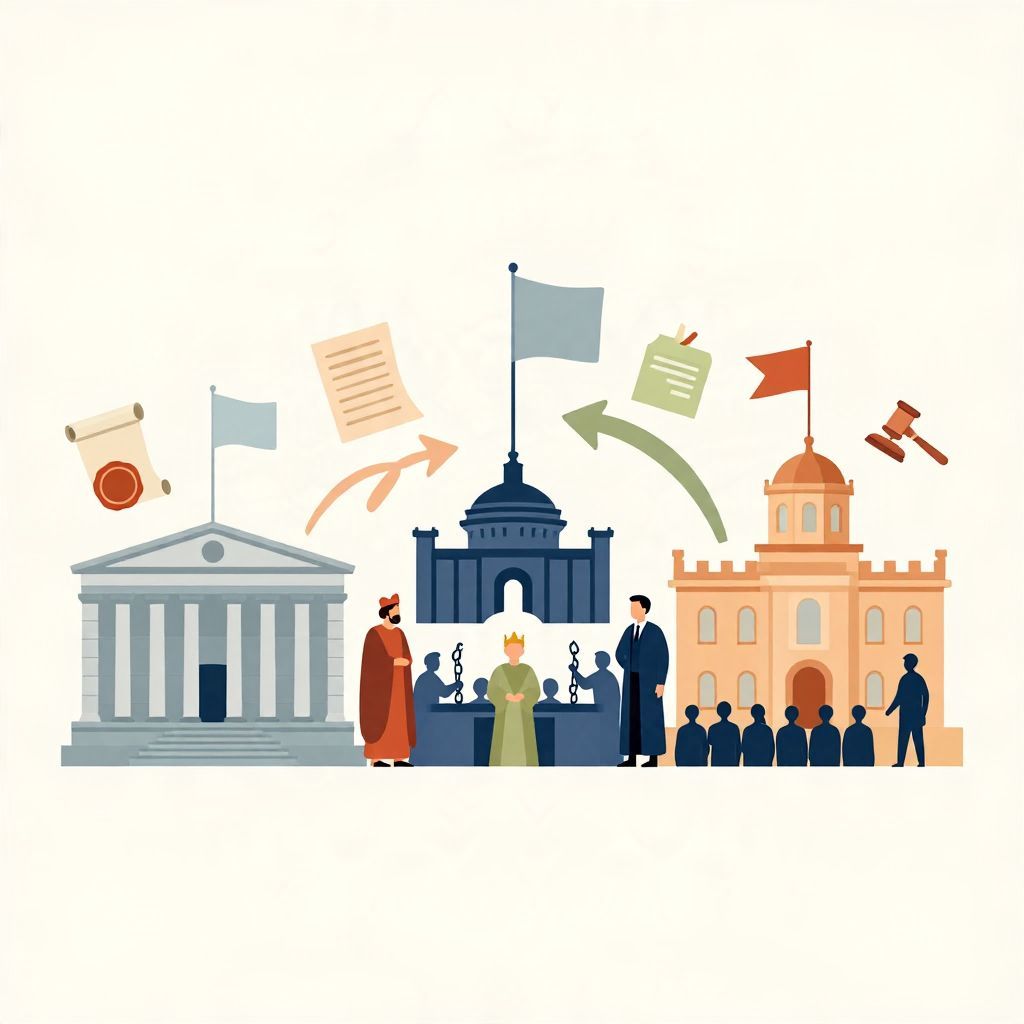
Political change is one of the most important forces in history. It shapes who rules, how power is organized, what rights people have, and how states respond to crisis, reform, revolution, or conquest.
But what is political change, exactly? In historical terms, it means any significant alteration in political authority, institutions, laws, leadership, or the relationship between rulers and the ruled. It can be gradual or sudden, peaceful or violent, and local, national, or imperial in scale.
What Is Political Change?
Political change is a shift in how power is gained, used, or limited within a society. It may involve new rulers, new constitutions, expanded rights, altered borders, or a transformed state system. Historians study it as a process, not just an event, because political change usually develops through pressure, conflict, negotiation, and adaptation.
The Meaning of Political Change in History
In history, political change is broader than simply replacing one leader with another. A king dying and his heir taking the throne may be routine succession, but a revolution that abolishes monarchy, a reform that creates elections, or a conquest that imposes a new governing elite all count as political change. The key issue is whether the structure of power itself has changed.
Common forms of political change
- Succession: a new ruler replaces an old one, often within an existing system.
- Reform: laws or institutions are adjusted without fully overthrowing the state.
- Revolution: a rapid and often dramatic overthrow of the existing political order.
- Coup d’état: a sudden seizure of power, usually by a small group within the state.
- Constitutional change: the rules of government are rewritten or reinterpreted.
- Devolution or decentralization: authority is shifted away from a central government.
- State formation or collapse: new political systems emerge, or old ones break apart.
How Political Change Happens
Political change usually results from pressure building over time. Economic hardship, war, social unrest, religious conflict, technological shifts, and leadership failures can all weaken existing authority. Sometimes change comes from above, when rulers introduce reforms to preserve their power. At other times it comes from below, when subjects, citizens, or soldiers force a new political order.
Major causes historians look for
- War and military defeat: defeats can expose weakness and destabilize governments.
- Economic crisis: taxes, inflation, famine, or debt can undermine legitimacy.
- Social movements: groups excluded from power may demand representation.
- Ideological change: new ideas about sovereignty, rights, or citizenship can challenge old systems.
- Elite rivalry: factions within ruling groups may compete for control.
- Colonial resistance: subject peoples may reject imperial rule and build new states.
Political Change in the Ancient World
Political change is not a modern invention. Ancient societies regularly experienced shifts in kingship, empire, and law. In Mesopotamia, Egypt, China, Greece, and Rome, political authority often changed through dynastic succession, conquest, rebellion, or administrative reform. These changes could be dramatic even when the language of “democracy” or “citizenship” had not yet developed in the modern sense.
Examples from antiquity
In ancient Egypt, political change often took the form of dynastic transitions, foreign invasions, or periods of fragmentation between strong central kingdoms. In classical Athens, political change included the gradual development of democracy in the 5th century BCE, which altered who could participate in government, though participation remained limited to male citizens.
Rome offers another clear example. The Roman Republic, founded traditionally in 509 BCE, developed a mixed political system with elected magistrates and a senate. Over centuries, internal conflict and civil war transformed the republic into the Roman Empire under Augustus in 27 BCE. That was not merely a change in ruler; it was a major restructuring of political authority.
Political Change in the Middle Ages
During the medieval period, political change often came through dynastic succession, feudal fragmentation, religious authority, and conquest. In Europe, power was frequently divided among kings, nobles, church leaders, and local lords. In other regions, including the Islamic world, China, and parts of Africa, empires expanded, split, or reformed as rulers sought to centralize authority.
Why medieval political systems changed
Medieval states were often less centralized than modern ones, so political change could be uneven. A king might gain authority in one region while losing control in another. Religious institutions sometimes legitimized rulers, but they could also challenge them. The struggle between emperors and popes in medieval Europe is one example of how political power could be contested across institutions, not just individuals.
Conquest also played a major role. The Norman Conquest of England in 1066, for instance, replaced the Anglo-Saxon ruling elite with a new Norman monarchy and aristocracy. This changed landholding, administration, and elite culture, showing how military victory could reshape a political order for generations.
Early Modern Political Change: Reformation, Revolution, and State Building
From roughly the 15th to the 18th centuries, political change accelerated in many parts of the world. Expanding trade, gunpowder warfare, religious conflict, and overseas empire-building encouraged stronger states and new political ideas. Monarchs centralized power, but they also faced resistance from parliaments, nobles, religious groups, and colonized peoples.
The rise of stronger states
In Europe, rulers in France, Spain, England, and elsewhere worked to build more centralized administrations, collect taxes more effectively, and maintain standing armies. This process did not happen evenly, and it often faced resistance. Political change here meant not only who ruled, but how rule itself was organized.
Revolutions and new political ideas
The English Civil Wars of the 17th century, the Glorious Revolution of 1688, the American Revolution, and the French Revolution all changed political authority in different ways. Some limited royal power; others overthrew monarchy altogether. These events helped spread the idea that legitimacy could rest on popular sovereignty, constitutional government, or rights rather than inherited rule alone.
The French Revolution, beginning in 1789, is especially important because it combined social upheaval, war, and ideological transformation. It challenged monarchy, nobility, and church privilege while introducing new political language about citizenship and nationhood. Its consequences spread far beyond France.
Political Change in the Modern Era
Modern political change has often been tied to mass politics, nationalism, industrialization, decolonization, and democratization. As literacy, newspapers, political parties, and broader suffrage expanded, more people began to participate in political life. At the same time, modern states developed more powerful bureaucracies, police forces, and military systems.
Democracy, nationalism, and empire
In the 19th century, political change frequently involved the creation of nation-states. Italy and Germany unified through a combination of diplomacy, war, and nationalist movements. Elsewhere, empires such as the Ottoman, Austro-Hungarian, and Russian empires faced internal pressures from ethnic, religious, and national groups seeking autonomy or independence.
At the same time, European imperial expansion reshaped politics across Asia, Africa, and the Americas. Colonized societies experienced imposed rule, but they also developed nationalist movements that later drove independence struggles. In this sense, anti-colonial resistance was a major form of political change in the 20th century.
Twentieth-century transformations
The 20th century saw revolutions, coups, world wars, and the collapse of empires on a global scale. The Russian Revolution of 1917 replaced the tsarist autocracy with a communist state. After the Second World War, many European empires weakened, and new states emerged in Asia and Africa through decolonization. In Latin America, Africa, and parts of Asia, military coups and authoritarian regimes also marked political change, though not always in democratic directions.
After 1945, many countries adopted constitutions, expanded voting rights, and created international institutions meant to stabilize political life. Yet political change remained uneven. Some societies moved toward democracy; others experienced dictatorship, civil war, or repeated constitutional crises.
Reform Versus Revolution
One of the most useful distinctions in studying political change is between reform and revolution. Reform changes the political system from within, often gradually. Revolution seeks a more abrupt break with the existing order. In practice, the boundary is not always clear. A reform movement may trigger a revolution, and a revolution may preserve some older institutions.
How historians distinguish them
- Reform usually preserves the basic state while changing laws or procedures.
- Revolution aims to replace the political order or its core legitimacy.
- Counterrevolution tries to restore or defend the older system.
- Transition often describes a broader shift from one regime type to another.
Why Political Change Matters
Political change matters because it affects nearly every other part of historical life. It can determine who pays taxes, who serves in the army, who may vote, which laws are enforced, and whether dissent is tolerated. It also shapes education, religion, property rights, and foreign policy. In many periods, political change was inseparable from social and economic change.
For historians, political change is not just a list of governments or rulers. It is a way to understand continuity and disruption over time. A state may survive while its institutions become more representative. A revolution may overthrow a ruler but preserve old inequalities. A reform may look modest at first but alter the balance of power for generations.
Conclusion: The Historical Meaning of Political Change
Political change is the historical process by which power is reorganized, challenged, limited, or redistributed. It can happen through succession, reform, revolution, conquest, or collapse, and it has shaped every major era of world history. To understand political change is to understand how societies decide who governs, by what right, and to what ends. For related topics, see what political ideology means and how political reform works.