
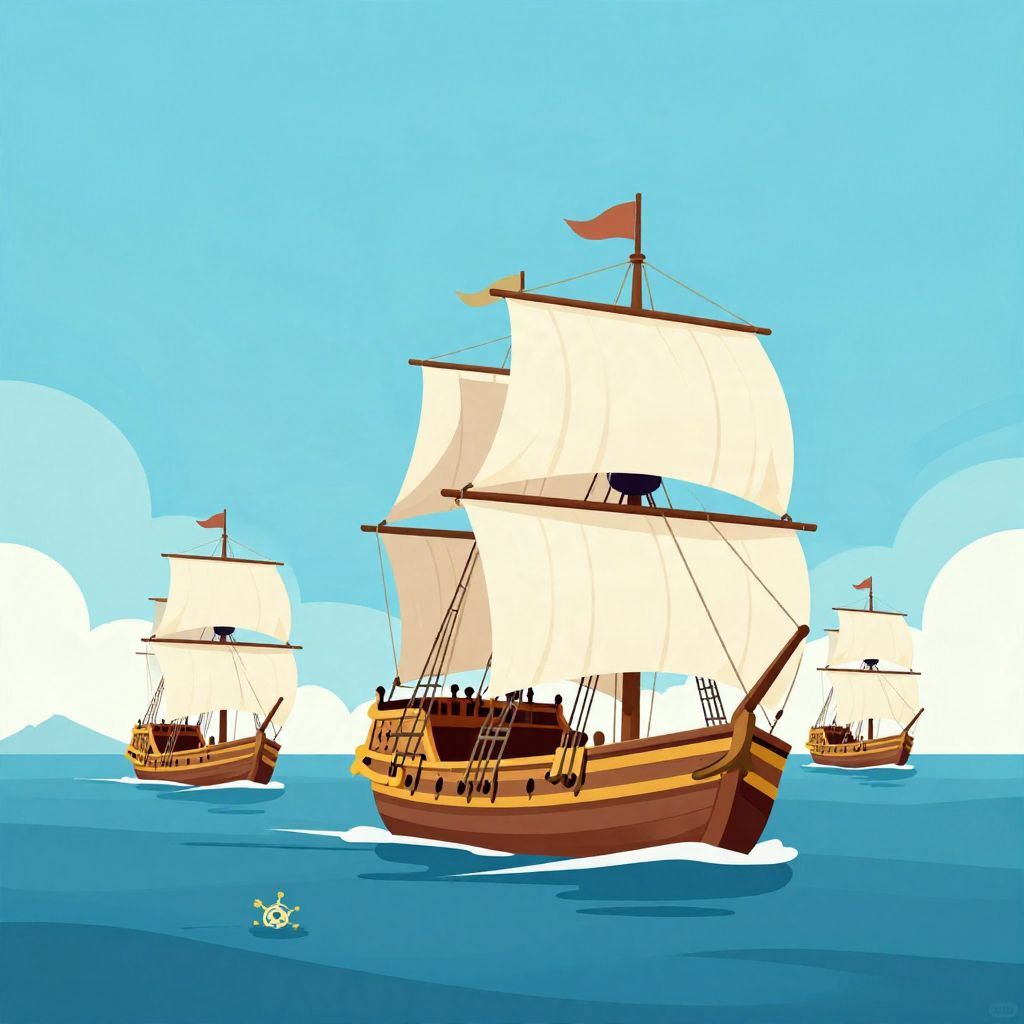
When did Columbus sail the ocean blue? The short answer is August 3, 1492, when Christopher Columbus left Spain on his first transatlantic voyage. He did not “discover” an empty world, however; he reached islands already inhabited by Indigenous peoples and opened a new era of sustained contact between Europe, Africa, and the Americas.
That journey is remembered because it became one of the most consequential voyages in world history. The famous rhyme about “1492” points to the year, but the exact departure date, route, and aftermath matter just as much as the legend.
When Did Columbus Sail the Ocean Blue?
Christopher Columbus sailed from Palos de la Frontera, Spain, on August 3, 1492. After a stop in the Canary Islands, his expedition crossed the Atlantic and landed in the Bahamas on October 12, 1492. The phrase “sail the ocean blue” is a later rhyme, but the date of the voyage is well established in historical records.
The 1492 Voyage in Context
Columbus did not set out to “discover America” in the modern sense. He was seeking a western sea route to Asia, hoping to reach the riches of the Indies by sailing across the Atlantic. European mapmaking, trade ambitions, and rivalry with Portuguese exploration all shaped the project.
In the late 15th century, Europeans were searching for faster access to Asian spices, silk, and luxury goods. Portugal had already made major gains by sailing around Africa, and Columbus persuaded Ferdinand and Isabella of Spain to support a competing route westward. His plan was risky, but it promised enormous rewards if it worked.
Why 1492 mattered
The year 1492 is remembered not just for Columbus’s departure, but for the broader turning point it represents. The voyage helped launch sustained European contact with the Americas, which led to colonization, forced labor, disease catastrophe for Indigenous populations, and the growth of Atlantic trade networks.
Columbus’s First Voyage: A Brief Timeline
The first voyage unfolded over several months. Here is the basic sequence of events:
- August 3, 1492: Columbus departs from Palos de la Frontera with three ships: the Niña, the Pinta, and the Santa María.
- August 9–September 6, 1492: The expedition stops in the Canary Islands for repairs and supplies.
- September 6, 1492: The ships leave the Canaries and head west into the Atlantic.
- October 12, 1492: Land is sighted in the Bahamas, likely on an island Columbus called San Salvador.
- Late October–December 1492: Columbus explores parts of the Caribbean, including Cuba and Hispaniola.
- December 25, 1492: The Santa María runs aground near Hispaniola; its timber is later used to build Fort Navidad.
- March 15, 1493: Columbus returns to Spain after the first voyage.
What Columbus Actually Reached
Columbus believed he had reached islands near Asia, but he had actually arrived in the Caribbean. This misunderstanding lasted through his voyages. He never realized he had encountered a landmass previously unknown to Europeans, and he remained convinced that he was near the outer regions of Asia.
His first landfall was somewhere in the Bahamas, though scholars cannot identify the exact island with complete certainty. The historical record is clear about the date, but less certain about the precise location. That uncertainty is one reason historians distinguish between the voyage itself and the later myth of a single, neatly defined “discovery.”
Why the location is debated
Columbus’s journals and later copies of them are not perfectly precise, and the geography of the Bahamas makes exact identification difficult. Several islands have been proposed over time, but no consensus has completely settled the question.
The Myth and the Famous Rhyme
The phrase “In 1492, Columbus sailed the ocean blue” is a modern educational rhyme, not a line from Columbus’s time. It is popular because it is simple and memorable, but it can also oversimplify history. Columbus’s voyage was not the first crossing of the Atlantic by humans, and it was not the first contact between the Americas and the wider world.
Long before 1492, Indigenous peoples had built complex societies across the Americas. In addition, Norse voyagers reached parts of North America around the late 10th or early 11th century, including the settlement at L’Anse aux Meadows in present-day Newfoundland. Columbus’s voyage mattered because it led to permanent, large-scale European expansion, not because it was the first human presence in the hemisphere.
Who Was on the Voyage?
Columbus commanded the expedition, but the voyage depended on many others. The crews of the three ships included experienced sailors, navigators, and shipboard workers from Iberian port communities. The expedition was a collective effort, even though Columbus became the most famous name attached to it.
- Christopher Columbus – Genoese navigator and expedition leader
- Niña – one of the smaller caravels, known for its speed and maneuverability
- Pinta – another caravel, often associated with the sighting of land
- Santa María – the largest ship, which later wrecked off Hispaniola
Why the Voyage Changed History
Columbus’s first voyage opened the door to the Columbian Exchange, the vast transfer of plants, animals, people, diseases, and technologies between the Eastern and Western Hemispheres. This exchange transformed diets, economies, environments, and populations on both sides of the Atlantic.
Some of the most dramatic consequences were devastating. European diseases such as smallpox and measles spread rapidly among Indigenous communities, causing catastrophic population loss. At the same time, European colonization expanded, African enslavement intensified, and new imperial systems took shape across the Americas.
Major long-term effects
- European colonization of the Caribbean and mainland Americas
- Expansion of Atlantic trade networks
- Collapse of many Indigenous populations due to disease, violence, and displacement
- Growth of plantation economies and the transatlantic slave trade
- Lasting cultural and demographic mixing across the Atlantic world
How Historians View Columbus Today
Modern historians generally view Columbus as a skilled navigator whose voyage had world-changing consequences, but also as a figure tied to conquest, exploitation, and the beginning of colonial violence. That balanced view is important because older celebrations often ignored the suffering that followed his arrival in the Caribbean.
In many places, Columbus Day or similar commemorations have become controversial. Some communities now emphasize Indigenous Peoples’ Day or other observances that recognize Native history and survival. This shift reflects a broader effort to tell the history of 1492 more honestly and completely.
Quick Facts About Columbus’s First Voyage
- Departure date: August 3, 1492
- First landfall in the Americas: October 12, 1492
- Departure point: Palos de la Frontera, Spain
- Ships: Niña, Pinta, and Santa María
- Main goal: Reach Asia by sailing west
- Historical significance: Beginning of sustained European contact with the Americas
Conclusion
So, when did Columbus sail the ocean blue? He set sail on August 3, 1492, and his voyage reached the Caribbean on October 12 of that year. The date is easy to remember, but the history behind it is more complex: Columbus did not “discover” a vacant world, and his journey set in motion profound changes that reshaped global history. For related reading, see When Did Christopher Columbus Sail the Ocean Blue? and What Happened in 2013?