
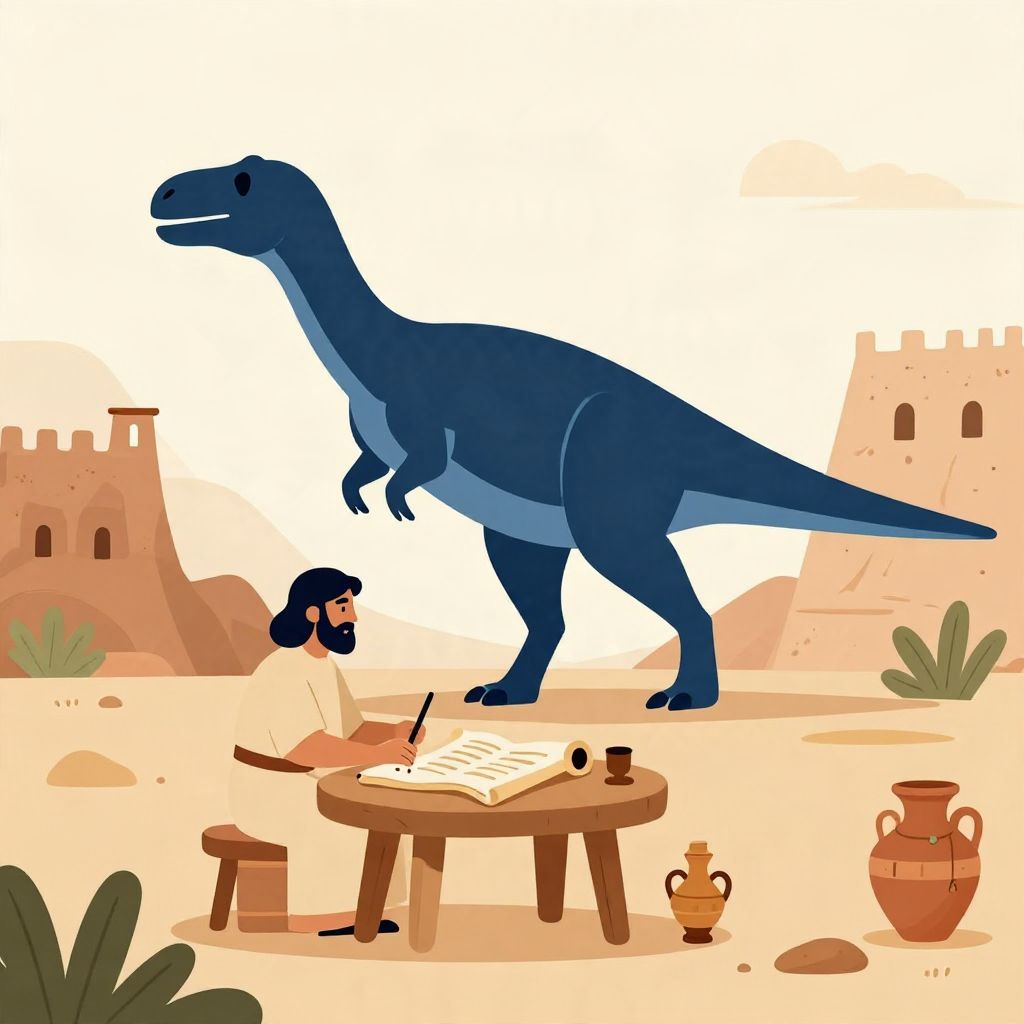
The question “Does the Bible mention dinosaurs?” comes up because the Bible is ancient, while dinosaurs were discovered by modern science. The short answer is that the Bible does not use the word “dinosaur,” but some readers think a few passages may describe large creatures that resemble them. Others see those texts as references to known animals, mythic imagery, or poetic symbolism.
The issue is less about a direct mention than about interpretation: what did biblical writers mean in their own historical setting, and how should modern readers understand animal imagery in ancient texts?
Does the Bible Mention Dinosaurs?
No biblical book explicitly names dinosaurs, because the term was coined in 1841 by the British anatomist Richard Owen. However, some passages in the Old Testament describe enormous or unusual creatures, and these have been interpreted in different ways by Jews, Christians, and modern readers. Whether they refer to dinosaurs depends on theology, translation, and historical context.
Why the Bible Does Not Say “Dinosaur”
The Bible was written long before modern paleontology. Its books were composed over many centuries, roughly from the first millennium BCE into the early centuries CE. Ancient Hebrew, Aramaic, and Greek authors wrote about the world they knew: livestock, wild animals, kings, empires, seas, and symbolic creatures. They did not have a scientific category for extinct reptiles from millions of years earlier.
The word itself is modern
“Dinosaur” comes from Greek roots meaning “terrible lizard.” It was created in the nineteenth century to classify fossils of large extinct reptiles. Because the biblical texts predate that scientific vocabulary by thousands of years, any claim that the Bible “mentions dinosaurs” must rely on interpretation rather than direct naming.
Passages Often Linked to Dinosaurs
Several biblical passages are frequently discussed in this debate. None is universally accepted as a dinosaur description, but they are central to the conversation because they mention massive creatures or strange beasts.
Behemoth in Job
In Job 40, God describes Behemoth as a powerful creature with great strength, a tail “like a cedar,” and bones compared to bronze or iron. Some readers argue this sounds like a sauropod dinosaur. Others note that the passage uses poetic language and may refer to a hippopotamus, an elephant, or a symbolic creature representing untamed power.
Historically, Job is wisdom literature, not a zoological catalog. Its purpose is theological and poetic: to emphasize the limits of human understanding. That makes Behemoth important as literature, but not straightforward evidence for dinosaurs.
Leviathan in Job and Psalms
Leviathan appears in Job 41, Psalm 74, and Isaiah 27. It is portrayed as a fearsome sea creature, sometimes linked to chaos and divine power. Some modern interpreters compare it to a dinosaur or dragon-like reptile, but many scholars see it as a mythic image drawn from ancient Near Eastern traditions about sea monsters.
In the ancient world, sea chaos was a common symbol. Leviathan likely functioned as a literary and religious image rather than a report of a living animal. That does not make it unimportant; it shows how biblical writers used familiar symbolic language to communicate divine authority.
“Great sea creatures” in Genesis
Genesis 1:21 speaks of God creating “the great sea creatures.” The phrase is broad and does not identify dinosaurs. It probably refers to large marine animals or, in some interpretations, to mythic creatures. Because the verse is general, it cannot be used as clear proof that the Bible mentions dinosaurs.
How Ancient Readers Would Have Understood These Texts
To understand the Bible historically, it helps to ask how ancient audiences heard these passages. The writers and first readers lived in societies where large animals such as lions, crocodiles, hippos, cattle, and camels were known, while fossil science did not exist. They explained the world through observation, tradition, and theology, not paleontology.
Poetry, symbolism, and ancient worldview
Biblical texts often use exaggeration, metaphor, and cosmic imagery. A creature with a cedar-like tail may be a poetic way to describe size and strength, not a literal anatomical report. Likewise, monstrous sea beings often symbolize danger, disorder, or forces that only God can control.
This matters because ancient literature should be read on its own terms. Modern readers sometimes expect scientific precision from texts that were written for worship, law, history, prophecy, and poetry.
Did Humans and Dinosaurs Live at the Same Time?
From the standpoint of mainstream science, non-avian dinosaurs went extinct about 66 million years ago, long before humans appeared. The earliest members of our species, Homo sapiens, emerged roughly 300,000 years ago. That enormous gap is why historians and scientists generally reject the idea that biblical writers were describing ordinary encounters with dinosaurs.
Why some people disagree
Some religious traditions, especially young-earth creationist interpretations, argue that humans and dinosaurs coexisted and that the Bible hints at this. They often connect Behemoth and Leviathan to dinosaurs or other prehistoric creatures. This view is a theological interpretation, not the consensus of historical scholarship or natural science.
Other believers accept the findings of geology and paleontology while reading the Bible as a theological and literary text rather than a scientific record. That approach allows the Bible to retain religious meaning without turning it into a fossil guidebook.
What the Historical Evidence Actually Shows
The historical evidence supports three careful conclusions. First, the Bible does not directly mention dinosaurs by name. Second, some passages describe large or terrifying creatures that later readers have associated with dinosaurs. Third, those passages were originally written in ancient literary and religious contexts, so their meaning is not settled by modern science alone.
- Direct mention: No, the Bible does not use the word “dinosaur.”
- Possible indirect references: Some readers point to Behemoth, Leviathan, and “great sea creatures.”
- Scholarly caution: These are usually understood as poetic, symbolic, or referring to known animals.
- Scientific context: Dinosaurs became known through nineteenth-century fossil study, long after the Bible was written.
Why the Question Still Matters
This question remains popular because it sits at the intersection of faith, science, and interpretation. For many readers, it is not only about dinosaurs but also about whether ancient sacred texts should be read literally, symbolically, or historically. The debate reflects larger questions about how people reconcile religious tradition with modern knowledge.
It also shows how language changes over time. A modern reader may imagine a dinosaur whenever they encounter a giant beast, but an ancient writer may have intended a symbol of chaos, a real animal, or a poetic image of power. Careful history asks us to slow down before importing modern categories into ancient texts.
Conclusion
So, does the Bible mention dinosaurs? Not directly. The Bible never names dinosaurs, and its authors were not writing with modern paleontology in mind. Still, a few passages describe enormous creatures that some readers connect to dinosaurs, while many historians and scholars understand them as poetic or symbolic references. If you want to explore related biblical history, you may also find what a eunuch is in the Bible and when Moses was born useful starting points.