
The question “What is a eunuch in the Bible?” appears often because the word can sound unfamiliar, even harsh, to modern readers. In biblical texts, however, “eunuch” has a specific historical meaning tied to ancient royal courts, household administration, and social status.
In the Bible, a eunuch was usually a man who had been castrated, or more broadly a high-ranking court official who served in a royal household. The term appears in both the Hebrew Bible and the New Testament, where eunuchs could be foreign officials, trusted servants, or people marked by bodily difference and social exclusion.
What Is a Eunuch in the Bible?
A eunuch in the Bible is generally a man associated with a royal court who may have been castrated, though the term can also mean a palace official regardless of physical condition. In ancient Near Eastern and Greco-Roman societies, eunuchs often held positions of trust because they were seen as less likely to threaten dynasties through marriage or heirs.
The Historical Meaning of “Eunuch”
Physical condition and court office
The biblical word translated as “eunuch” can refer to two overlapping realities. In some cases, it likely means a castrated man. In others, it may simply mean a court officer, chamberlain, or high official. Ancient languages and translations do not always separate these meanings cleanly, so context matters.
This is one reason scholars are careful when reading the term. A biblical eunuch might be physically altered, socially marginalized, or simply employed in a royal administration. The Bible reflects all of these possibilities across different books and historical settings.
Why eunuchs existed in ancient courts
Eunuchs were common in several ancient empires, including Assyria, Babylon, Persia, and later the Roman East. Rulers often entrusted them with access to women’s quarters, treasury duties, or palace administration. Their role made them politically useful, especially in systems where loyalty to the king mattered more than family ambition.
That broader ancient background helps explain why eunuchs appear so often in biblical narratives about kings, palaces, and imperial power.
Eunuchs in the Hebrew Bible
Old Testament references and context
In the Hebrew Bible, eunuchs appear in royal and imperial settings. Some are clearly court officials serving foreign kings. Others are mentioned in laws or prophecies about exclusion and future inclusion. Their presence reflects the Bible’s engagement with real ancient institutions, not a symbolic invention.
One of the most important passages is Deuteronomy 23:1, which excludes a man with crushed testicles or a severed penis from the assembly of the Lord. This reflects ancient ideas about bodily wholeness, ritual status, and participation in sacred community life.
Eunuchs in royal service
Several biblical books mention eunuchs as officials in foreign courts. For example, in the books of 2 Kings and Jeremiah, eunuchs appear among the elite servants and administrators of kings. These figures are usually not the focus of the story, but they show how common the office was in the political world surrounding ancient Israel and Judah.
In 2 Kings 20:18 and Isaiah 39:7, the descendants of King Hezekiah are said to become eunuchs in the palace of the king of Babylon. This is a grim image of political defeat and exile, suggesting loss of independence and humiliation under imperial rule.
Exile and the promise of inclusion
One of the most striking developments comes in Isaiah 56:3–5, where eunuchs are promised a place and a name within God’s house if they keep covenant faithfulness. This passage is important because it moves beyond exclusion toward inclusion. It does not erase earlier legal restrictions, but it shows a later biblical vision of welcome and restoration.
That shift matters historically because it reflects changing ideas within Israelite religion about identity, belonging, and who could participate in the community of worship.
Eunuchs in the New Testament
The Ethiopian eunuch in Acts
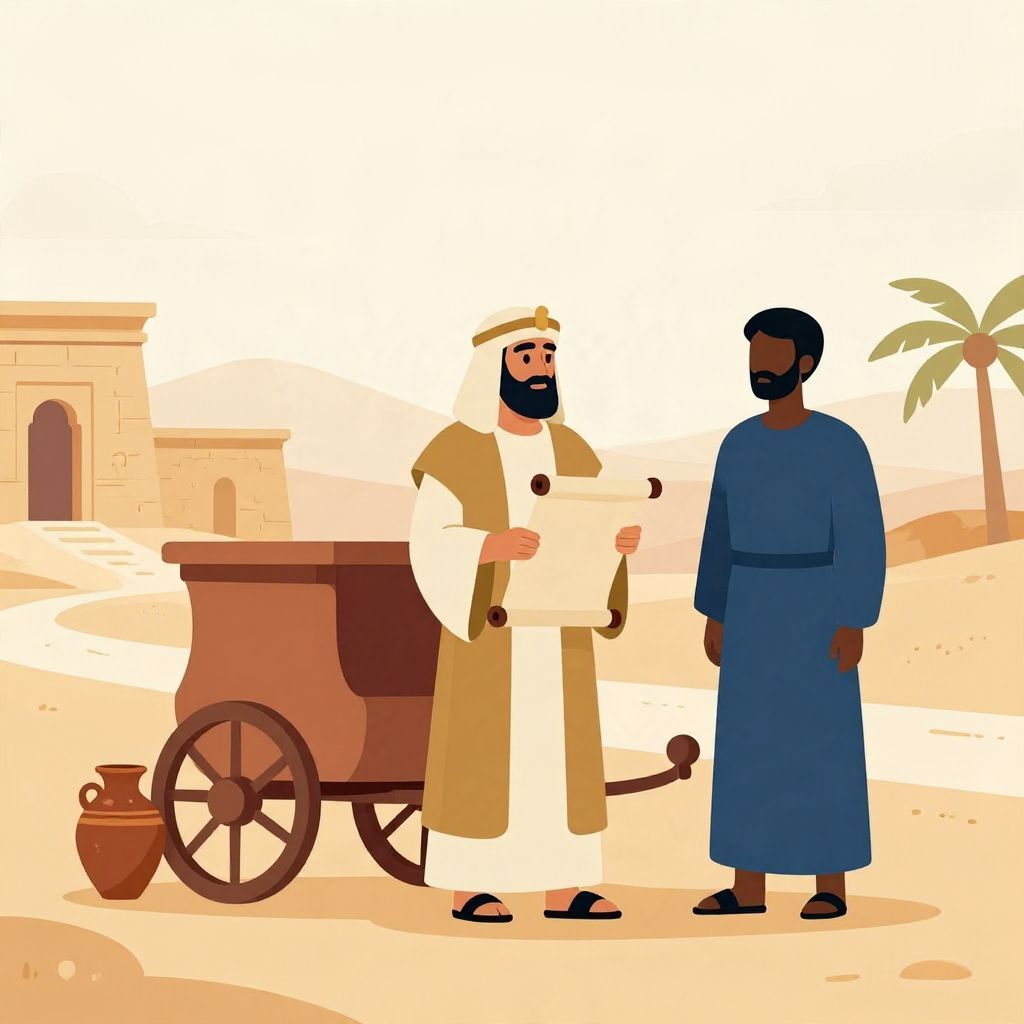
The most famous biblical eunuch is the Ethiopian official in Acts 8. He is a high-ranking treasury officer under the queen of the Ethiopians, reading Isaiah when Philip explains the scripture and baptizes him. Historically, this story is significant because it shows the early Christian movement reaching across ethnic, social, and bodily boundaries.
The text does not identify him by name, and “Ethiopian” in ancient usage usually referred broadly to a person from the region south of Egypt, not the modern nation in its current form. The story is less about modern geography than about the spread of the gospel into the wider world of the ancient Mediterranean and Africa.
Jesus and eunuchs in Matthew
In Matthew 19:12, Jesus speaks of eunuchs who were born that way, made that way by others, or who choose celibacy for the sake of the kingdom of heaven. This saying has been interpreted in several ways. Some readers see it as recognition of bodily difference and social realities; others see it as a teaching about voluntary celibacy.
Historically, the passage shows that the term “eunuch” could be used more broadly than simple physical castration. It could also describe people who lived outside ordinary marriage patterns, whether by circumstance or choice.
What the Bible Says About Eunuchs: Exclusion and Inclusion
Law, purity, and social boundaries
In ancient Israel, bodily wholeness was often linked to ritual participation. That does not mean eunuchs were always despised, but it does mean they could be restricted in certain religious settings. The biblical laws reflect an ancient worldview in which physical condition, lineage, and holiness were closely connected.
At the same time, the Bible is not uniform. Some texts exclude eunuchs from full participation, while later prophetic and Christian texts imagine their inclusion. This tension is part of the Bible’s historical development and should not be flattened into a single rule.
From marginal status to honored service
Eunuchs could occupy an ambiguous social position. They were sometimes outsiders because of their bodies or origin, yet they could also be trusted insiders in palace administration. Their status depended on the political and religious setting. In biblical literature, that ambiguity becomes meaningful: eunuchs can represent vulnerability, loyalty, exile, and unexpected belonging all at once.
Why Eunuchs Matter in Biblical History
A window into ancient empires
References to eunuchs help historians understand how biblical writers lived in a world shaped by imperial power. Assyrian, Babylonian, Persian, and later Hellenistic and Roman systems all used court officials in ways that influenced local societies. The Bible preserves traces of those institutions, especially in stories of kings, exile, and administration.
A sign of changing religious thought
The biblical treatment of eunuchs also reveals changing ideas about who belongs in God’s people. Early legal texts stress boundaries. Later prophetic and Christian texts open those boundaries more widely. That development is historically important because it shows how biblical traditions responded to new social realities, exile, and expanding religious communities.
A term that shaped later interpretation
Because “eunuch” can mean both a castrated man and a court official, later readers have often debated how to interpret specific passages. Some translations preserve the traditional wording, while others try to clarify the role or condition being described. The ambiguity is not a mistake; it reflects the complexity of ancient language and institutions.
Common Misunderstandings
Not every eunuch in the Bible is the same
It is a mistake to assume that every biblical eunuch was identical in status or experience. Some were palace officers with power. Some may have been physically castrated. Some were foreigners. Some appear as symbols of exclusion, and others as examples of inclusion. The Bible uses the term in multiple historical contexts.
Not all references are about sexuality
Modern readers sometimes read “eunuch” mainly through the lens of sexuality, but in the ancient world the term was more closely tied to court service, bodily status, and household politics. Sexual meaning is part of the history, but it is not the whole story.
The Bible does not give one simple definition
Because the Bible was written over many centuries and in different genres, it does not offer a single, fixed definition. Instead, it presents a word whose meaning shifts with context. That is why careful historical reading is essential.
Conclusion
So, what is a eunuch in the Bible? Historically, it is usually a man associated with a royal court, often castrated and trusted with administrative duties, though the term can also mean a palace official more broadly. In biblical history, eunuchs embody both exclusion and service, and their stories reveal how ancient societies handled power, identity, and belonging. For related background, you may also want to explore ancient Israel and Judah and the world of the New Testament.