
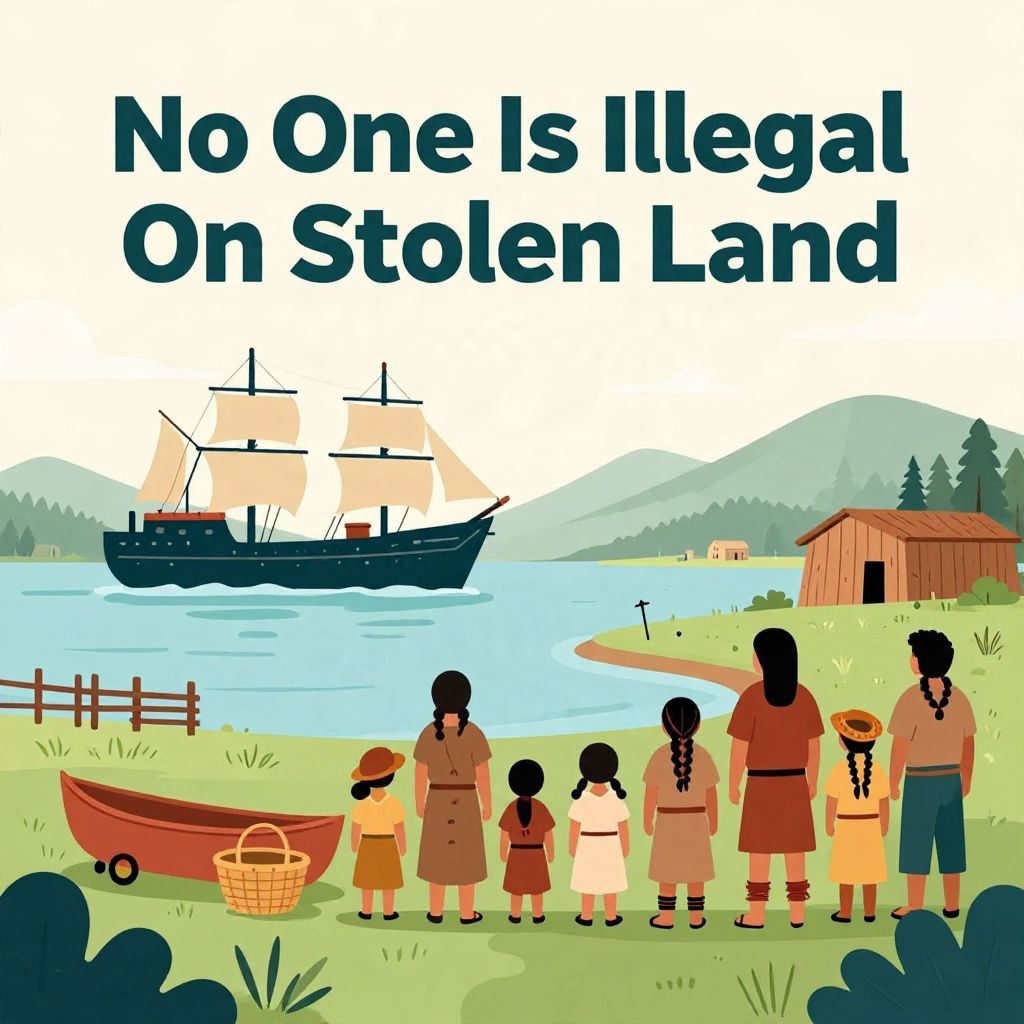
“No one is illegal on stolen land” is a modern political slogan, but it draws on a much older history of conquest, colonization, migration, and Indigenous dispossession. To understand it, you need to trace how land was taken, how borders were imposed, and why many Indigenous and anti-colonial आंद movements argue that present-day immigration laws sit on top of earlier acts of theft.
The phrase is not a historical slogan from the past; it is a contemporary statement of political and moral argument. Its force comes from the history of settler colonialism, especially in the Americas, where European empires and later nation-states claimed territory already inhabited by Indigenous peoples. That history helps explain why the slogan remains powerful and controversial today.
What does “No One Is Illegal on Stolen Land” mean historically?
Historically, the phrase argues that modern states often police migration on land acquired through conquest, treaties made under pressure, forced removal, or outright seizure. In that view, “illegal” is not a neutral label: it reflects laws created by states whose own authority rests on earlier dispossession. The slogan is therefore both a critique of borders and a reminder of Indigenous sovereignty.
Origins of the idea behind the slogan
The exact wording “No one is illegal on stolen land” is difficult to date precisely, because it emerged through activist circles rather than a single founding moment. It became widely associated with Indigenous solidarity, migrant-rights, and anti-border movements in North America during the late 20th and early 21st centuries. The idea behind it, however, is much older.
Settler colonialism and Indigenous dispossession
Settler colonialism is a system in which outsiders come to stay, claim land, and build permanent political control. In North America, this process began in the late 15th century and accelerated over the next several centuries through warfare, disease, forced treaties, land seizures, and removal policies. The result was not simply immigration; it was the restructuring of entire societies and landscapes.
For many Indigenous communities, the slogan points to a basic historical fact: the land was inhabited long before modern borders existed. European empires and later settler states drew boundaries across Indigenous homelands, often without consent. From that perspective, the moral authority of those borders is contested from the start.
Why “illegal” is part of the argument
The word “illegal” usually refers to a violation of laws made by a state. But laws are historical products, not timeless truths. The slogan challenges the idea that a state can define belonging while ignoring its own origins in conquest. It does not mean that all law is meaningless; rather, it asks whose law, whose land, and whose history are being treated as legitimate.
Historical timeline: from conquest to modern border regimes
The slogan makes more sense when placed on a long timeline of colonization and migration control. The following sequence is especially important in the Americas, though similar dynamics exist in other settler societies.
- Late 1400s onward: European empires begin claiming territory in the Americas, Africa, and elsewhere through exploration, conquest, and colonization.
- 16th–18th centuries: Indigenous peoples face warfare, forced labor, disease, missionization, and land loss as colonial settlements expand.
- 19th century: New settler states such as the United States, Canada, Australia, and others expand inland, often through removal, reservation systems, and military campaigns.
- Late 19th to early 20th century: Immigration restriction and border enforcement become more systematic as states define who belongs and who does not.
- Late 20th century: Indigenous land-rights movements and migrant-rights activism increasingly overlap, especially in North America.
- 21st century: The slogan circulates widely in protests, social media, and solidarity campaigns, especially around deportation, detention, and Indigenous sovereignty.
Key historical examples in North America
In what is now the United States, colonial expansion was tied to dispossession from the beginning. The Doctrine of Discovery, a set of European legal-religious ideas, helped justify claims over lands already inhabited by Indigenous peoples. Later, U.S. expansion westward brought treaties, broken promises, forced removals such as the Trail of Tears in the 1830s, and violent conflict.
In Canada, the history includes treaty-making, residential schools, the reserve system, and policies designed to assimilate or displace Indigenous peoples. In Australia and New Zealand, colonization likewise involved land seizure, legal doctrines that denied Indigenous sovereignty, and long struggles over recognition and rights. The slogan resonates in all of these contexts, though it is used most often in North American activism.
How the slogan developed in modern activism
The phrase gained traction in activist spaces where Indigenous rights and migrant justice intersected. It was especially useful because it links two realities that are often discussed separately: the historical dispossession of Indigenous peoples and the modern policing of migrants. Activists used it to argue that border enforcement is not just a present-day policy issue but part of a longer colonial structure.
Indigenous sovereignty and migrant solidarity
Some Indigenous activists have embraced the slogan because it centers land theft and colonial history. Others use it more cautiously, arguing that solidarity with migrants should not erase the specific political rights of Indigenous nations. That distinction matters. The slogan is not a simple claim that everyone belongs everywhere in the same way; rather, it is a challenge to colonial states that claim authority over land they took by force.
Migrant-rights groups have also adopted the phrase to criticize deportation systems, detention centers, and racialized border policing. In that setting, the slogan emphasizes that many migrants are themselves displaced by histories of empire, war, and economic extraction. The phrase can therefore connect local border struggles to global patterns of inequality.
Why the slogan is historically significant
The historical significance of “No one is illegal on stolen land” lies in how it reframes the meaning of law, territory, and belonging. It asks readers to see borders not as natural facts but as political creations. It also forces a confrontation with the fact that many modern states were built through dispossession and then used law to normalize that dispossession.
It challenges the idea of settled national history
National histories often present borders as legitimate, final, and orderly. The slogan interrupts that story. It reminds us that the making of states was often violent, contested, and unequal. In that sense, it belongs to a broader historical tradition of anti-colonial critique, alongside Indigenous land defense, civil rights struggles, and campaigns against forced removal and exclusion.
It connects past and present forms of power
The phrase also shows how history shapes present policy. Immigration laws may seem modern and administrative, but they are built on older systems of racial classification, labor control, and territorial control. By linking migrant status to stolen land, the slogan argues that current border regimes cannot be understood apart from colonial history.
Common misunderstandings about the phrase
Because the slogan is politically charged, it is often misunderstood. Historically, it does not mean that every person has an identical legal claim to every place. Nor does it erase Indigenous nationhood by suggesting that all claims are the same. Instead, the phrase is a moral and political critique of states that criminalize movement while resting on earlier acts of conquest.
Not a claim that history is simple
History is rarely neat. Indigenous peoples are not a single group, colonial histories differ by region, and immigration has taken many forms, including forced migration, indentured labor, and refuge-seeking. A careful historical reading recognizes these differences while still acknowledging the common thread of land seizure and state power.
Not every border was created the same way
Some borders were drawn after wars, others through diplomacy, and many through colonial administration. But in settler-colonial contexts, the larger issue is that the state’s territorial claim often predates or overrides Indigenous sovereignty. That is why the slogan is especially powerful in places where borders were imposed on already inhabited lands.
Lasting historical significance
Today, “No one is illegal on stolen land” survives because it condenses a long history into a memorable sentence. It speaks to Indigenous land rights, anti-colonial thought, and migrant justice at the same time. Its endurance shows that historical memory remains politically active: the past is not finished, because its institutions and inequalities still shape the present.
The phrase is best understood not as a literal legal doctrine but as a historical argument. It insists that before states can demand obedience to their borders, they must be judged against the history of how those borders were made. For that reason, it remains a sharp and influential reminder that law, land, and legitimacy have never been separate from power.