
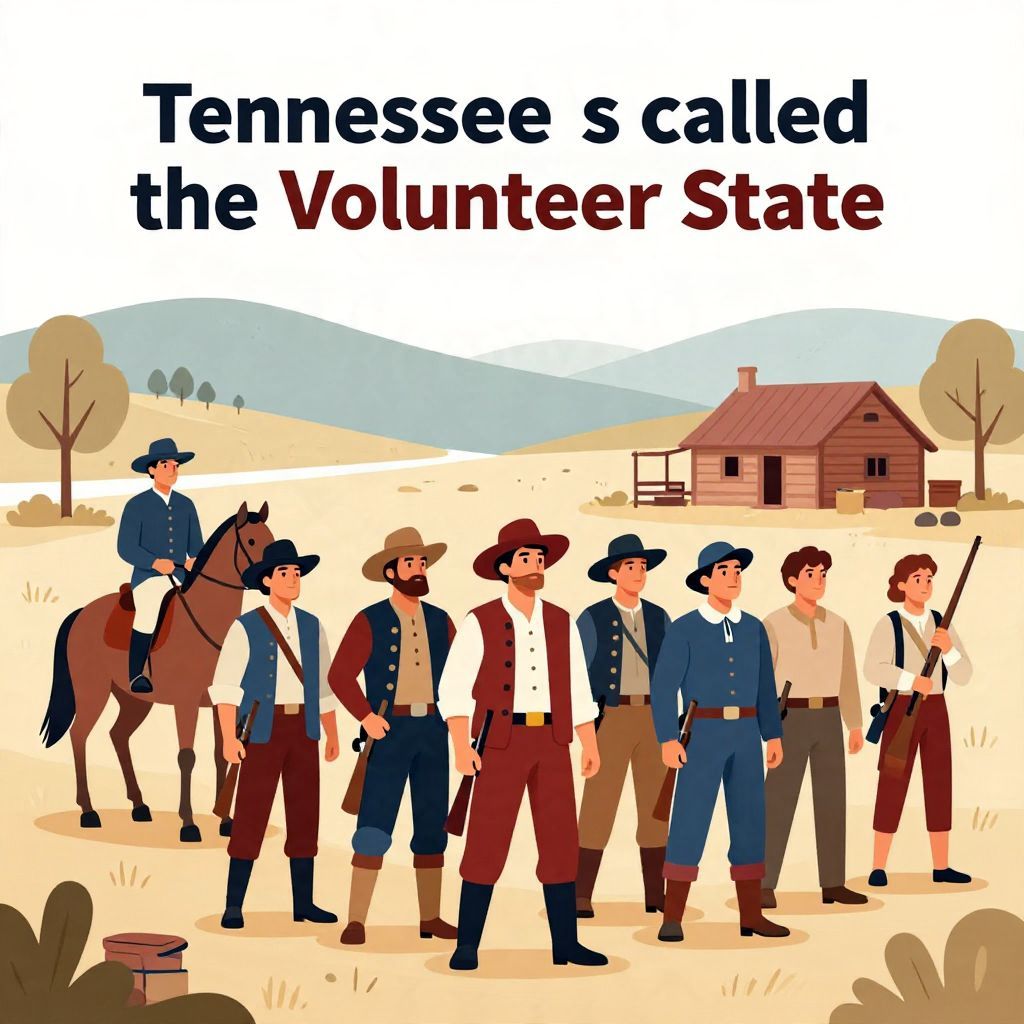
Why is Tennessee called the Volunteer State? The short answer is that Tennesseans earned the nickname through repeated and highly visible military volunteering, especially during the War of 1812 and the Mexican-American War. Over time, the label became a proud public identity tied to service, frontier spirit, and state reputation.
The nickname is not based on one single event alone. Instead, it grew from a pattern: Tennessee repeatedly supplied large numbers of volunteers for national wars, and those soldiers became part of the state’s public image.
Why Is Tennessee Called The Volunteer State?
Tennessee is called the Volunteer State because its citizens became famous for volunteering in wartime, especially in the early 19th century. The nickname was strengthened by the large number of Tennessee men who answered military calls in the War of 1812 and the Mexican-American War, giving the state a lasting reputation for patriotic service.
The War of 1812 and the Making of a Nickname
The strongest early link between Tennessee and the word “volunteer” came during the War of 1812. When the United States fought Britain, Tennessee supplied a large force of militia and volunteer soldiers. Their service was especially associated with Andrew Jackson, a Tennessean who led troops to victory at the Battle of New Orleans in 1815.
This was not just a matter of numbers. Tennessee men were widely praised for answering the call quickly and in large groups, often traveling long distances to join military campaigns. That public image mattered in a young nation where state pride and military reputation were closely connected.
Andrew Jackson’s role
Jackson was not the only Tennessean to serve, but he became the most famous symbol of the state’s martial energy. As a general and later president, he helped spread the idea that Tennessee produced determined, ready-to-fight volunteers. His fame gave the nickname wider national recognition.
It is important, however, not to oversimplify the story. The nickname did not appear overnight, and it was not officially assigned by a single law or ceremony. It emerged gradually from public praise, newspaper language, and repeated wartime experience.
The Mexican-American War and the Nickname’s Lasting Power
The nickname became even more firmly attached to Tennessee during the Mexican-American War in 1846–1848. When the federal government asked states for troops, Tennessee again responded with enthusiasm. The state’s volunteers were so numerous that Tennessee’s reputation as a source of soldiers became widely celebrated.
This war helped transform “Volunteer State” from a flattering description into a lasting identity. By then, the phrase was no longer just about one campaign. It described a broader state culture in which military service was seen as honorable, civic-minded, and deeply patriotic.
Why the Mexican-American War mattered
Several factors made this conflict especially important for the nickname:
- Tennessee supplied more volunteers than the federal request required.
- State leaders and newspapers promoted the idea of eager enlistment.
- The war gave the nickname fresh visibility in national politics and public memory.
Because the conflict was widely covered and politically significant, the association between Tennessee and volunteer soldiers became more permanent than it had been after earlier wars.
Was Tennessee Really Full of Volunteers?
Yes, but the phrase should be understood in historical context. “Volunteer” did not mean every Tennessean enlisted, nor that the state was uniquely patriotic compared with all others. Rather, Tennessee developed a strong reputation for producing large numbers of militia and volunteer troops when the nation called.
That reputation was shaped by the state’s frontier society. In the early 1800s, Tennessee was still a relatively young state, with many settlers living in communities where military readiness, hunting, and local defense were part of everyday life. In such a setting, volunteering for war could be seen as a natural extension of civic duty.
Frontier culture and military service
Tennessee’s early settlers came from a mix of backgrounds, including migrants from Virginia and North Carolina, along with others moving westward into the Appalachian frontier. These communities often valued self-reliance and local militias. That culture made volunteer enlistment more common and more celebrated than in some older, more settled states.
The nickname therefore reflects both military history and social identity. It was not only about battlefields; it was also about how Tennesseans understood themselves and how others saw them.
How the Nickname Became Officially Embraced
By the mid-19th century, “Volunteer State” had become a popular phrase in newspapers, speeches, and public memory. Over time, Tennesseans embraced it as an honorable state nickname. Like many state nicknames, it grew from popular usage rather than from a formal act of government.
Once established, the nickname endured because it fit a broader story Americans liked to tell about the state: brave citizens, strong military tradition, and a willingness to answer the nation’s call. The phrase also worked well politically, especially in an era when public memory of wars shaped state pride.
Nicknames and historical memory
State nicknames often simplify the past. “Volunteer State” highlights one powerful theme in Tennessee history, but it does not capture everything about the state’s past. Tennessee was also shaped by Native American displacement, slavery, plantation agriculture, Civil War division, and industrial change. The nickname reflects a proud tradition, but it is only one part of a much larger history.
Common Myths and What the Evidence Actually Shows
One common myth is that Tennessee received the nickname from a single dramatic moment. In reality, the name developed over time through repeated military service. Another misconception is that the nickname refers to all Tennesseans equally. Historically, military volunteering was shaped by race, class, and gender, as was true across the United States.
It is also worth noting that the state’s volunteer tradition did not always mean unanimous enthusiasm. Some men volunteered because of patriotism, some because of pressure, and others because local culture made enlistment socially expected. Historical evidence supports the importance of volunteering, but not a simplistic picture of universal eagerness.
Why the Nickname Still Matters Today
The phrase “Volunteer State” remains one of Tennessee’s most recognizable symbols because it connects the present to a formative period of state history. It evokes early American expansion, wartime service, and the creation of a public identity around civic duty. Even now, the nickname is used in schools, sports, tourism, and state branding.
Its endurance shows how historical memory can outlast the events that created it. A wartime habit of volunteering became a permanent label, and that label became part of Tennessee’s civic identity.
Timeline of the Nickname’s Development
- Early 1800s: Tennessee’s frontier culture and militia traditions help shape a reputation for military readiness.
- War of 1812: Large numbers of Tennessee volunteers, especially under Andrew Jackson, bring national attention to the state’s military contributions.
- 1846–1848: The Mexican-American War reinforces the nickname as Tennessee again supplies many volunteers.
- Mid-19th century onward: “Volunteer State” becomes a lasting and widely accepted nickname.
Conclusion
Tennessee is called the Volunteer State because its people became famous for answering military calls with unusually large numbers of volunteers, especially in the War of 1812 and the Mexican-American War. The nickname reflects both real wartime service and the frontier culture that encouraged it. For more on state identity and American historical memory, see related history topics such as history articles on American state history and introductory historical overviews.