
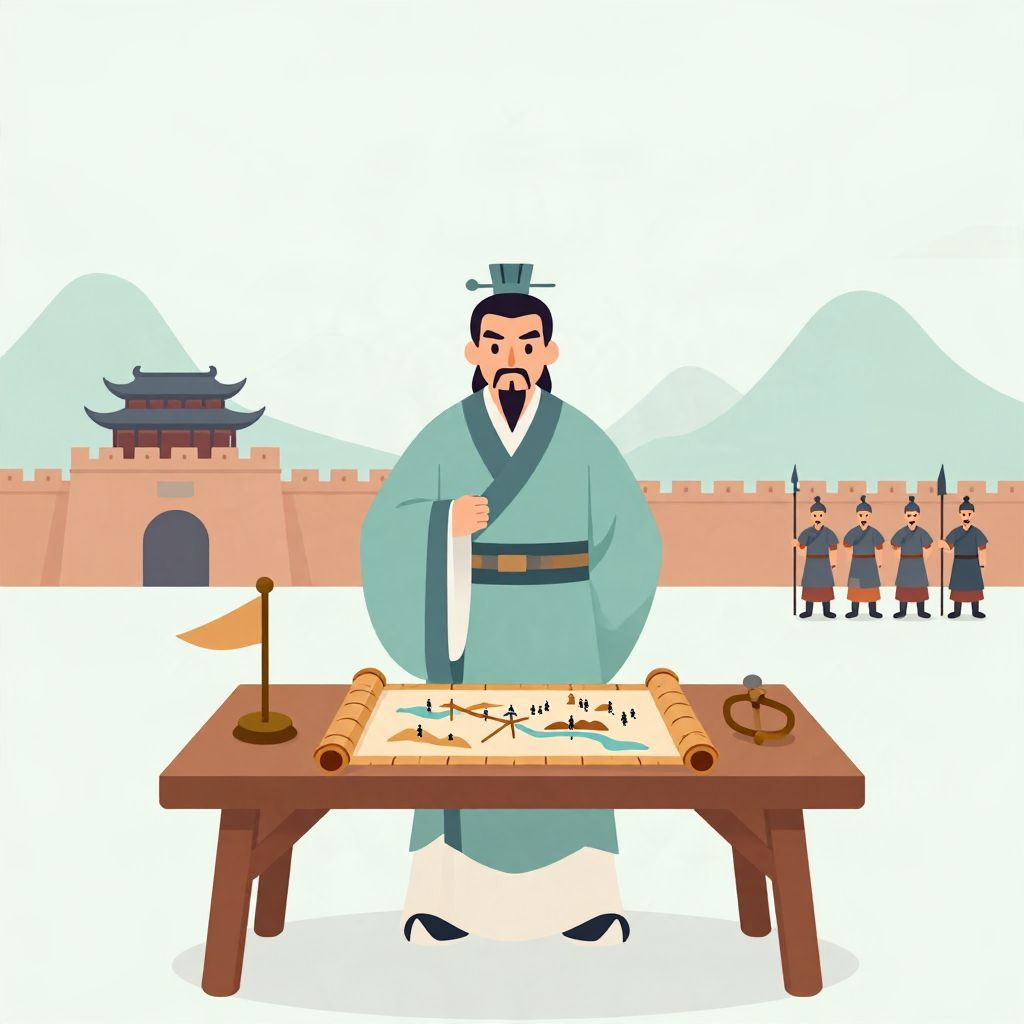
What is The Art of War about? At its core, The Art of War is an ancient Chinese treatise on strategy, leadership, and conflict. Traditionally attributed to Sun Tzu, it explains how to win by understanding opponents, terrain, timing, discipline, and deception rather than relying only on brute force.
Written in the context of the Warring States period, it became one of the most influential military texts in world history. Its ideas later spread far beyond warfare, shaping politics, business, and leadership language in many cultures.
What Is The Art of War About?
The Art of War is about how to achieve victory efficiently and intelligently in conflict. It argues that the best commander avoids unnecessary battles, studies the enemy carefully, uses deception when needed, and preserves strength for the decisive moment. Its central message is that strategy matters more than sheer force.
Origins of The Art of War
Who wrote it?
The book is traditionally credited to Sun Tzu (also written Sunzi), a figure usually placed in ancient China around the late 6th or early 5th century BCE. However, historians cannot verify every detail of his life, and some scholars think the text may have been compiled or edited over time rather than written by one man alone.
When was it written?
Most scholars date the core text to the Warring States period (roughly 475–221 BCE), when Chinese states fought for dominance. The surviving version likely reflects military thinking from that era, though some ideas may preserve earlier traditions. Archaeological discoveries of bamboo manuscripts have helped confirm that the text circulated in ancient forms long before the modern era.
Why did it matter in ancient China?
China during the Warring States period was fragmented into rival kingdoms that needed practical advice for survival. Warfare was frequent, expensive, and politically decisive. A guide that taught rulers how to win with fewer losses would have been highly valuable. The Art of War fit that world because it treated war as a serious statecraft problem, not a matter of glory alone.
The Main Ideas in The Art of War
1. War is costly
One of the text’s strongest themes is that war drains a state’s resources. Armies consume food, money, labor, and time. A long campaign can weaken the victor as much as the defeated. For that reason, the book repeatedly urges commanders to avoid prolonged conflict unless it is truly necessary.
2. Know yourself and your enemy
The text stresses careful intelligence. A commander should understand both their own strengths and weaknesses and those of the opponent. This is one of the book’s most famous ideas: success depends on accurate knowledge, not guesswork. In practice, that means scouting, espionage, observation, and honest assessment.
3. Victory comes from strategy, not just force
The Art of War values planning over direct confrontation. It recommends shaping conditions so that battle becomes unnecessary or, if battle is unavoidable, so that it happens on favorable terms. The ideal victory is one gained with minimal damage, because preserving troops and morale matters for later campaigns.
4. Deception is a tool of war
The text famously treats deception as normal in conflict. Feints, disguises, false signals, and misleading the enemy can create advantage. This does not mean chaos or dishonesty for its own sake; rather, it reflects the idea that war is a contest of perception as much as force.
5. Timing and terrain matter
Sun Tzu emphasizes the importance of geography, weather, and timing. Hills, rivers, roads, and supply lines can decide a campaign. A wise commander chooses ground that helps their army and hinders the enemy. The book therefore combines military theory with practical attention to environment.
6. Discipline and leadership are essential
The treatise also discusses command structure, morale, rewards, and punishment. An army must be organized and responsive. Leaders should be calm, adaptable, and capable of making decisions without emotional excess. In this sense, the text is as much about governance and leadership as it is about combat.
Historical Context: China in the Age of Rival States
To understand The Art of War, it helps to know the political world that produced it. The Warring States period was an age of intense competition among powerful regional states such as Qin, Chu, Qi, Wei, and Zhao. Armies grew larger, warfare became more professional, and rulers sought every possible advantage.
Earlier Chinese warfare had often been tied to aristocratic chariot combat, but by this later period armies increasingly relied on infantry, cavalry, crossbows, and bureaucratic organization. That shift made military administration and strategy even more important. The Art of War reflects this more complex and more lethal world.
What the Book Is Not About
Despite its title, The Art of War is not a celebration of violence. It does not present war as noble or heroic in a simple sense. Instead, it treats war as a dangerous necessity that should be handled with calculation. The goal is not destruction for its own sake, but political survival and advantage.
It is also not a purely philosophical work in the abstract sense. Although it contains broad ideas about human behavior and leadership, it is rooted in concrete military problems: marching armies, managing supplies, reading terrain, and defeating rivals. Its wisdom is practical, not mystical.
How the Text Was Preserved and Interpreted
Manuscripts and transmission
For centuries, the text was copied, commented on, and reinterpreted. Versions found in later manuscripts show that it circulated in different forms. Ancient Chinese scholars and military officials studied it alongside other strategic writings, and later dynasties treated it as a classic of military learning.
Commentaries and later influence
Chinese commentators expanded on its ideas, and later readers often applied them to politics, administration, and diplomacy. Over time, the book’s reputation grew well beyond the battlefield. In East Asia, it became part of a broader intellectual tradition that linked military success with disciplined thought and statecraft.
How The Art of War Spread Beyond China
The text eventually reached readers far outside China, especially through translation and military study in Japan, Korea, and later Europe and the Americas. In the modern era, it became widely read by soldiers, diplomats, executives, and self-help writers. This global popularity sometimes stretches the book’s meaning, but it also shows how flexible its strategic language is.
People often quote it in business or sports because its advice about competition, preparation, and adaptability seems broadly useful. Still, those modern uses should not erase its original setting. The book was written for rulers and generals in a violent age, not for offices or boardrooms.
Common Misunderstandings About The Art of War
It is not a simple “win at all costs” manual
Some readers assume the text promotes ruthless aggression. In fact, it often argues the opposite. The best outcome is the one achieved with the least damage. A commander who wins but exhausts their army may still lose in the long run.
It is not only about battle tactics
Many people focus on individual tricks or battlefield maneuvers, but the book is broader than that. It discusses leadership, intelligence gathering, logistics, morale, and political judgment. These are the foundations of strategy, and they are what make the text enduring.
It should not be read as timeless in every detail
Some principles remain useful, but the text belongs to an ancient military world. Modern warfare involves technologies and institutions unimaginable in Sun Tzu’s time. So while the book offers lasting insights, it should be read historically, not as a universal manual detached from its era.
Why The Art of War Still Matters
The lasting importance of The Art of War lies in its way of thinking. It teaches that success depends on preparation, flexibility, information, and judgment. Those ideas helped make it one of the most studied military texts ever written. It endures because it asks readers to think before acting, and to measure victory by results rather than spectacle.
Historically, the book is a window into ancient Chinese statecraft and the realities of premodern warfare. Culturally, it became a classic because its language of strategy could be adapted to many different settings. That combination of historical rootedness and broad applicability explains its extraordinary influence.
In short, The Art of War is about winning wisely: understanding conflict, avoiding waste, and using strategy to secure an advantage. If you want to explore related military history themes, you may also be interested in what total war means and the longest war in history.