
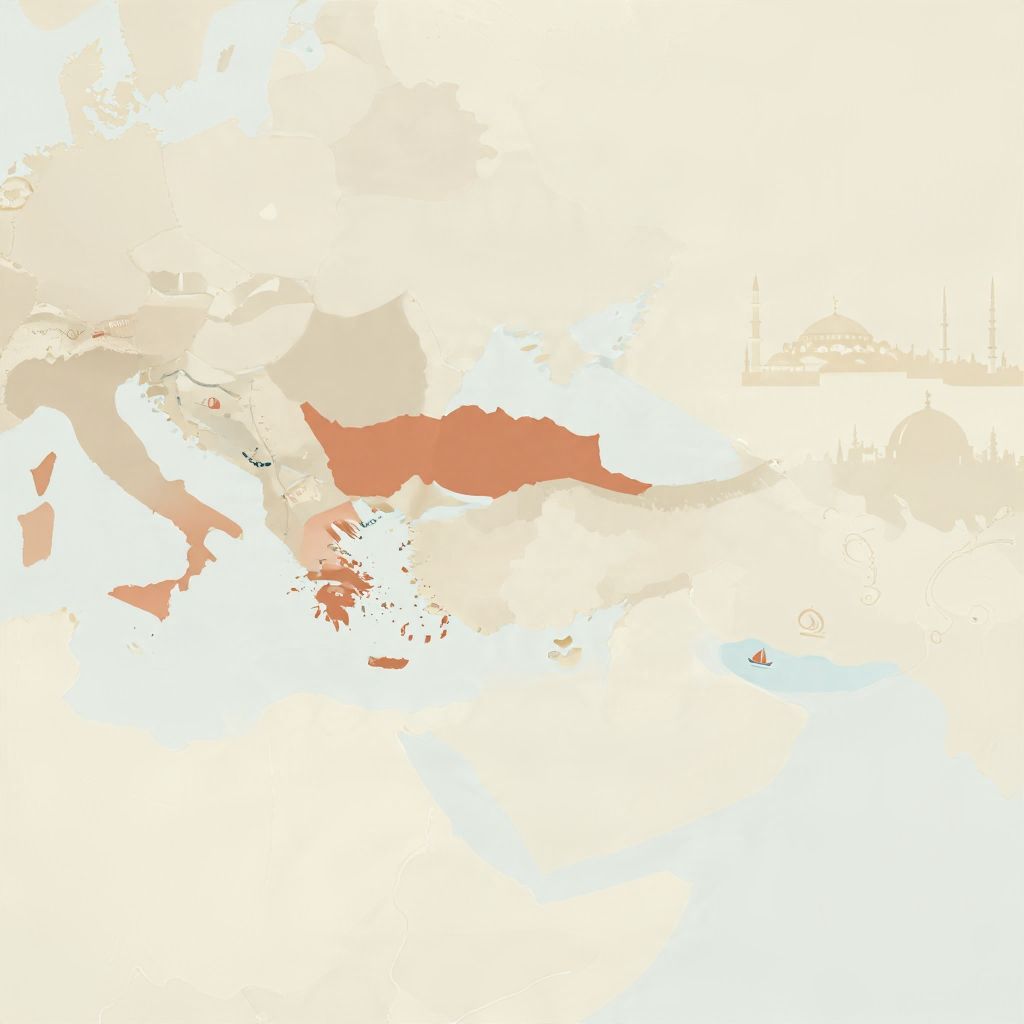
When people ask, “Where is the Ottoman Empire?” they usually mean one of two things: where it was located geographically, or where it fits in history today. The short answer is that the Ottoman Empire was centered in Anatolia, with its capital in Constantinople, and at its height it controlled much of southeastern Europe, western Asia, and North Africa.
It no longer exists as a political empire. Its lands were divided after World War I, and the Republic of Turkey emerged from its core territories in 1923. But the Ottoman legacy still shapes the modern map of the Balkans, the Middle East, and the eastern Mediterranean.
Where Is The Ottoman Empire?
The Ottoman Empire was a transcontinental empire based in present-day Turkey, beginning in northwestern Anatolia and expanding into the Balkans, the Middle East, North Africa, and parts of the Caucasus. Its capital was Constantinople, now Istanbul. Today, the empire no longer exists, but its former lands are spread across several modern countries.
What Was the Ottoman Empire, and Where Did It Begin?
The Ottoman Empire began as a small Turkish principality in northwestern Anatolia in the late 13th century, near the frontier of the declining Byzantine Empire. It grew from this borderland position into a major imperial power over several centuries. The dynasty took its name from Osman I, the early ruler usually credited as its founder.
The early Ottoman homeland
The original Ottoman base was in the region around Söğüt and nearby areas in northwestern Anatolia, in what is now northwestern Turkey. This was not yet a vast empire, but a frontier state positioned between Byzantine territory and other Turkish powers. Its location helped it expand through warfare, alliances, and migration.
From frontier state to empire
By the 14th century, the Ottomans had crossed into Europe and established a foothold in the Balkans. Over time they absorbed rival states, took key cities, and built a centralized government. The capture of Constantinople in 1453 was a turning point that transformed the Ottoman polity into one of the great empires of the early modern world.
What Modern Countries Were Once Part of the Ottoman Empire?
At its greatest extent, the Ottoman Empire included territory that is now part of Turkey, Greece, Bulgaria, Romania, Serbia, Bosnia and Herzegovina, Montenegro, North Macedonia, Albania, Croatia, Hungary, parts of Ukraine, Syria, Lebanon, Israel, Palestine, Jordan, Iraq, Saudi Arabia’s western coast, Egypt, Libya, Tunisia, Algeria, and parts of the Arabian Peninsula and Caucasus. The exact borders changed constantly over time.
Europe
In Europe, Ottoman rule reached deep into the Balkans and, for a period, into parts of Hungary and the eastern Mediterranean islands. The empire’s European presence was especially significant from the 14th through the 19th centuries. Cities and fortresses in the Balkans became important military, administrative, and commercial centers under Ottoman control.
Asia
In Asia, the empire’s core territory was Anatolia, but it also extended into the Levant, Mesopotamia, and the Arabian provinces. These regions connected the empire to major trade routes, holy cities, and diverse religious communities. Ottoman rule in Asia was shaped by local customs, imperial administration, and the strategic importance of land routes between continents.
Africa
Ottoman authority also reached North Africa, especially Egypt, Libya, and coastal areas of the Maghreb. These regions were important for trade, naval power, and the empire’s rivalry with European states in the Mediterranean. However, control varied widely; some areas were directly governed, while others were loosely tied to the Ottoman center.
Where Was the Ottoman Capital?
The Ottoman capital was Constantinople, renamed Istanbul in the 20th century. The city became the imperial center after its conquest in 1453. Its location on the Bosporus made it strategically powerful, linking Europe and Asia and controlling access between the Black Sea and the Mediterranean.
Why Constantinople mattered
Constantinople was not only a political capital but also a symbolic one. It had been the capital of the Byzantine Empire before the Ottoman conquest, so taking it gave the Ottomans prestige and legitimacy. The city’s harbors, walls, and position on major trade routes made it one of the most valuable cities in the world.
Istanbul today
Modern Istanbul still preserves much of the Ottoman era in its architecture, neighborhoods, mosques, palaces, and urban layout. Although the city is no longer the capital of Turkey, it remains the most famous reminder of the Ottoman imperial past.
How Did the Ottoman Empire Expand Across Such a Large Area?
The Ottoman Empire expanded through a combination of military conquest, diplomacy, settlement, and administrative flexibility. Its rulers took advantage of political fragmentation in neighboring regions, especially the weakening Byzantine Empire and divided Balkan states. The empire also benefited from skilled cavalry, artillery, and a well-organized bureaucracy.
Military and political strategy
Ottoman expansion was not simply a matter of battlefield victory. The state often incorporated local elites, allowed a degree of religious autonomy, and used taxation and governance to stabilize conquered lands. This practical approach helped the empire govern a wide variety of peoples, languages, and faiths.
Trade and geography
Its location between Europe, Asia, and Africa gave the empire access to major trade routes and strategic chokepoints. Control of the Bosporus, the Dardanelles, eastern Mediterranean ports, and overland routes made the Ottoman state economically and militarily influential for centuries.
What Was the Ottoman Empire Like at Its Height?
At its height in the 16th and early 17th centuries, the Ottoman Empire was one of the most powerful states in the world. It governed a vast territory, supported a sophisticated court culture, and maintained a strong military and administrative system. Under rulers such as Suleiman the Magnificent, it became a major force in international politics.
Government and society
The empire was ruled by a sultan, but power was shared among a complex set of officials, military leaders, religious scholars, and provincial administrators. Society was diverse, including Muslims, Christians, Jews, and many ethnic groups. The Ottoman system was not modern democracy or simple absolute monarchy; it was an imperial structure adapted to a multiethnic realm.
Culture and religion
Islam was central to Ottoman legitimacy, but the empire was not culturally uniform. It drew from Turkish, Persian, Arab, Byzantine, and Balkan traditions. Ottoman art, architecture, law, and literature reflected this blend. Religious communities often lived under separate legal arrangements, though these varied by period and place.
Why Did the Ottoman Empire End?
The Ottoman Empire did not disappear overnight. It weakened over centuries because of military defeats, internal reform struggles, economic pressures, nationalist movements, and competition with European powers. By the 19th and early 20th centuries, it was often called the “sick man of Europe,” though that phrase oversimplifies a long and uneven decline.
World War I and collapse
The empire entered World War I on the side of the Central Powers and lost. After the war, Allied occupation and partition plans targeted Ottoman lands. Resistance led by Turkish nationalists under Mustafa Kemal Atatürk helped create the Republic of Turkey. The Ottoman sultanate was abolished in 1922, and the caliphate followed in 1924.
What happened to Ottoman lands?
Former Ottoman provinces were redrawn into new states or placed under European mandates. This process helped shape modern borders in the Middle East and southeastern Europe. Some frontiers reflected imperial provinces, while others were created through wartime diplomacy and postwar settlement, often with lasting political consequences.
How Should We Think About the Ottoman Empire on a Map Today?
If you look for the Ottoman Empire on a modern map, you will not find it as a country. Instead, you find its former territories spread across many states. The best way to locate it is to think historically: it began in northwestern Anatolia, centered on Istanbul, and extended across three continents at different times.
A simple geographic summary
- Core region: Anatolia, especially northwestern Anatolia
- Main capital: Constantinople/Istanbul
- European reach: The Balkans and, at times, Hungary and nearby regions
- Asian reach: The Levant, Mesopotamia, and parts of the Arabian Peninsula
- African reach: Egypt, Libya, and parts of North Africa
Why the Ottoman Empire Still Matters
The Ottoman Empire matters because it shaped the political geography and cultural history of a huge region that still affects global affairs today. Modern Turkey, Greece, the Balkans, the Arab world, and parts of North Africa all carry Ottoman-era legacies in law, architecture, language, religious institutions, and national memory.
So, where is the Ottoman Empire? It is gone as a state, but its historical footprint stretches from southeastern Europe to the Middle East and North Africa, with its heart in Anatolia and Istanbul. For more background, see how long the Ottoman Empire lasted and when the Ottoman Empire started.