
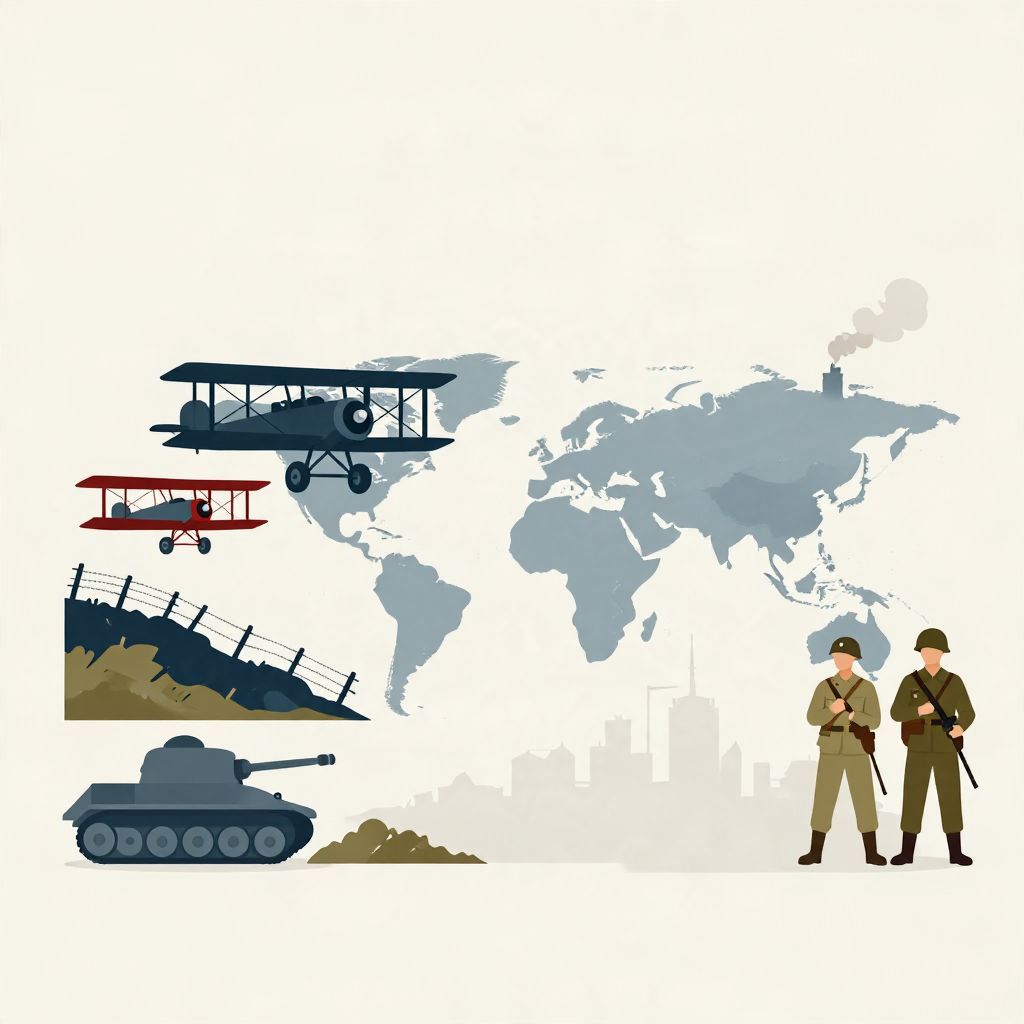
When people ask, “How many world wars have there been?” they usually mean the major global conflicts of the 20th century. The short answer is that historians recognize two World Wars: World War I and World War II. Both involved many countries across several continents and reshaped international politics, borders, and societies.
There have been later wars with worldwide consequences, but none are officially called a third world war. The term “world war” is used for conflicts so large and interconnected that they draw in multiple great powers and affect much of the globe.
How many world wars have there been?
There have been two widely recognized World Wars: World War I (1914–1918) and World War II (1939–1945). These are the only conflicts commonly and historically identified by that title. Other wars have been global in impact, but they are not generally classified as world wars by historians.
What made World War I a “world war”?
World War I began in Europe in 1914, but it quickly spread because of imperial alliances, colonial empires, and global military and economic ties. Fighting took place not only on the Western and Eastern Fronts, but also in Africa, the Middle East, Asia, and at sea, involving soldiers and resources from across the world.
Why the conflict expanded beyond Europe
The war started after the assassination of Archduke Franz Ferdinand in Sarajevo, but the deeper causes included militarism, alliance systems, imperial rivalry, and nationalism. Once Austria-Hungary and Serbia were drawn in, their allies followed. European empires then pulled in troops and supplies from colonies in India, Africa, Australia, Canada, and elsewhere.
What changed after World War I
World War I ended with the defeat of the Central Powers and the collapse of empires including the Austro-Hungarian, Ottoman, Russian, and German empires. The peace settlement redrew borders, created new states, and left unresolved grievances that helped shape the next global conflict. The war also marked a major shift in modern warfare, with trench combat, artillery, poison gas, tanks, and mass mobilization.
Why is World War II considered the second world war?
World War II is called the second world war because it was even more geographically extensive and politically transformative than the first. From 1939 to 1945, fighting spread across Europe, North Africa, the Atlantic, the Pacific, East Asia, and parts of the Middle East. It involved the major powers of the time and many smaller states and colonies.
The road to war
The conflict grew out of unresolved tensions from World War I, economic instability, authoritarian expansion, and aggressive territorial ambitions. Nazi Germany, Fascist Italy, and Imperial Japan sought to expand by force. Britain, France, the Soviet Union, the United States, China, and many others became involved as the war widened into a truly global struggle.
The scale of World War II
World War II is remembered for its immense human cost, including military deaths, civilian bombing, genocide, famine, and displacement on a vast scale. The Holocaust, in which Nazi Germany and its collaborators murdered six million Jews, stands as one of the war’s central atrocities. The conflict also ended with the use of atomic bombs on Hiroshima and Nagasaki in August 1945.
Why do historians count only two World Wars?
Historians count two World Wars because the label has become tied to two specific conflicts that met the broad criteria of global scale, great-power involvement, and worldwide consequences. The phrase “World War” was not always used immediately at the start of the first conflict, but it became standard afterward to distinguish these wars from earlier regional or imperial wars.
What the term means historically
A “world war” is not just any war with many participants. It usually refers to a conflict that crosses continents, involves major powers, and affects international systems far beyond one region. By that definition, World War I and World War II are the clearest examples in modern history.
What about other global conflicts?
Some historians and commentators have compared later crises to a “third world war,” especially during the Cold War. However, those comparisons are metaphorical rather than official historical classifications. The Cold War, for example, was a global rivalry and proxy conflict, but it did not become a single direct world war on the scale of the first two.
Were there any “world wars” before 1914?
Not in the modern historical sense. Earlier wars could be enormous and international, such as the Napoleonic Wars or the Seven Years’ War, and they involved multiple continents and empires. Still, historians do not usually call them world wars because the term emerged later and is reserved for the 20th-century conflicts that transformed the modern international order.
Why earlier wars are different
Before the 20th century, warfare could be global through empire and trade, but the level of industrial mobilization, total war, and worldwide political integration was different. World War I and World War II were shaped by railways, telegraphs, industrial production, mass conscription, and global alliances in a way earlier wars were not.
Key facts about the two World Wars
- World War I: 1914–1918
- World War II: 1939–1945
- Total recognized world wars: 2
- Main regions affected: Europe, Asia, Africa, the Middle East, and the oceans
- Major consequence: profound political, social, and territorial change worldwide
How the two wars are connected
The two World Wars are often studied together because the first helped create the conditions for the second. The peace settlement after 1918 left Germany resentful, Europe unstable, and international cooperation weak. Economic crisis, political extremism, and revisionist ambitions then pushed the world toward another catastrophic war two decades later.
Continuity and difference
Although connected, the wars were not identical. World War I was primarily a struggle among imperial powers and alliance blocs, while World War II became an ideological war against fascism, militarism, and genocide. The second war also involved more direct civilian targeting and ended with the United States and Soviet Union emerging as superpowers.
Why the answer matters
Knowing that there have been two World Wars helps place modern history in context. These conflicts explain the rise of the United Nations, the decline of European imperial dominance, the division of Europe during the Cold War, and many of the borders and political tensions that still shape the world today.
So, the historical answer is simple: there have been two World Wars. Understanding why they are counted that way reveals how modern global warfare developed, and why the aftermath of 1914–1918 and 1939–1945 still matters. For more background, see what year World War I began and why Germany was blamed for World War I.