
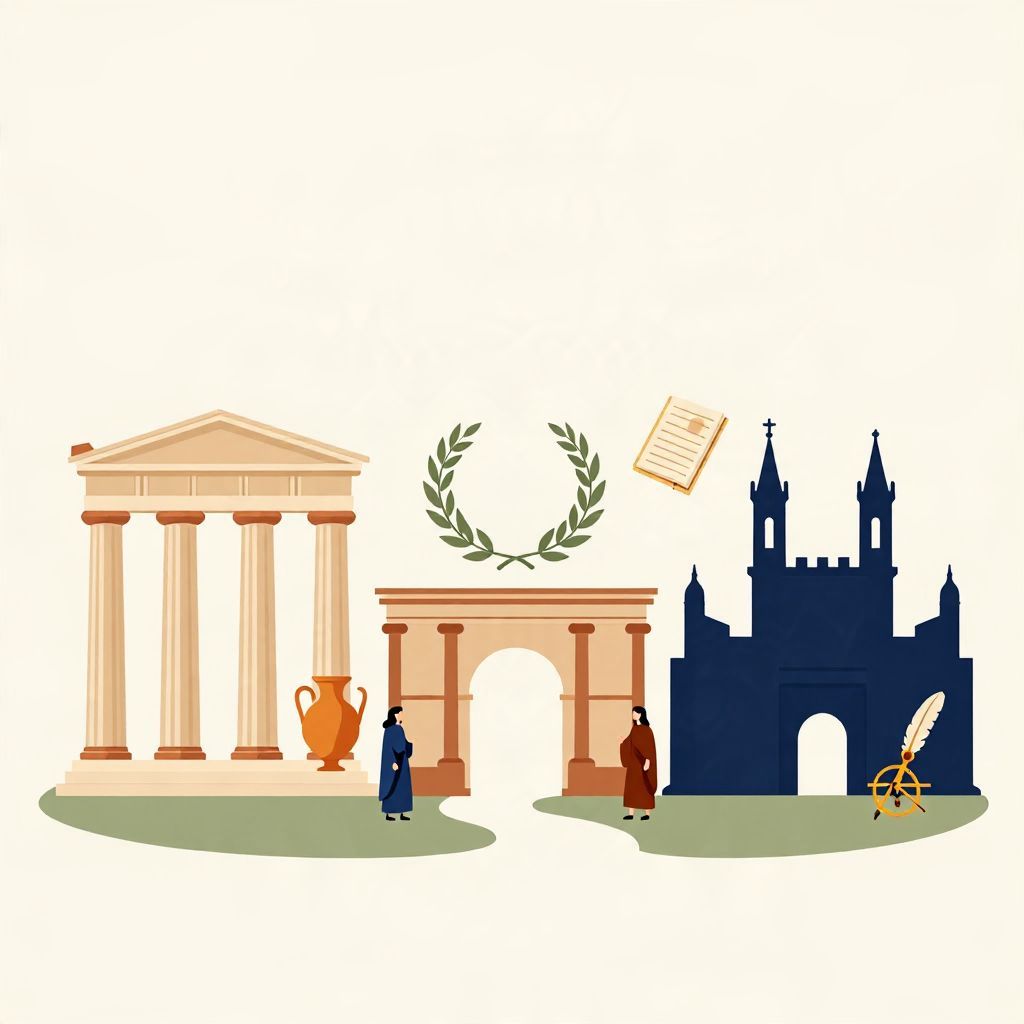
What is Western civilization? The term usually refers to the historical traditions that grew out of the ancient Mediterranean world and later spread across Europe and the Americas. It is not a single culture with fixed borders, but a broad and changing set of ideas, institutions, languages, religions, and political practices.
Because the phrase has been used in different ways, its meaning depends on context. Historians often treat it as a shorthand for a long historical process shaped by Greece, Rome, Christianity, medieval Europe, the Renaissance, the Enlightenment, industrialization, and European expansion.
What Is Western Civilization?
Western civilization is a historical and cultural tradition rooted in the ancient Mediterranean and developed through Europe into the modern Atlantic world. It includes classical philosophy, Roman law, Christianity, later secular political thought, and institutions such as universities, representative government, and scientific inquiry.
Where Did Western Civilization Begin?
There is no single founding moment for Western civilization. Its earliest major roots are usually traced to ancient Greece and Rome, especially from about the 8th century BCE onward. Greek city-states developed philosophy, political debate, drama, and historical writing, while Rome built legal, administrative, and imperial systems that shaped later Europe.
Ancient Greece and Rome
Ancient Greece contributed ideas about citizenship, reasoned argument, and forms of political participation, though these were limited to small groups and excluded women, enslaved people, and many outsiders. Rome expanded the tradition by creating a vast empire and a legal culture that later European societies admired and adapted. Latin became one of the most important languages of learning and government in the West for centuries.
The Role of the Mediterranean World
Western civilization did not emerge in isolation. It was shaped by contact with Egypt, the Near East, Persia, and later the Islamic world. Trade, warfare, translation, and conquest all helped transmit knowledge. Many ideas associated with the West were preserved, challenged, or transformed through these wider exchanges rather than created in one place alone.
How Christianity Shaped the West
Christianity became one of the central forces in Western civilization after the Roman Empire adopted and then institutionalized the religion in the 4th century CE. The church preserved texts, educated clergy, influenced law and morality, and provided a shared framework across much of Europe after Rome’s political collapse in the West.
From Roman Empire to Medieval Europe
After the Western Roman Empire weakened in the 5th century CE, Europe became politically fragmented. Yet Roman institutions, Christian belief, and local customs blended into new medieval societies. Monasteries, bishoprics, and royal courts became centers of literacy and authority. The idea of a unified Christian Europe mattered even when political unity did not exist.
Faith, Authority, and Learning
Medieval Western civilization was deeply religious, but it was not intellectually static. Scholars in cathedral schools and universities debated theology, natural philosophy, and law. The medieval period also saw the rise of canon law, scholasticism, and new forms of public administration. Christianity gave the West a common vocabulary, even as disagreements over doctrine and power divided it.
What Ideas and Institutions Define Western Civilization?
Western civilization is often identified with a cluster of traditions rather than one doctrine. These include classical learning, Christianity, legal systems derived from Roman and canon law, and later ideas about individual rights, constitutional government, and scientific investigation. None of these developed all at once, and each changed over time.
Law and Government
Roman law became one of the most enduring legacies of the ancient world. In the medieval and early modern periods, rulers, jurists, and scholars revived and adapted it. Later, constitutionalism and parliamentary traditions developed in some Western states, especially in England and parts of continental Europe. These institutions were uneven and often limited, but they became important markers of Western political development.
Philosophy and Science
Greek philosophy, especially the work of thinkers such as Plato and Aristotle, influenced medieval and early modern thought. During the Renaissance and Scientific Revolution, Europeans increasingly studied nature through observation, experiment, and mathematical reasoning. This did not replace religion, but it changed how many educated people understood the world.
Art, Literature, and Education
Western civilization is also associated with a long artistic tradition: classical sculpture and architecture, medieval cathedrals, Renaissance painting, and modern literature and music. Universities, first emerging in medieval Europe, became key institutions for preserving and advancing knowledge. The liberal arts tradition also helped define education in the West.
How Did Western Civilization Change in the Renaissance and Enlightenment?
Between roughly the 14th and 18th centuries, Western civilization changed dramatically. The Renaissance renewed interest in classical texts and human achievement. The Reformation fractured religious unity. The Enlightenment emphasized reason, criticism, and natural rights. Together, these movements weakened older assumptions and helped create the modern West.
The Renaissance
The Renaissance began in Italian city-states before spreading across Europe. It was not simply a rebirth of ancient culture, but a period of new artistic, scholarly, and political energy. Humanists studied classical languages and texts, while artists developed new techniques in perspective, realism, and portraiture. Wealth from trade and banking helped support this cultural flowering.
The Reformation and Religious Division
In the 16th century, Protestant reformers challenged the authority of the Roman Catholic Church. The resulting conflicts reshaped Europe politically and culturally. Western civilization became more religiously diverse, but also more divided. The wars of religion encouraged some thinkers to seek stronger states, toleration, or new forms of authority.
The Enlightenment
Enlightenment thinkers in the 17th and 18th centuries argued that reason, evidence, and debate should guide politics and society. Their ideas influenced revolutions, constitutions, and reforms. At the same time, the Enlightenment was not uniformly democratic or egalitarian. Many of its leading figures accepted empire, slavery, or social hierarchy, which reveals the contradictions within Western thought.
How Did Western Civilization Spread Beyond Europe?
Western civilization expanded globally through exploration, colonization, trade, migration, and empire from the late 15th century onward. Spanish, Portuguese, British, French, Dutch, and other European powers carried languages, religions, legal systems, and institutions across the Atlantic and other oceans. This expansion transformed both Europe and the wider world.
The Atlantic World
European colonization of the Americas created societies that were deeply shaped by Western institutions but also by Indigenous peoples and Africans, especially through forced migration and slavery. The resulting Atlantic world was not a simple extension of Europe. It was a new and often violent historical formation that mixed cultures, economies, and populations.
Industrialization and Global Power
From the late 18th century, industrialization gave Western states unprecedented economic and military power. Factories, railways, steamships, and new weapons increased European influence across the globe. This helped drive imperial expansion in the 19th century, when industrial economies sought raw materials, markets, and strategic control. Western civilization thus became associated not only with ideas, but with global dominance.
Is Western Civilization the Same as Europe?
Not exactly. Europe is a geographic region, while Western civilization is a cultural and historical concept. The two overlap strongly, but they are not identical. Western civilization includes the United States, Canada, Australia, New Zealand, and parts of Latin America in different ways, depending on how broadly the term is defined.
A Flexible and Contested Definition
Scholars disagree about the boundaries of the West. Some emphasize Greco-Roman and Christian roots. Others stress the Atlantic world, capitalism, liberalism, and empire. Still others criticize the term for implying a single, unified tradition where there were actually many competing traditions. Because of this, “Western civilization” is best understood as a useful but debated historical category.
What It Excludes and Why That Matters
The term can obscure the influence of non-Western societies on Europe and the West’s own internal diversity. Jewish, Islamic, African, Asian, and Indigenous contributions have all shaped what is often called Western civilization. The concept can also minimize conflict within the West itself, including class struggle, religious persecution, colonial violence, and political exclusion.
Why Does Western Civilization Matter Today?
Western civilization matters because it helps explain the origins of many modern institutions and debates: democracy, constitutionalism, secularism, capitalism, universities, science, and human rights language. It also helps explain empire, racism, colonialism, and global inequality. In other words, the history of the West is both a story of creativity and a story of power.
Modern Legacy
Today, the phrase is often used in political argument, education debates, and cultural identity discussions. But historically, it should be treated carefully. Western civilization is not a timeless essence. It is a changing tradition built over centuries through borrowing, conflict, adaptation, and exchange.
So, what is Western civilization? It is the long and evolving historical tradition that emerged from the ancient Mediterranean, was reshaped by Christianity and medieval Europe, transformed by Renaissance and Enlightenment thought, and expanded globally through empire and migration. To understand it fully, it helps to study both its achievements and its contradictions. For related context, see what the Holy Roman Empire was and how industrialization led to imperialism.