
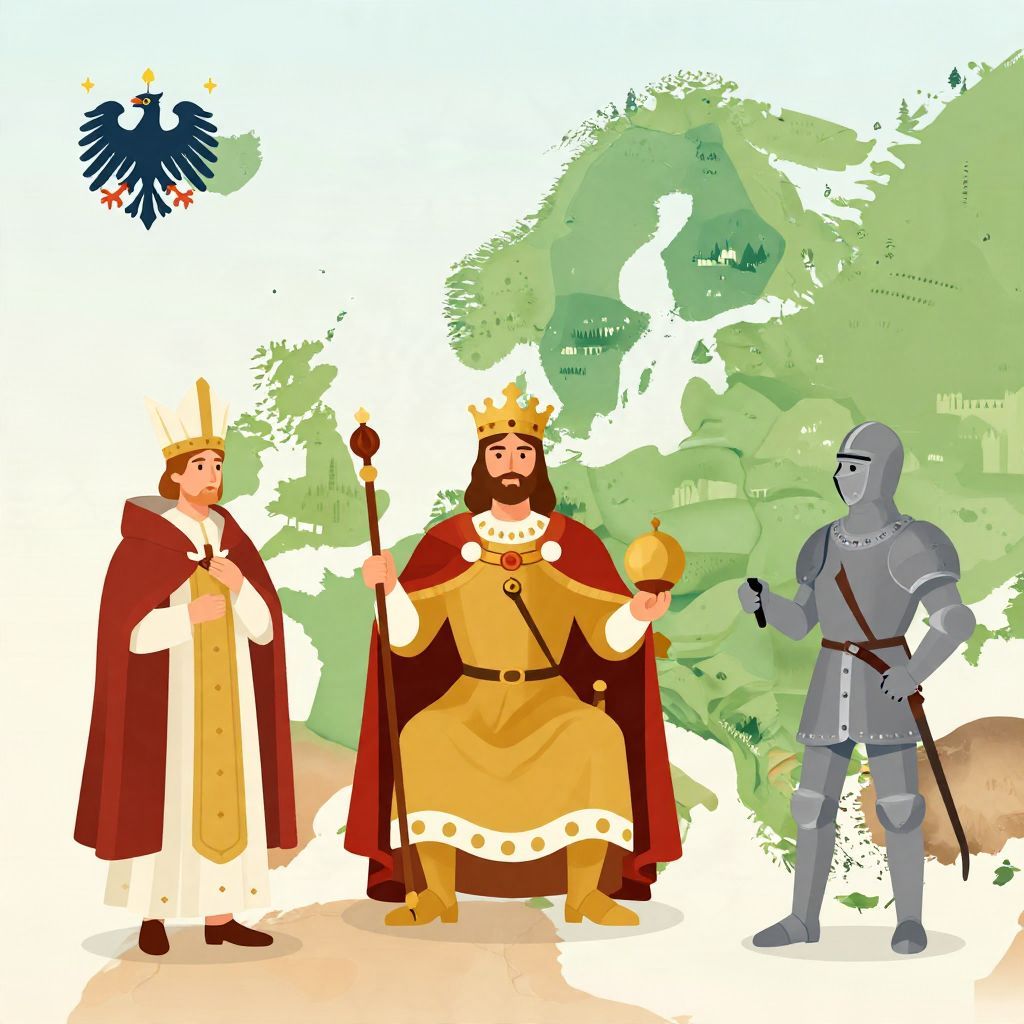
The Holy Roman Empire was a long-lasting political order in central Europe that lasted from the early Middle Ages until 1806. It was not a single centralized nation-state like modern France or Britain, but a loose federation of kingdoms, duchies, bishoprics, free cities, and other territories under an emperor.
Its history is often confusing because the name sounds more unified and “Roman” than the empire really was. To understand what it was, you have to look at how medieval rulers tried to revive Roman imperial authority in Christian Europe and how that idea changed over the centuries.
What Was The Holy Roman Empire?
The Holy Roman Empire was a political and religious framework in central Europe, centered on German-speaking lands but extending across much of modern Germany, Austria, Switzerland, the Czech lands, parts of Italy, and the Low Countries at different times. It began in the early medieval period, grew out of the Carolingian legacy, and formally ended in 1806 under pressure from Napoleon.
How Did the Holy Roman Empire Begin?
The empire’s origins are usually traced to 800, when Pope Leo III crowned Charlemagne emperor in Rome. That event symbolized a revival of western imperial power after the fall of the Western Roman Empire in 476. The later Holy Roman Empire, however, was not a direct continuation of Charlemagne’s realm in a simple sense; it emerged more clearly under the East Frankish and German kings in the 10th century.
Most historians point especially to Otto I, king of East Francia, who was crowned emperor in 962. This moment is often treated as the real beginning of the Holy Roman Empire because it established a durable imperial title tied to German kingship and papal coronation.
Why “Holy,” “Roman,” and “Empire”?
- Roman: rulers claimed to inherit the prestige of ancient Rome and its universal imperial authority.
- Holy: the empire was closely linked to Christianity and the Church, especially through papal coronation and religious legitimacy.
- Empire: its ruler was an emperor, theoretically above ordinary kings in rank.
Despite the name, the empire was never simply “Roman” in language, population, or administration. It was a medieval Christian empire that borrowed Roman symbolism to strengthen its authority.
How Was It Governed?
The Holy Roman Empire was famously decentralized. The emperor was important, but he did not rule like an absolute monarch. Power was divided among many princes, bishops, electors, dukes, counts, and independent cities. This made the empire flexible and durable, but also politically fragmented.
Over time, the empire developed institutions to manage this complexity. The most important were the imperial diets, courts, and circles, which helped negotiate disputes among territories. Yet the emperor’s practical power depended heavily on personal alliances, family lands, and cooperation from regional rulers.
The Role of the Emperor
The emperor was the symbolic head of the empire and a protector of Christian order. In practice, his authority varied greatly from one reign to another. Strong emperors could influence politics across central Europe; weaker ones relied on compromise and local support.
From the late medieval period onward, the emperor was usually chosen rather than automatically inherited. This election system limited dynastic centralization and reinforced the empire’s character as a political community of princes.
Who Chose the Emperor?
By the later Middle Ages, a small group of powerful princes known as electors had the right to choose the king of the Romans, who was usually the future emperor. This was formalized in the Golden Bull of 1356, issued by Emperor Charles IV. It helped stabilize succession rules and confirmed the political importance of leading territorial rulers.
The emperor was usually crowned by the pope in earlier centuries, though this became less central over time. In 1530, Charles V was the last emperor crowned by a pope in the traditional way. After that, imperial legitimacy increasingly rested on election and acceptance within the empire rather than papal ritual.
What Territories Were in the Empire?
The empire’s borders changed constantly, so there was never one fixed map. At its broadest, it included most of the German lands, Austria, Bohemia, parts of northern Italy, Burgundy, and many smaller territories. Some regions were directly part of the empire, while others were associated with it in looser ways.
Because of this, the Holy Roman Empire was less a compact state than a layered political system. Local rulers often had their own laws, armies, taxes, and courts. The emperor’s realm was therefore a patchwork of jurisdictions rather than a single uniform territory.
Major Regions Commonly Associated with the Empire
- German principalities and bishoprics
- Austria and the Habsburg hereditary lands
- Bohemia
- Parts of northern and central Italy in earlier periods
- Imperial cities such as Nuremberg and Frankfurt
Why Was the Holy Roman Empire So Fragmented?
Fragmentation was built into the empire’s history. Medieval rulers depended on local elites for military support, administration, and legitimacy. In return, princes and bishops gained privileges that made them increasingly autonomous. The empire’s size and diversity also made direct central control difficult.
Several long-term developments deepened this decentralization:
- Feudal relationships gave local lords significant authority.
- Elective monarchy limited hereditary centralization.
- Conflicts with the papacy weakened imperial authority in some periods.
- Regional identities grew stronger over time.
This does not mean the empire was chaotic or meaningless. It had rules, traditions, and institutions. But its political culture favored negotiation and layered authority rather than direct centralized rule.
What Was the Investiture Controversy?
One of the empire’s defining struggles was the Investiture Controversy of the 11th and 12th centuries, a conflict over who had the right to appoint bishops and abbots. Emperors wanted to control church offices because bishops were major political figures and landholders. Popes argued that spiritual authority belonged to the Church.
The dispute weakened imperial influence and helped define the boundaries between secular and religious power in medieval Europe. The famous clash between Emperor Henry IV and Pope Gregory VII became a symbol of the broader struggle, though the conflict lasted beyond any single confrontation.
How Did the Reformation Change the Empire?
The Protestant Reformation in the 16th century transformed the empire’s political and religious landscape. Martin Luther’s ideas spread quickly in many imperial territories, and rulers often adopted Protestantism for both conviction and political advantage. The empire became a battleground between Catholic and Protestant powers.
The Peace of Augsburg in 1555 recognized the principle that a ruler’s religion would determine the religion of his territory, within limits. This did not solve the empire’s divisions; it institutionalized them. Later, the Thirty Years’ War (1618–1648) devastated much of the empire and exposed the weakness of imperial unity.
The Thirty Years’ War and Its Consequences
The war began as a religious and constitutional conflict but expanded into a wider European struggle involving major powers. The Peace of Westphalia in 1648 is often seen as a turning point because it confirmed the autonomy of many imperial states and reduced the emperor’s ability to impose a single religious or political settlement.
After Westphalia, the empire survived, but its nature was even more clearly federal and decentralized. It remained an important legal and diplomatic structure, even if it was no longer a strong centralized power.
Was the Holy Roman Empire Really “Holy,” “Roman,” or an “Empire”?
Historians have long noted that the name is partly a political claim. “Holy” emphasized Christian legitimacy, “Roman” evoked universal authority, and “Empire” suggested imperial rank. But the actual reality was more complex. The empire was Christian, but not uniformly controlled by church leaders; Roman in symbolism, but not in ethnic or administrative continuity; imperial in title, but limited in direct power.
For that reason, the name should be understood as an ideal and a tradition, not a literal description in modern terms. The title expressed what rulers wanted the empire to be, and what they hoped it would represent in Europe.
How Did the Empire End?
The Holy Roman Empire came to an end during the Napoleonic era. After years of French military pressure and political restructuring in Germany, Emperor Francis II abdicated the imperial title in 1806 and dissolved the empire. He had already become emperor of Austria in 1804, anticipating the collapse of the older imperial structure.
The end of the empire was not a sudden collapse of a unified state, because it had never been one. Instead, it was the final dissolution of a centuries-old political system that had already been weakened by war, reform, and changing ideas about sovereignty.
Why Does the Holy Roman Empire Matter?
The Holy Roman Empire mattered because it shaped the political map of central Europe for nearly a thousand years. It influenced the development of Germany, Austria, Switzerland, the Czech lands, and neighboring regions. It also left a lasting legacy in constitutional thought, federalism, religious politics, and the balance between local and central power.
Modern historians often see the empire not as a failed nation-state, but as a different kind of political order. It was built on negotiation, layered sovereignty, and shared legitimacy. In that sense, it offers an important alternative to the modern idea that all states must be centralized and uniform.
Quick Timeline of the Holy Roman Empire
- 800 – Charlemagne crowned emperor in Rome
- 962 – Otto I crowned emperor; common starting point of the Holy Roman Empire
- 1356 – Golden Bull formalizes imperial election rules
- 1517 – Reformation begins with Luther’s challenge to the Church
- 1555 – Peace of Augsburg recognizes religious division
- 1618–1648 – Thirty Years’ War
- 1648 – Peace of Westphalia reshapes imperial authority
- 1806 – Empire dissolved by Francis II
The Holy Roman Empire was a medieval and early modern political system that united many territories under an emperor without creating a centralized nation-state. Its history is best understood as a story of continuity, compromise, and changing authority rather than simple rise and fall. For related reading, see when the Holy Roman Empire fell and the largest empire in history.