
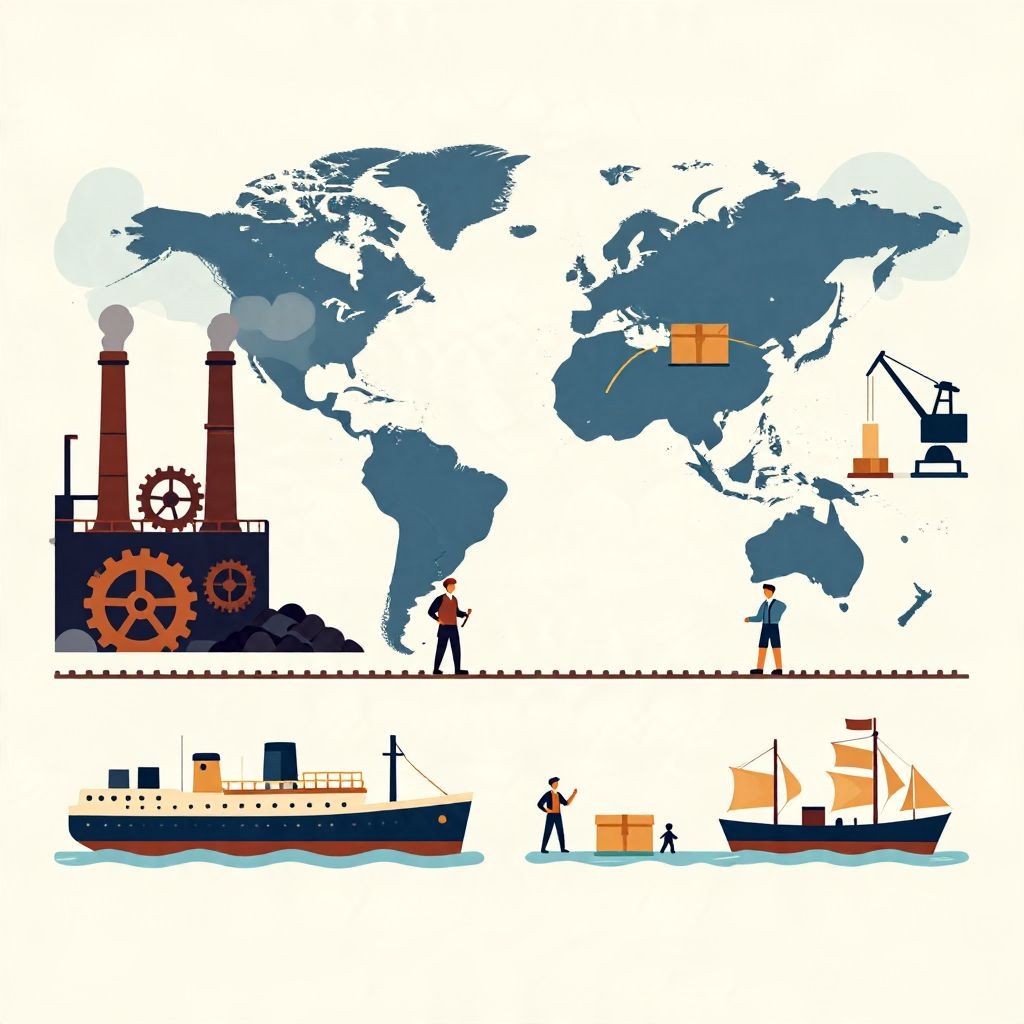
Industrialization changed how states produced goods, moved armies, and organized economies. It did not cause imperialism by itself, but it made overseas expansion far more profitable, practical, and competitive for industrial powers in the 19th century.
As factories multiplied in Europe and later the United States and Japan, industrial nations sought raw materials, new markets, strategic ports, and political prestige. Those needs helped drive the “New Imperialism” of roughly 1870 to 1914, when European empires expanded rapidly across Africa and Asia.
How Did Industrialization Lead To Imperialism?
Industrialization led to imperialism by creating a demand for raw materials, overseas markets, and investment opportunities while also giving industrial states the ships, weapons, railways, and communications systems needed to conquer and control distant territories. In short, industrial power made empire both more tempting and more achievable.
The Economic Pressures Behind Expansion
Factories required steady supplies of cotton, rubber, coal, copper, palm oil, and other materials that were often cheaper or more abundant outside Europe. At the same time, industrial production created more goods than home markets could always absorb, so imperial powers looked abroad for consumers. Colonies also offered places to invest surplus capital and extract profits.
Raw materials and industrial supply chains
Industrial economies depended on global supply chains long before the phrase existed. British textile mills, for example, relied heavily on cotton from the American South and later from India and Egypt. As industrial production expanded, European states and companies increasingly wanted direct access to sources of raw materials rather than dependence on independent traders or rival powers.
Markets for manufactured goods
Industrialization increased output faster than wages and domestic demand could always keep up. Imperial control seemed to guarantee captive markets for manufactured cloth, tools, machinery, and other goods. This was not the only motive for empire, but it was an important one in the age of mass production. Colonies were often expected to buy finished goods while exporting cheap raw materials.
Investment and finance
Industrial capitalism also produced large pools of private wealth. Investors, banks, and industrial firms looked overseas for railways, mines, plantations, and ports that could generate returns. Sometimes this happened through formal colonization; at other times it took the form of economic domination without full annexation. Either way, industrial finance encouraged imperial expansion.
Industrial Technology Made Empire Easier
Industrialization did not just create motives for empire; it also supplied the tools. Steamships, railroads, telegraphs, modern rifles, machine guns, and improved medicine made it easier for European powers to travel, fight, communicate, and stay in control. These technologies sharply widened the gap between industrial states and many societies they sought to dominate.
Steam power and transportation
Steamships reduced dependence on wind patterns and made long-distance travel faster and more reliable. Railways helped imperial powers move troops, settlers, and goods inland after coastal conquest. In places such as India and parts of Africa, rail networks became instruments of extraction and control as much as transportation systems.
Telegraphs and administration
The telegraph allowed imperial governments to send orders across vast distances much more quickly than before. That mattered because empire required coordination: officials had to collect taxes, suppress resistance, negotiate with local elites, and respond to crises. Faster communication made it possible to govern territories that would previously have been too distant to manage effectively.
Weapons and military advantage
Industrial production transformed warfare. Breech-loading rifles, repeating firearms, artillery, steam-powered gunboats, and, later, machine guns gave industrial armies a major advantage over many opponents. This does not mean conquest was easy or bloodless—far from it—but industrial military technology often tipped the balance in colonial wars and punitive expeditions.
Medicine and survival in the tropics
Advances in medicine also mattered. The spread of quinine as a treatment for malaria made it easier for Europeans to survive in some tropical regions, especially in Africa and parts of Asia. This removed one of the earlier barriers to deeper inland expansion, although disease still remained a major obstacle and killed many colonizers and colonized people alike.
Industrialization and the Age of New Imperialism
The strongest link between industrialization and imperialism appeared in the late 19th century, during the period often called the New Imperialism. Between about 1870 and 1914, industrial powers accelerated their overseas expansion, especially in Africa and Asia. This was not a single unified plan, but a broad pattern shaped by economic competition, nationalism, and strategic rivalry.
The Scramble for Africa
The partition of Africa is one of the clearest examples of industrial-era imperialism. After the 1880s, European states raced to claim African territory, often with little regard for existing political boundaries or local societies. The Berlin Conference of 1884–1885 helped formalize rules for European claims, but it did not protect African sovereignty. Industrial demand for minerals, land, and trade routes helped intensify this scramble.
British expansion in India
Britain’s empire in India predated the height of New Imperialism, but industrialization deepened and reshaped it. India supplied raw materials such as cotton and opium and served as a major market for British goods. Railways, ports, and telegraphs were built under imperial rule, but these projects also strengthened British economic extraction and military control.
Japan and non-European imperialism
Industrialization and imperialism were not exclusively European phenomena. Japan’s rapid modernization after the Meiji Restoration beginning in 1868 helped it become an imperial power itself. By the late 19th century, Japan used industrial and military modernization to expand into Korea, Taiwan, and later parts of China. This shows that industrialization could empower states to become imperial rivals, not just victims.
Nationalism, Competition, and Prestige
Industrialization intensified competition among states. Factories, railways, steel production, and armaments became symbols of national strength. Governments and publics increasingly linked empire to prestige, believing that great powers needed colonies to prove their status. Imperial acquisition was therefore tied not only to economics but also to national pride and geopolitical rivalry.
Empire as a sign of great-power status
In the 19th century, many political leaders and commentators argued that a modern industrial nation should possess an empire. Colonies were seen as evidence of strength, civilization, and global reach. This idea was especially powerful in Britain, France, Germany, Belgium, and Italy, where imperial success was often celebrated as proof of national greatness.
Strategic rivalry and naval power
Industrialization also transformed naval warfare. Steel warships, coaling stations, and canals made overseas bases strategically valuable. Imperial territories could serve as refueling points and military outposts, helping states protect trade routes and project force. Control of ports and chokepoints became central to imperial strategy.
Ideologies That Justified Imperialism
Economic and technological change alone do not explain imperialism. Industrial powers also developed ideas that justified conquest. Some people believed in a “civilizing mission,” claiming that European rule would bring progress, Christianity, education, and order. Others used racist theories and Social Darwinist arguments to portray domination as natural or beneficial.
Racism and Social Darwinism
Racial ideologies became deeply entangled with imperialism in the industrial age. Social Darwinism misapplied ideas about natural selection to human societies, suggesting that stronger nations were destined to rule weaker ones. These arguments were not scientific in any modern sense, but they were influential and helped legitimize conquest, forced labor, and unequal rule.
The civilizing mission
Many imperial supporters claimed they were improving the lives of colonized peoples through infrastructure, education, and law. Some colonial projects did build roads, railways, and schools, but these often served imperial priorities first. The language of uplift frequently masked coercion, land seizure, and economic exploitation.
Did Industrialization Cause Imperialism by Itself?
Not entirely. Industrialization was a major driver, but imperialism also grew from older traditions of conquest, mercantilism, missionary activity, strategic rivalry, and state building. European powers had expanded overseas long before the Industrial Revolution. What changed in the 19th century was the scale, speed, and intensity of expansion, along with the industrial tools that made it more effective.
Continuities with earlier empires
Before industrialization, empires already sought tribute, trade routes, land, and prestige. Spain, Portugal, the Dutch Republic, France, and Britain had all built overseas possessions in earlier centuries. Industrialization did not invent empire; it transformed it into a more global, systematic, and economically integrated project.
Why the 19th century was different
The difference was that industrial economies required more raw materials, generated more surplus goods, and possessed far more powerful technologies of transport and war. That combination made overseas expansion more attractive and more feasible than it had been in earlier periods. Industrialization therefore accelerated imperialism and changed its character.
Key Events That Show the Link Between Industry and Empire
Several 19th-century developments reveal how industrialization and imperialism reinforced one another:
- 1839–1842 and 1856–1860: the Opium Wars showed how industrial-era military power could be used to force trade access in China.
- 1869: the opening of the Suez Canal shortened routes to Asia and increased the strategic value of Egypt and nearby territories.
- 1870s–1914: the New Imperialism saw rapid European expansion in Africa and Asia.
- 1884–1885: the Berlin Conference formalized European rules for claiming African territory.
- 1898: the Spanish-American War marked the rise of the United States as an overseas imperial power.
- 1899–1902: the South African War demonstrated the importance of mineral wealth, strategic control, and industrial logistics.
Consequences for Colonized Societies
Industrial imperialism reshaped colonized regions in profound and often violent ways. Colonial economies were reorganized around export production, cash crops, and mineral extraction. Local industries could be weakened by competition from imported manufactured goods. Borders were redrawn, labor systems were transformed, and political authority was often concentrated in colonial administrations that served imperial interests.
Resistance and adaptation
Colonized peoples did not passively accept imperial rule. Resistance took many forms: armed revolt, diplomatic negotiation, religious movements, labor strikes, and everyday forms of refusal. Some local elites collaborated with imperial powers to preserve influence, while others tried to adapt industrial tools and institutions for their own purposes. Imperialism was therefore contested from the start.
Conclusion: The Industrial Roots of Imperial Power
Industrialization led to imperialism by giving industrial states the economic incentives, military tools, and administrative systems needed to seize and manage overseas territories. It turned empire into a modern system of extraction, competition, and global control, especially in the late 19th century. For a closer look at related themes, see how advanced weaponry helped Europe during New Imperialism and what mercantilism was.