
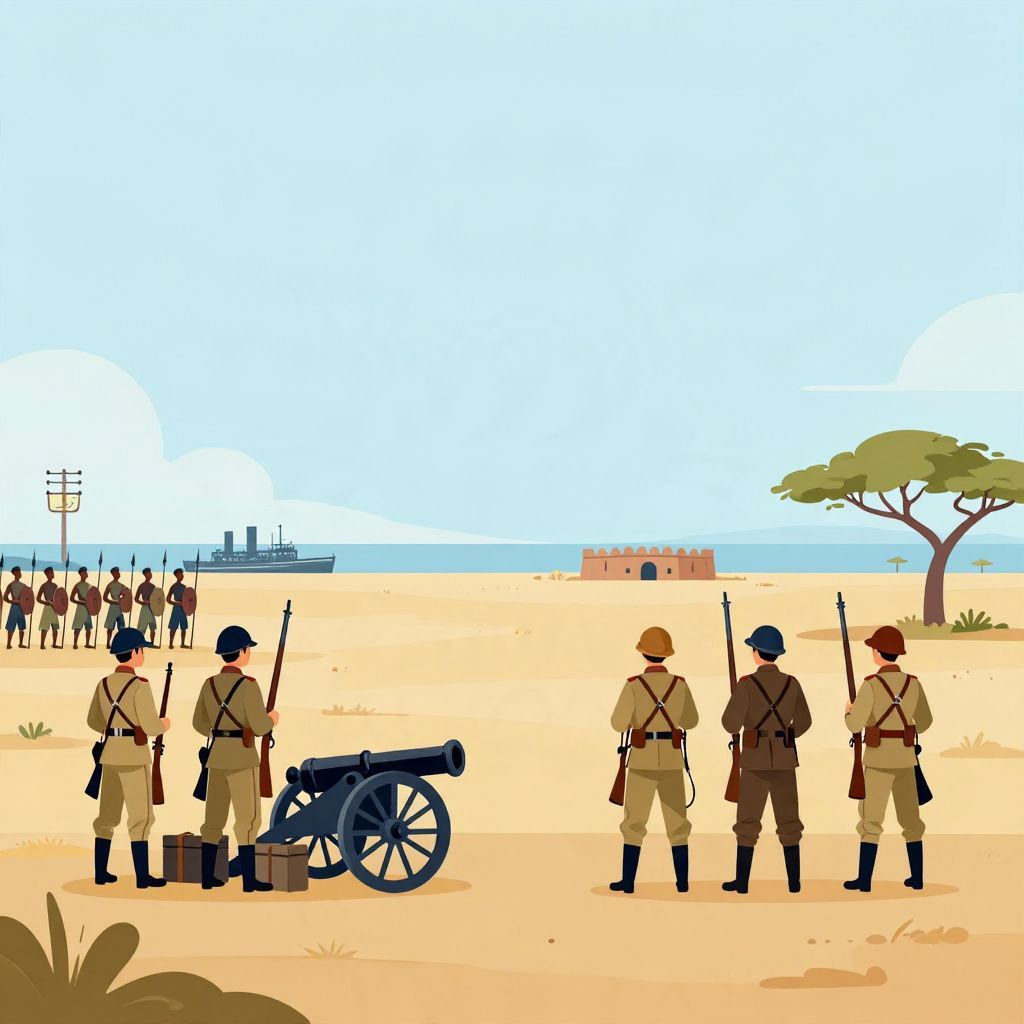
How did advanced weaponry help Europe during New Imperialism? In the late 19th and early 20th centuries, European powers used new military technologies to conquer, intimidate, and control overseas territories far more efficiently than before.
Weapons such as machine guns, breech-loading rifles, modern artillery, ironclad ships, and telegraphs gave imperial armies a decisive edge over many opponents. These tools did not make conquest easy or risk-free, but they sharply increased Europe’s ability to project power across Africa, Asia, and the Pacific.
How did advanced weaponry help Europe during New Imperialism?
Advanced weaponry helped Europe during New Imperialism by giving European states overwhelming battlefield superiority, faster communication, and greater mobility. Technologies like the Maxim gun, steam-powered warships, and modern artillery allowed relatively small European forces to defeat larger local armies, seize territory quickly, suppress resistance, and protect trade routes and colonies.
The military technology behind imperial expansion
New Imperialism, roughly from the 1870s to the outbreak of World War I in 1914, was shaped by industrialization. Europe’s factories could mass-produce weapons, ammunition, railways, and ships. This industrial base meant imperial powers could arm armies more cheaply and replace losses more easily than many of the societies they confronted.
Machine guns and rapid-fire firepower
The most famous symbol of this era was the machine gun, especially the Maxim gun, invented in the 1880s. It could fire continuously and mow down attacking troops at a pace that older muskets or rifles could not match. In colonial warfare, this often meant that a small European detachment could defeat much larger forces.
This advantage was not absolute, but it was dramatic. In battles such as Omdurman in 1898, British and Egyptian forces used modern firepower to crush Sudanese troops. Similar patterns appeared in other colonial campaigns, where massed infantry charges became extremely vulnerable to rapid-fire weapons.
Modern rifles and artillery
Breech-loading and bolt-action rifles also improved European combat power. Soldiers could reload faster, fire more accurately, and sustain longer engagements. Artillery became more destructive and more mobile, especially when paired with industrial production and improved transport. Together, these weapons made European armies more lethal and more flexible than many of the forces they faced.
Colonial armies often relied on older weapons, fewer rounds of ammunition, or less standardized logistics. That did not mean they were weak in every respect, but it did mean that direct battlefield confrontations increasingly favored the better-equipped imperial power.
Steamships, ironclads, and naval dominance
Advanced weaponry at sea was just as important. Steam-powered warships and ironclads allowed European navies to move quickly, carry heavier guns, and operate with less dependence on wind. Naval power helped Europeans seize ports, blockade coasts, punish resistance, and support inland campaigns along rivers and rail lines.
Control of the sea also mattered for empire because it protected shipping lanes, troop movements, and commercial networks. Britain, in particular, used naval superiority to defend a global empire centered on trade, coaling stations, and strategic chokepoints such as the Suez route.
Why did these weapons matter so much in colonial conquest?
Advanced weapons mattered because imperial conquest was often a contest of speed, shock, and logistics. European states did not always need huge armies if they could use superior firepower, transport, and communication to strike quickly, defeat resistance, and reinforce their positions before opponents could regroup.
Psychological shock and deterrence
Modern weapons had a psychological effect as well as a physical one. The destructive power of machine guns and artillery could break morale, discourage open battle, and convince local rulers to negotiate or submit. In many cases, Europeans used the threat of overwhelming force as much as the force itself.
This was especially true in regions where imperial officials wanted to control territory without committing large numbers of troops. A display of naval guns, a punitive expedition, or a rapid battlefield victory could be enough to force treaties, concessions, or the surrender of a capital city.
Communication and coordination
Weaponry alone did not create empire. Telegraphs, railways, and steam transport helped European armies coordinate attacks, move supplies, and send orders across vast distances. These systems made military power more effective by linking battlefield technology to administration and logistics.
For example, a force deep inland could still receive reinforcements, ammunition, and instructions from a coastal base. This reduced the chances that local defenders could isolate and destroy an invading column before help arrived.
Key events that show how advanced weaponry shaped New Imperialism
Several major imperial campaigns reveal how European military technology supported expansion. These were not the only causes of empire—economic motives, nationalism, racism, and strategic rivalry also mattered—but advanced weaponry made conquest far more feasible.
- 1884–1885: The Berlin Conference helped formalize the Scramble for Africa, as European states claimed territories with confidence in their military and technological advantages.
- 1896: The Battle of Adwa showed that African states could defeat European powers under certain conditions; Ethiopia’s victory over Italy is a reminder that imperial conquest was not automatic.
- 1898: The Battle of Omdurman demonstrated how machine guns and modern artillery could devastate a larger opposing force.
- 1899–1902: The South African War showed the importance of railways, artillery, and industrial logistics in a prolonged imperial conflict.
- 1904–1905: The Russo-Japanese War revealed that industrial military power was no longer exclusively European, even though Europe still dominated much of the colonial world.
The Scramble for Africa
During the Scramble for Africa, European powers carved up much of the continent in a relatively short time. Military technology helped them claim territory, but it worked alongside diplomacy, rivalries between European states, and the exploitation of local political divisions. In many places, Europeans relied on alliances with one group against another, then backed those alliances with superior weapons.
It is important not to oversimplify this process. African societies were diverse, politically complex, and often capable of serious resistance. Still, the combination of modern weapons and industrial support gave Europeans a major advantage in many confrontations.
India and the wider Asian world
In Asia, European imperial power had already taken root earlier, but advanced weaponry strengthened and extended it. British rule in India depended on a long military and administrative buildup, and by the late 19th century modern rifles, artillery, and steam transport helped maintain control. Similar patterns appeared in parts of Southeast Asia and coastal China, where gunboats and modern armies pressured local rulers.
How advanced weaponry changed the balance of power
Advanced weaponry changed the balance of power by reducing the military cost of empire for Europeans and raising the cost of resistance for colonized peoples. It made it easier to conquer, but also easier to police and defend imperial possessions once they were taken.
Smaller forces could control larger populations
One of the clearest effects of modern weapons was the ability of relatively small European forces to dominate much larger populations. This did not mean Europeans ruled alone; they often depended on colonial troops, local auxiliaries, interpreters, and administrators. But modern firepower made the European command structure far more secure.
Colonial warfare became more one-sided
In many campaigns, older forms of warfare—mass charges, cavalry assaults, or traditional infantry formations—were badly exposed by rapid-fire weapons. This made direct resistance extremely costly. As a result, some leaders chose negotiation, while others shifted to guerrilla tactics, retreat, or strategic avoidance of open battle.
Imperial rule became easier to defend
Once a colony was established, advanced weaponry helped Europeans suppress revolts and protect infrastructure. Forts, armed patrols, naval bombardments, and mobile columns could be used to maintain order. This did not eliminate resistance, but it often made resistance harder to sustain in the face of industrial military power.
Limits and consequences of European firepower
Advanced weaponry gave Europe a major advantage, but it did not guarantee permanent control. Some societies adapted quickly, acquired modern arms, or used terrain and tactics to offset European strengths. Ethiopia’s victory at Adwa is the best-known example of an African state defeating a European invader through organization, strategy, and access to modern weapons.
There were also long-term consequences for Europe itself. The same industrial military systems that supported empire also fueled arms races, militarism, and international tension. By the early 20th century, Europe’s confidence in modern firepower contributed to a more dangerous global environment, one that helped set the stage for World War I.
Imperial power and militarism
Advanced weaponry encouraged some European leaders to believe that military strength could solve political problems abroad. That mindset did not cause imperialism by itself, but it reinforced the idea that force could secure markets, territory, and prestige. In this sense, New Imperialism and militarism were closely connected.
Conclusion
Advanced weaponry helped Europe during New Imperialism by making conquest faster, resistance more difficult, and imperial rule easier to maintain. Machine guns, modern rifles, artillery, and steam-powered navies gave European states a powerful military edge, though not an unbeatable one. The result was a dramatic expansion of European empires—and deeper global consequences that shaped the modern world. For related reading, see how imperialism led to World War I and how militarism led to World War I.