
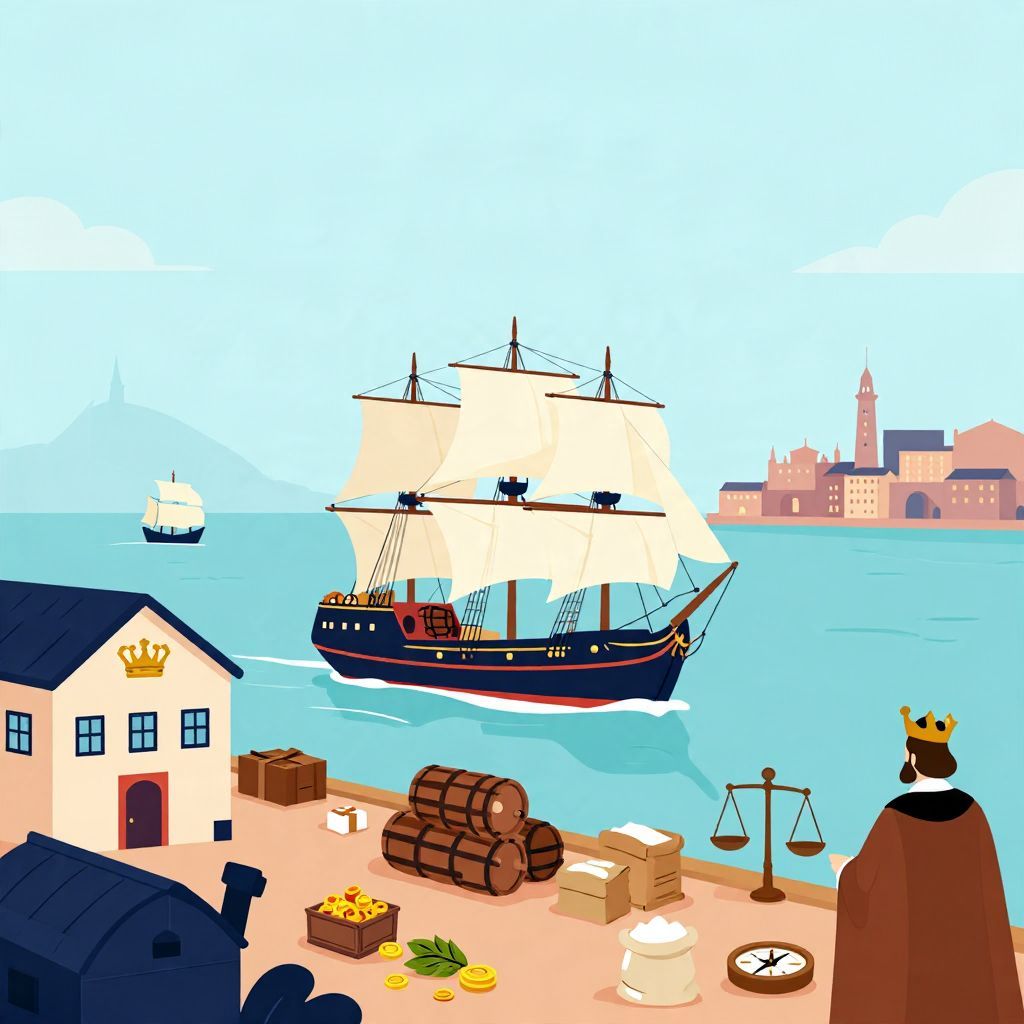
What was mercantilism, and why did it shape so much of early modern world history? In simple terms, mercantilism was a set of economic and political ideas that guided European states from roughly the 16th to the 18th centuries. It held that national power depended on controlling trade, accumulating wealth, and keeping a favorable balance with rivals.
It was not a single unified theory, but a broad practice of state-directed economics. Kings, ministers, and merchants used tariffs, monopolies, colonies, and naval power to strengthen their countries and weaken competitors.
What Was Mercantilism?
Mercantilism was an early modern system of economic thought and policy that treated wealth as finite and national power as tied to state control of trade. Governments tried to export more than they imported, gather precious metals, and regulate commerce so the state would grow richer and stronger than its rivals.
Historians usually place mercantilism in the period from the 1500s through the late 1700s, though its exact start and end are debated. It was never a single doctrine with one founder. Instead, it was a cluster of policies shared by many European states, especially England, France, Spain, and the Dutch Republic in different forms.
The Origins of Mercantilism
Mercantilism emerged as European states expanded overseas, built standing armies and navies, and competed for colonies, routes, and markets. The growth of long-distance trade after the Age of Exploration made rulers think more carefully about bullion, customs revenue, shipping, and colonial supply lines.
From medieval trade to state power
Earlier medieval economies were more local and less centrally managed. By the 16th century, however, monarchies were becoming stronger, and rulers needed money for war, administration, and diplomacy. Trade was no longer just a private matter; it became a strategic tool of statecraft.
Several developments encouraged mercantilist thinking:
- Overseas expansion opened access to American silver, Asian goods, and Atlantic trade.
- Religious and dynastic wars increased the need for revenue.
- Growing navies made shipping and port control matters of national security.
- Colonial competition pushed states to regulate who could trade with whom.
Influences and early writers
The word “mercantilism” itself was coined later by historians, not by early modern officials. People at the time did not necessarily call their policies mercantilist. They spoke instead of trade balance, bullion, customs, navigation, colonies, and manufacturing.
Some writers associated with mercantilist ideas include Thomas Mun in England and Jean-Baptiste Colbert, the French minister under Louis XIV, whose policies became famous as Colbertism. Their works and policies reflected a common belief: a state should intervene to protect domestic production and secure wealth from abroad.
How Mercantilism Worked in Practice
Mercantilist policy aimed to increase a nation’s wealth by controlling imports, promoting exports, and limiting dependence on foreign rivals. Governments used laws and institutions to direct trade rather than leaving it entirely to market forces.
Common mercantilist policies
- Tariffs on imported goods to make foreign products more expensive.
- Navigation laws requiring trade to be carried on national ships.
- Colonial monopolies that reserved trade with colonies for the mother country.
- Subsidies and bounties for industries seen as strategically important.
- Restrictions on exports of raw materials so domestic manufacturers could use them.
- Regulation of guilds and production to maintain quality and output.
These policies were meant to create a favorable balance of trade: more goods sold abroad than bought from abroad. The resulting inflow of silver and gold was thought to strengthen the state. Precious metals mattered not only as money, but also as a symbol of power and a practical means of financing war.
Mercantilism and colonies
Colonies played a central role in mercantilist systems. European empires often treated colonies as sources of raw materials and captive markets for finished goods. Colonial trade was frequently restricted so that wealth would flow back to the imperial center rather than to rival powers.
This logic shaped the Atlantic world. Sugar, tobacco, cotton, timber, and enslaved labor were all tied to imperial trade networks. Mercantilism therefore cannot be separated from empire, coercion, and the exploitation of colonial labor. It was an economic system, but also a political one.
Mercantilism in Different Countries
Mercantilism was not identical everywhere. Different states adapted it to their own geography, institutions, and rivalries. Still, the basic aim was similar: strengthen the state through controlled trade and accumulation of wealth.
England and the Navigation Acts
In England, mercantilist policy became especially visible in the Navigation Acts beginning in the mid-17th century. These laws aimed to channel trade through English ships and English merchants, reducing Dutch dominance and supporting England’s maritime power.
England also used colonial policy to secure raw materials and markets. Over time, this helped create the commercial and naval base that supported British imperial expansion in the 18th century.
France and Colbertism
In France, Jean-Baptiste Colbert, finance minister under Louis XIV, promoted manufacturing, infrastructure, and state supervision of trade. He supported industries such as textiles, imposed quality standards, and sought to reduce imports of luxury goods. French mercantilism is often associated with a strong centralized state and careful regulation.
Yet France’s mercantilist efforts were limited by war, regional differences, and fiscal strain. Like other states, it could not fully control the economy, and smuggling and local resistance often undermined official policy.
Spain, the Dutch Republic, and others
Spain received vast quantities of American silver, but bullion alone did not guarantee lasting economic strength. Heavy military commitments, inflation, and dependence on imported manufactured goods complicated Spanish policy. The Dutch Republic, by contrast, became a major commercial power through shipping, finance, and trade networks, sometimes operating in ways that challenged simpler mercantilist models.
These differences matter because mercantilism was not a rigid formula. It was a broad set of state responses to competition in an age of empire and war.
What Did Mercantilists Believe About Wealth?
Mercantilists generally believed that wealth was limited and that one nation’s gain could be another’s loss. This zero-sum view made trade a matter of rivalry. A strong state should therefore protect its own merchants and industries while limiting foreign advantage.
The balance of trade
One of the most important mercantilist ideas was the balance of trade. If a country exported more than it imported, it would receive payment from abroad, ideally in silver or gold. If it imported more than it exported, wealth would leave the country.
Modern economists often see this as too simplistic. Goods, credit, investment, and services all matter in ways mercantilists did not fully capture. But in the early modern world, when coin and bullion were central to state finance, the idea had practical appeal.
Wealth, power, and war
Mercantilism linked economic policy to military power. A richer state could build ships, pay soldiers, and fund diplomacy. Trade policy was therefore not just about profit; it was about survival in a competitive international system.
This is why mercantilism flourished alongside absolutist monarchy, imperial rivalry, and naval warfare. Economic regulation and state power reinforced one another.
Criticism and Decline
Mercantilism did not disappear overnight. It gradually lost influence in the late 18th and early 19th centuries as new economic ideas emerged, especially from thinkers such as Adam Smith, whose The Wealth of Nations was published in 1776. Smith argued that wealth came from productive labor and free exchange, not simply from hoarding bullion or controlling trade.
Why mercantilism declined
- Classical economics challenged the idea that trade was always a zero-sum struggle.
- Industrialization shifted attention from bullion to production, labor, and capital.
- Growing criticism of monopolies made state favoritism look inefficient.
- Political change in the age of revolutions encouraged freer markets in some places.
That said, mercantilist habits did not vanish completely. Tariffs, colonial preferences, and state support for strategic industries continued in many forms. The older system faded, but the idea that governments should shape trade for national advantage remained influential.
Why Mercantilism Matters in History
Mercantilism matters because it helps explain how early modern states built power. It connects commerce, empire, war, and political centralization. It also shows that economic ideas are historical: they arise from specific conditions and serve particular needs.
Mercantilism helped finance empires, encourage shipbuilding, expand ports, and integrate distant regions into global trade networks. At the same time, it contributed to exploitation, colonial dependency, and conflict. It was both a system of growth and a system of control.
For students of history, mercantilism is important not because it was perfectly coherent, but because it reveals how rulers in the 16th, 17th, and 18th centuries imagined national strength. They saw trade as a weapon, colonies as assets, and wealth as something the state had to manage.
Quick Summary: What Was Mercantilism?
Mercantilism was the early modern belief that a nation’s power depended on controlling trade and accumulating wealth through state intervention. It favored exports over imports, protected domestic industries, and used colonies to enrich the mother country. Most influential from the 1500s to the late 1700s, it shaped the rise of European empires and the development of modern states.
If you want to explore the topic further, see what mercantilism is in more detail and how it fits into the broader story of empire in the largest empires in history.