
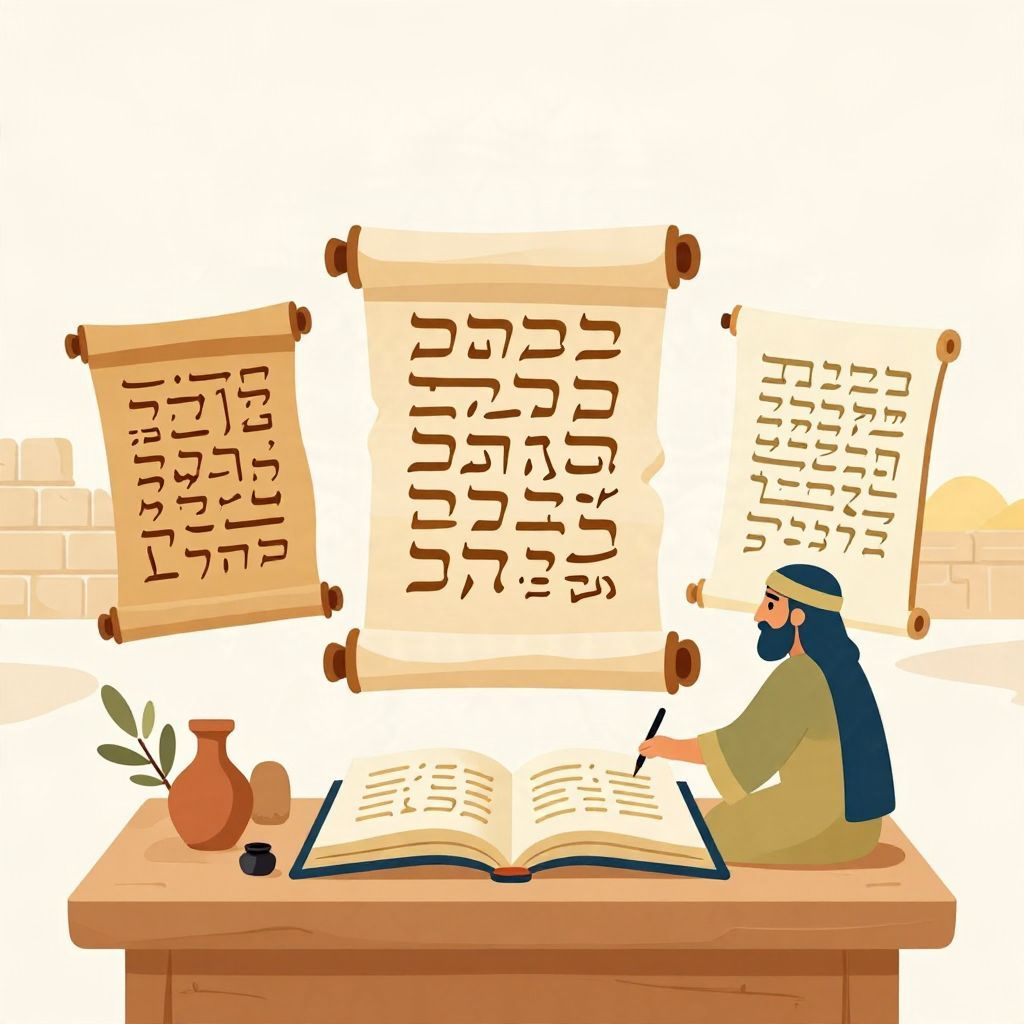
What was the original language of the Bible? The short answer is that there was not just one. The Bible was written over many centuries by different authors, so its earliest texts appeared mainly in Hebrew, with some parts in Aramaic and the New Testament written in Greek.
That mix reflects the long history of ancient Israel, the Babylonian exile, the Hellenistic world, and the spread of early Christianity. To understand the Bible’s original language, it helps to look at when each section was written and why different languages were used.
What was the original language of the Bible?
The Bible was originally written in three main languages: Hebrew for most of the Old Testament, Aramaic for a few passages, and Koine Greek for the New Testament. There is no single “original language” for the whole Bible because it is a library of books composed across different periods and communities.
Why the Bible was not written in just one language
The Bible developed over a long span of time, roughly from the first millennium BCE into the first century CE. As political powers changed in the ancient Near East, so did everyday languages. The result was a multilingual text shaped by the historical world of Israel, Judah, exile, empire, and the early Christian movement.
Hebrew: the main language of the Old Testament
Most of the Hebrew Bible, often called the Old Testament by Christians, was written in Biblical Hebrew. This was the language of ancient Israel and Judah, especially in texts associated with law, poetry, prophecy, history, and worship. Hebrew remained central to Jewish identity even as other languages became more common in daily life.
Many of the best-known books were composed or edited in Hebrew, including Genesis, Exodus, Samuel, Kings, Psalms, Proverbs, Isaiah, Jeremiah, and many others. Scholars debate the exact dates of composition for individual books, but much of the material reflects settings from the monarchic period, the exile in Babylon, and the Persian period that followed.
Aramaic: the language of a few biblical sections
Aramaic appears in several parts of the Bible because it became a major language of the Near East after the rise of the Assyrian and Babylonian empires. By the sixth century BCE and later, Aramaic was widely used in administration, trade, and daily communication across a broad region.
In the Bible, Aramaic appears in small but important sections, including parts of Daniel and Ezra, as well as a few words and phrases elsewhere. These passages show the historical transition from a Hebrew-speaking literary tradition to a world where Aramaic was increasingly influential.
Greek: the language of the New Testament
The New Testament was written in Koine Greek, the common Greek used across the eastern Mediterranean after the conquests of Alexander the Great in the late fourth century BCE. By the first century CE, Greek was the main shared language of commerce, urban life, and much intellectual exchange in the Roman Empire’s eastern provinces.
The authors of the New Testament wrote in Greek because it allowed their message to reach a wide audience. Books such as the Gospels, Acts, the letters of Paul, and Revelation were composed in this common language, even though Jesus and many of his earliest followers likely spoke Aramaic in everyday life.
How Hebrew became the Bible’s foundational language
Hebrew was not only a language of communication; it became a marker of religious and cultural identity. The Hebrew texts preserved the traditions of Israel’s ancestors, covenant ideas, legal customs, and national memory. Over time, these writings were copied, edited, and collected into a sacred corpus.
Ancient Israel and Judah
Hebrew emerged as the principal literary language of the Israelite kingdoms. Inscriptions from the ancient Levant help confirm that Hebrew was used in writing well before the destruction of Jerusalem in 586 BCE. The surviving biblical texts, however, were shaped by generations of scribes, so the final form of many books likely reflects later editing as well as older traditions.
Exile and preservation
The Babylonian exile was a turning point. When many Judeans were displaced from their homeland, preserving sacred traditions became even more important. Some writings were likely compiled or revised during this period, helping to stabilize the Hebrew textual tradition. After the exile, Hebrew remained a literary and religious language even as Aramaic spread more widely.
Why Aramaic appears in the Bible
Aramaic entered the biblical world because empire changed language use. The Assyrian and Babylonian empires made Aramaic a practical administrative language, and later Persian rule reinforced its importance. For Jews living under these empires, Aramaic was often part of ordinary public life.
Where Aramaic appears
- Daniel 2:4b–7:28 is written largely in Aramaic.
- Ezra 4:8–6:18 and Ezra 7:12–26 contain Aramaic sections.
- Short Aramaic phrases appear elsewhere, such as in place names or expressions preserved in translation.
These passages are historically significant because they show that the Bible was not created in isolation. It reflects a multilingual environment in which Hebrew remained sacred and literary, while Aramaic served broader practical and political needs.
Why the New Testament was written in Greek
Greek was the language of the New Testament because it was the most effective written medium for reaching the eastern Roman world. After Alexander’s conquests, Greek became widespread far beyond Greece itself, and by the first century CE it functioned as a common language across cities, trade routes, and Jewish diaspora communities.
Koine Greek and the early church
The New Testament authors wrote in Koine Greek, a simpler and more widely used form of Greek than classical literary Greek. This choice made the texts accessible to communities in Judea, Syria, Asia Minor, Greece, and beyond. Paul’s letters, for example, were addressed to mixed audiences in cities where Greek was the normal language of communication.
Jesus and Aramaic
Although the New Testament is Greek, Jesus of Nazareth almost certainly taught primarily in Aramaic, the everyday language of many Jews in Galilee and Judea. That does not mean the Gospels were first written in Aramaic; rather, it means the sayings and stories about Jesus were transmitted orally in a Semitic-speaking environment before being written down in Greek.
Some Aramaic words were preserved in the New Testament, such as Talitha koum and Eloi, Eloi, lema sabachthani, which suggests that early Christians sometimes retained original expressions even while composing in Greek.
What language were the earliest biblical manuscripts copied in?
The original languages of the Bible were Hebrew, Aramaic, and Greek, but the surviving manuscripts we possess are copies, not the first autographs. Ancient scribes copied biblical books by hand for centuries, and the texts circulated in multiple forms before later standardization.
Textual transmission
For the Hebrew Bible, the most important manuscript tradition is the Masoretic Text, preserved by Jewish scribes in the medieval period but rooted in much earlier copying practices. The discovery of the Dead Sea Scrolls in the twentieth century showed that some biblical books existed in multiple textual forms in antiquity, confirming that the transmission process was complex.
For the New Testament, the earliest surviving manuscripts are in Greek, with later translations into Latin, Syriac, Coptic, and other languages. These versions helped spread Christianity, but they do not change the basic historical fact that the New Testament itself was first composed in Greek.
Did the Bible have a “lost original language”?
Popular discussion sometimes imagines that the Bible must have had a single hidden original language, but the historical evidence does not support that idea. Instead, the Bible reflects the multilingual realities of ancient Judaism and early Christianity. Hebrew, Aramaic, and Greek each played a role at different stages of its formation.
Some traditions and later legends have suggested that parts of the Bible were first written in another language and then translated. While translation certainly played a role in the Bible’s later history, scholars generally agree that the canonical books were composed in the languages preserved in the surviving textual tradition: Hebrew, Aramaic, and Greek.
Why this matters for reading the Bible historically
Knowing the Bible’s original languages helps readers understand meaning, context, and interpretation. Many words and phrases do not map neatly from one language to another, especially when ideas are shaped by ancient culture, law, poetry, and theology. Translation is always an act of interpretation, not a mechanical substitution of words.
Examples of meaning shaped by language
- Hebrew poetry often relies on parallelism and wordplay that can be difficult to reproduce in translation.
- Aramaic sections reflect the imperial and diaspora setting of later biblical books.
- Greek New Testament terms such as logos, ekklesia, and charis carry layers of meaning shaped by both Jewish and Greco-Roman contexts.
For historians, the Bible is therefore not just a religious text but also a record of language change, cultural contact, and the long survival of sacred writing. Its multilingual character is part of its history, not a complication added later.
The bottom line
The original language of the Bible was not one language but three: Hebrew, Aramaic, and Greek. Hebrew dominates the Old Testament, Aramaic appears in a few key passages, and Greek is the language of the New Testament. That linguistic mix reflects the Bible’s long and layered history across ancient Israel, the exile, and the early Roman world. For a closer look, see also what language the Bible was originally written in and what language the New Testament was written in.