
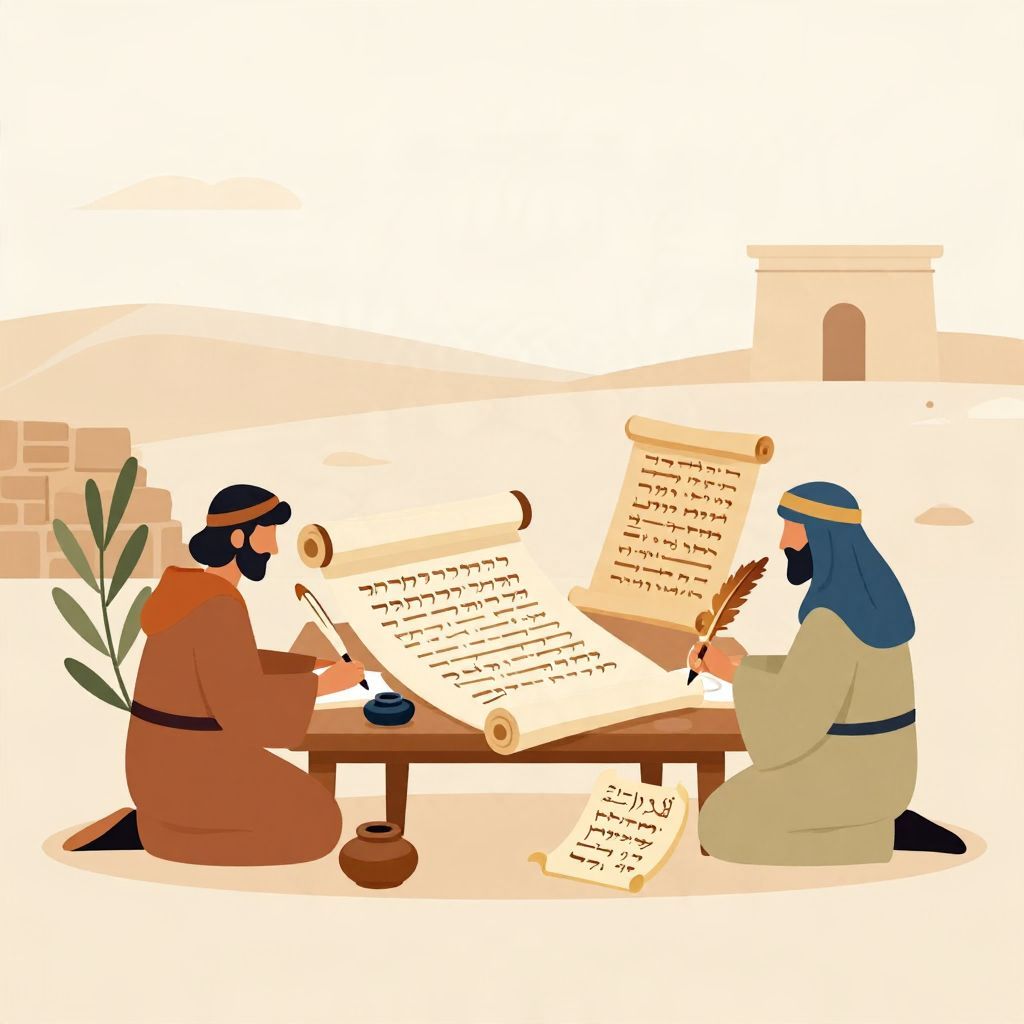
What language was the Bible originally written in? The short answer is that the Bible was not written in just one language. Its books were composed over many centuries, mainly in Hebrew, with some sections in Aramaic, and the New Testament written in Koine Greek.
That multilingual origin reflects the long history of the Bible itself. It was shaped across different communities, empires, and eras in the ancient Near East and the eastern Mediterranean, so its languages changed as its authors, audiences, and historical settings changed.
What language was the Bible originally written in?
The Bible was originally written in three main languages: Hebrew for most of the Old Testament, Aramaic for a smaller number of biblical passages, and Koine Greek for the New Testament. No single “original language” covers the whole Bible, because it is a library of texts written over roughly a thousand years.
The Bible’s original languages by section
Hebrew: the main language of the Old Testament
Most of the books in the Hebrew Bible, which Christians often call the Old Testament, were written in Biblical Hebrew. This was the language of ancient Israel and Judah, especially in the first millennium BCE. Hebrew appears in law codes, poetry, prophecy, narrative, and wisdom literature.
Books commonly associated with Hebrew include Genesis, Exodus, Samuel, Kings, Psalms, Proverbs, Isaiah, Jeremiah, and many others. The language is not exactly the same as modern Hebrew, but it is its ancestor and remains central to Jewish liturgy and study.
Aramaic: the language of empire and daily life
Some parts of the Bible were written in Aramaic, a closely related Northwest Semitic language that became widely used across the Near East. Aramaic grew in importance during the Assyrian, Babylonian, and Persian periods, when it served as a common language of administration and communication.
In the Bible, Aramaic appears in sections of Daniel and Ezra, along with a short phrase in Jeremiah. Aramaic was important because it reflects the historical world in which many Jews lived under foreign empires and increasingly spoke languages beyond Hebrew in everyday life.
Greek: the language of the New Testament
The New Testament was written in Koine Greek, the common Greek used throughout the eastern Mediterranean after the conquests of Alexander the Great in the late fourth century BCE. Koine Greek was the shared language of trade, administration, and communication across a broad region.
This choice made the Christian message accessible to a wide audience in the Roman Empire. The New Testament’s Greek is not the polished literary Greek of elite philosophy or rhetoric; it is a practical, widely understood form of the language suited to letters, preaching, and community instruction.
When were the biblical books written?
The Bible developed over a long period rather than being written at one moment. Scholars generally place the composition of its books between about the 12th century BCE and the 2nd century CE, though exact dates for many texts remain debated. The oldest traditions may go back earlier than the surviving written forms.
- Early Israelite traditions: oral material likely circulated before being written down.
- Monarchic period (roughly 10th–6th centuries BCE): many Hebrew texts took shape.
- Exilic and post-exilic periods (6th–5th centuries BCE): editing and compilation intensified.
- Second Temple period (5th century BCE–1st century CE): further development of Jewish texts and traditions.
- New Testament era (mid-1st century CE onward): Christian writings were produced in Greek.
Why the timeline matters
The Bible’s languages changed because history changed. As kingdoms fell, empires rose, and communities were displaced, scribes and teachers adapted to new linguistic realities. The Babylonian Exile in the 6th century BCE, for example, helped make Aramaic more prominent among Jews, while Greek became dominant in the Hellenistic world after Alexander’s conquests.
Why the Bible was not written in one language
The Bible’s multilingual character is a historical result of long composition, not a sign of confusion. Different books emerged in different places and periods, and the people who wrote, edited, and copied them lived in changing political and cultural environments. Language followed those changes.
Ancient Israel and Judah
In the earliest phases of biblical history, Hebrew was the main literary language for Israelite communities. It was used for identity, worship, law, and storytelling. As a result, many foundational texts about creation, covenant, kingship, exile, and return were preserved in Hebrew.
Imperial rule and language shift
When the Assyrian, Babylonian, and Persian empires controlled the region, Aramaic became increasingly important. It was the practical language of diplomacy and administration across a vast imperial network. Some biblical passages in Aramaic likely reflect that broader linguistic environment.
The Hellenistic and Roman worlds
By the time Christianity emerged, Greek had become the major language of educated and urban life in the eastern Mediterranean. Early Christians wrote in Greek because they were addressing communities spread across cities and provinces where Greek could be widely understood. That is why the New Testament, though rooted in Jewish tradition, is linguistically Greek.
How scholars know the Bible’s original languages
Scholars identify the Bible’s original languages through manuscript evidence, linguistic analysis, and comparison with related ancient texts. The surviving manuscripts are copies, not usually the first autographs, but they preserve the languages in which the books were transmitted. Grammar, vocabulary, style, and historical context all help establish the original language of each section.
Manuscripts and textual evidence
Ancient manuscripts such as the Dead Sea Scrolls, later Hebrew manuscripts, Greek New Testament papyri, and Aramaic passages in biblical books provide direct evidence of the Bible’s languages. These sources show that the biblical text existed in more than one language long before the invention of printing.
Related ancient languages
Hebrew and Aramaic are both part of the Semitic language family, which also includes Phoenician, Ugaritic, and Arabic. Greek belongs to a different language family entirely. Recognizing these differences helps historians and linguists understand how the Bible was composed, transmitted, and interpreted in antiquity.
The historical significance of the Bible’s original languages
The Bible’s original languages matter because they shaped meaning. Translation can preserve a text’s message, but it can also shift nuance, rhythm, and wordplay. Many biblical passages rely on the sounds and structures of Hebrew, Aramaic, or Greek, which can be difficult to reproduce fully in another language.
Meaning and interpretation
Some theological debates and interpretive traditions arise from the challenge of translating ancient languages. A word in Hebrew may carry a range of meanings that do not map neatly onto one modern term. Greek philosophical and legal vocabulary also influenced how early Christians expressed ideas about faith, law, and community.
Jewish and Christian textual traditions
For Judaism, Hebrew remained the sacred language of scripture even as Aramaic became widely spoken. For Christianity, Greek became the language of the earliest canonical writings, but later translations into Latin, Syriac, Coptic, and many other languages helped spread the faith across different regions. The Bible’s multilingual history therefore became part of its global influence.
Common misconceptions about the Bible’s original language
“The Bible was originally written in Latin”
This is a common misconception. Latin became important later, especially through the Roman church and the Latin Vulgate translation, but it was not the original language of the biblical books. The earliest biblical writings predate the Vulgate by many centuries.
“Jesus spoke the same language as the New Testament”
Jesus most likely spoke Aramaic in everyday life, while also likely having some knowledge of Hebrew and possibly Greek in certain contexts. The New Testament, however, was written in Greek by later authors, not in the everyday spoken language of Jesus himself.
“There is one Bible language”
There is no single biblical language. The Bible is better understood as a collection of texts produced across multiple centuries and settings. Its multilingual nature is one of the clearest signs of its long and complex historical development.
Why the Bible’s language history still matters today
Understanding the Bible’s original languages helps readers see it as a historical document as well as a religious one. Hebrew, Aramaic, and Greek open a window into the ancient societies that produced these texts, from Israelite kingdoms to Persian provinces to Greek-speaking Christian communities. Language reveals history.
So, what language was the Bible originally written in? The most accurate answer is: Hebrew, Aramaic, and Greek, depending on the book and period. That multilingual origin is not a complication to be explained away; it is part of the Bible’s historical identity. For related background, you may also want to read about what a eunuch was in the Bible and whether the Bible mentions dinosaurs.