
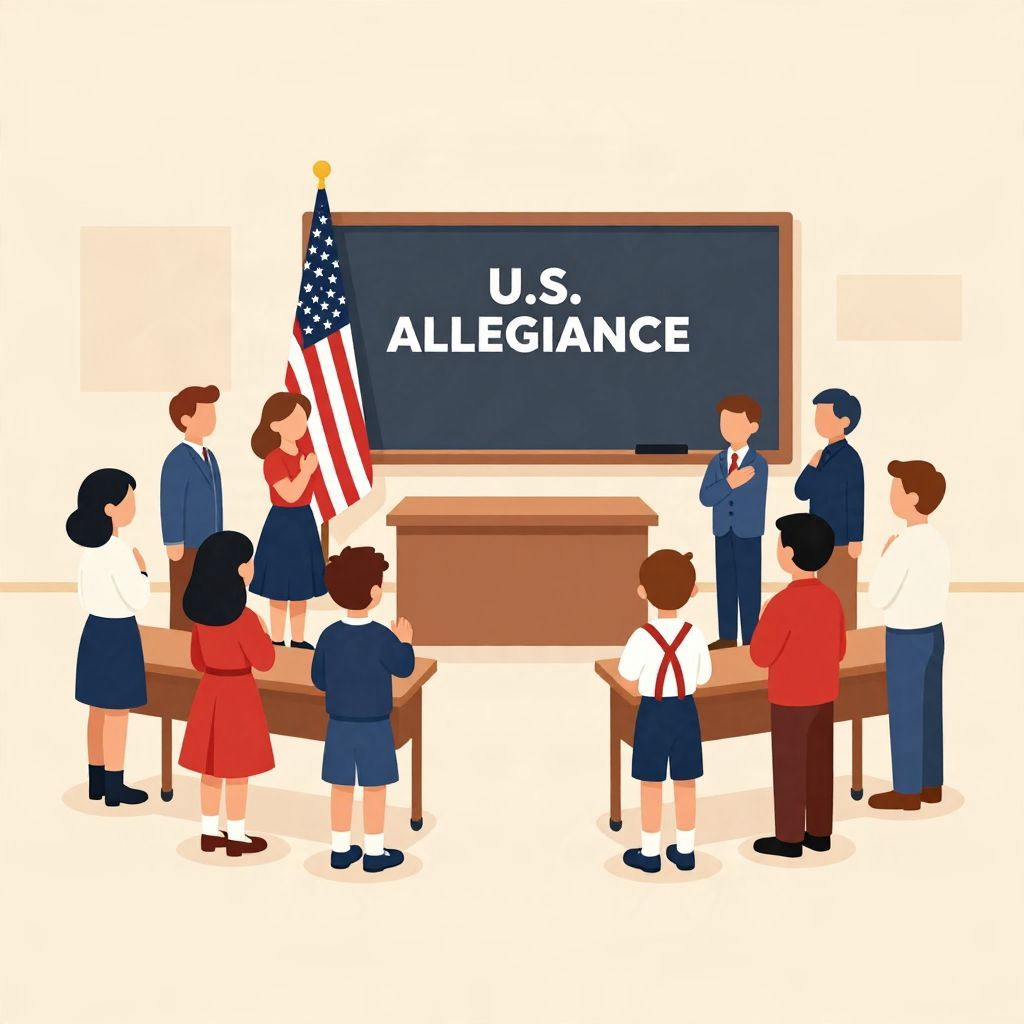
The Pledge of Allegiance is a short American oath of loyalty to the United States and its flag. It is recited in schools, public ceremonies, and civic events, and it reflects ideas about national unity, citizenship, and patriotism.
Its history is more complicated than many people realize. The words changed over time, the gesture associated with it changed too, and debates over religion, freedom of speech, and patriotism have shaped its meaning for more than a century.
What Is The Pledge Of Allegiance?
The Pledge of Allegiance is a formal statement of loyalty to the United States. In its modern form, it asks speakers to pledge allegiance “to the Flag of the United States of America, and to the Republic for which it stands,” while affirming “liberty and justice for all.” It is both a civic ritual and a symbol of American national identity.
Where Did the Pledge of Allegiance Come From?
The Pledge was first written in 1892 by Francis Bellamy, a Baptist minister and magazine writer, as part of a national school celebration of the 400th anniversary of Columbus’s voyage. Bellamy worked for The Youth’s Companion, a popular magazine that promoted flag education in schools. His original version was meant to encourage unity in a rapidly changing industrial nation.
The original 1892 wording
Bellamy’s first version was shorter and different from the one used today. It read: “I pledge allegiance to my Flag and the Republic for which it stands, one nation indivisible, with liberty and justice for all.” The phrase “my Flag” was later changed, and the wording evolved in the 20th century as concerns grew about clarity, nationalism, and immigration.
Why schools adopted it
In the late 19th century, public schools were seen as a major force for teaching common civic values. The Pledge fit that goal. It was intended to create a shared ritual that children from different backgrounds could repeat together, reinforcing loyalty to the nation rather than to a region, ethnicity, or political faction.
How Did the Pledge Change Over Time?
The Pledge did not remain fixed. Its wording, accompanying salute, and even the meaning of the gesture changed as American politics and public culture changed. The most important addition came in 1954, when the words “under God” were inserted during the Cold War era.
1892: The first version
- Written by Francis Bellamy in 1892
- Used the phrase “my Flag”
- Included “one nation indivisible”
1923–1924: Standardizing the wording
At national flag conferences in the 1920s, organizers decided to replace “my Flag” with “the Flag of the United States of America.” This change was meant to avoid confusion among immigrants and to make the pledge explicitly national rather than personal or local. In 1924, the wording was finalized in the form that became widely recognized.
1942: Official recognition in law
During World War II, Congress formally recognized the Pledge in the U.S. Flag Code. This did not make it mandatory, but it gave the ritual an official place in American civic life. The wartime context mattered: national symbols carried special weight when the country was mobilized for global conflict.
1954: The addition of “under God”
In 1954, Congress added the words “under God” after “one nation.” This change was strongly influenced by Cold War politics and by the desire of many lawmakers to contrast the United States with atheistic communism. Supporters saw the addition as a statement of religious heritage; critics argued that it blurred the line between church and state.
What Does the Pledge Mean?
The Pledge is not just a patriotic recitation. It expresses several ideas at once: loyalty to the nation, respect for the Constitution and republican government, and a commitment to freedom and justice. The phrase “the Republic for which it stands” is especially important because it points to government by elected representatives, not monarchy or dictatorship.
“Allegiance” in historical context
The word “allegiance” comes from older traditions of loyalty owed to a ruler or sovereign. In the American context, that idea was redirected after the Revolution. Citizens were not pledging loyalty to a king, but to a constitutional republic and the principles it represented. That shift is central to the Pledge’s meaning.
“One nation indivisible”
The phrase “one nation indivisible” reflected the trauma of the Civil War and the continuing effort to hold the country together. In the late 19th century, national unity was still a serious concern. The wording emphasized that the United States should not be split into rival sections or loyalties.
“With liberty and justice for all”
This closing phrase expresses an ideal rather than a completed reality. Historically, many Americans were denied liberty and justice because of slavery, segregation, discrimination, or unequal political rights. The phrase therefore has often functioned as both a declaration of national values and a reminder of unfinished democratic work.
Why Is the Pledge of Allegiance Controversial?
Although the Pledge is widely used, it has also been controversial for more than a century. Debates have focused on compulsory recitation, religious language, and whether the ritual promotes genuine civic unity or pressures people to conform. These disputes reveal the tension between patriotism and individual liberty in American history.
Freedom of speech and compulsory recitation
One of the most important legal questions has been whether schools or governments can require people to say the Pledge. The U.S. Supreme Court ruled in West Virginia State Board of Education v. Barnette (1943) that public schools could not force students to salute the flag or recite the Pledge. This decision became a landmark for free speech and religious liberty.
Religious language and constitutional debate
The words “under God” have been challenged by some Americans who believe they violate the separation of church and state. Supporters argue that the phrase is ceremonial and historical rather than a formal religious statement. Courts have generally allowed the phrase to remain, but the issue continues to be debated in public life.
Different views of patriotism
For many Americans, the Pledge is a harmless and meaningful expression of civic belonging. For others, it can feel exclusionary, especially when national ideals do not match lived experience. That disagreement is part of the Pledge’s history: it has always stood at the intersection of national identity, public ritual, and political debate.
How Is the Pledge Used Today?
Today, the Pledge is commonly recited in schools, at government meetings, and at public events, though practices vary by state, institution, and personal belief. It is not universally required, and individuals generally have the right to remain silent. Its use continues to reflect American ideas about citizenship, public memory, and national symbolism.
Common settings
- Public school classrooms
- City council and legislative meetings
- Sports events and civic ceremonies
- Veterans’ and national holiday observances
Why it still matters
The Pledge remains significant because it condenses a large part of American political culture into a few lines. It links the flag to the republic, loyalty to liberty, and national unity to justice. Even people who disagree about its use often recognize it as a powerful symbol of American civic life.
The Historical Significance of the Pledge of Allegiance
The Pledge of Allegiance is more than a schoolroom ritual. It grew out of late 19th-century efforts to build national unity, changed during moments of war and ideological conflict, and became a touchstone in debates over rights and identity. Its history shows how a simple public phrase can carry shifting meanings across generations.
Understanding the Pledge also helps explain broader American history: the rise of mass public schooling, the struggle to define citizenship, the impact of war on national symbols, and the continuing balance between unity and freedom. For related context, see the Constitution’s opening words on self-government and the rights named in the Declaration of Independence.