
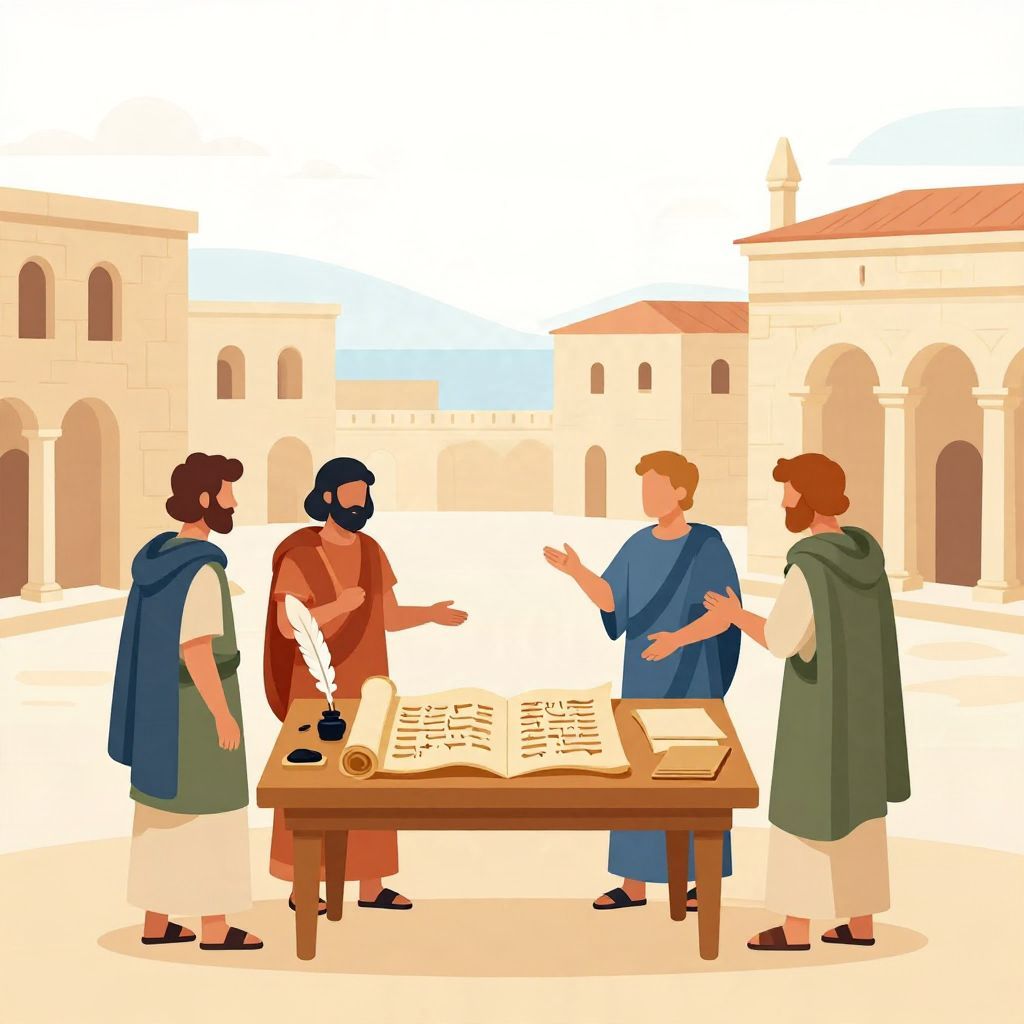
What language was the New Testament written in? The short answer is Koine Greek, the common Greek of the eastern Roman Empire in the first century CE. Most of the New Testament books were composed in Greek because it was the shared language of communication across much of the Mediterranean world.
That answer, however, sits inside a more complex historical setting. The New Testament emerged in a multilingual Jewish and Roman world where Hebrew, Aramaic, and Greek all had important roles. Understanding those languages helps explain how the texts were written, copied, translated, and eventually spread across Christianity.
What language was the New Testament written in?
The New Testament was written primarily in Koine Greek, the everyday Greek used from roughly the Hellenistic period through the early Roman Empire. This was the language of most of its books, including the Gospels, Acts, the letters of Paul, and Revelation. A few phrases preserve Aramaic or Hebrew expressions, but the surviving text is overwhelmingly Greek.
The historical setting: a multilingual Jewish world
To understand why Greek was used, it helps to picture the eastern Mediterranean in the first century CE. Judea and Galilee were part of the Roman Empire, but Greek had already become the region’s major international language after the conquests of Alexander the Great in the late fourth century BCE. By the time of Jesus and the earliest Christians, many people in the region could use more than one language.
Hebrew, Aramaic, and Greek each had a role
- Hebrew was the traditional sacred language of Jewish scripture and worship.
- Aramaic was widely spoken in daily life among Jews in Palestine.
- Greek served as the common language of trade, administration, and communication across the eastern Roman world.
This meant that early Christian writers were not choosing from a single language environment. They were writing for communities shaped by several languages at once, especially in cities such as Antioch, Corinth, Ephesus, and Rome.
Why Greek became the language of the New Testament
Greek was the practical choice for authors who wanted their writings to travel beyond a small local audience. The early Christian movement spread quickly through urban centers where Greek was widely understood. Writing in Greek made the message accessible to Jews of the diaspora and to non-Jews, or Gentiles, who were joining the movement in growing numbers.
Koine Greek was the common language of the age
Koine means “common” or “shared.” It was not the polished literary Greek of classical Athens, but a simpler, more widely used form. That made it ideal for letters, teaching, storytelling, and public reading. The New Testament authors wrote in a language that ordinary readers and listeners in the eastern empire could understand.
Paul’s letters show this clearly
The earliest surviving Christian writings are usually considered to be Paul’s letters, written in the 50s CE. Paul was a Jewish teacher who moved through Greek-speaking cities and addressed mixed communities. His letters make sense as Greek texts because they respond to local problems, debates, and questions in communities already using Greek as their shared written language.
Did Jesus speak Greek?
Scholars generally agree that Jesus’ everyday language was Aramaic, with Hebrew likely used in religious settings and some Greek possibly known in parts of Galilee and nearby urban areas. The New Testament preserves a few Aramaic phrases, such as “Talitha koum” and “Eloi, Eloi, lema sabachthani,” which strongly suggests that the earliest traditions remembered Jesus speaking Aramaic.
Aramaic traces inside Greek texts
These phrases were not left untranslated by accident. They often appear in the Gospels to give the reader a sense of immediacy or authenticity, then are followed by a Greek explanation. That pattern shows the authors were writing for Greek-speaking audiences while preserving memories from an Aramaic-speaking environment.
Which New Testament books were written in Greek?
Virtually all canonical New Testament books are preserved in Greek manuscripts and were composed in Greek as far as the historical evidence shows. There are occasional debates about whether one or two texts may preserve earlier Semitic sources, but the surviving books themselves are Greek compositions.
Main books and their language
- The Gospels — Matthew, Mark, Luke, and John were written in Greek.
- Acts — written in Greek as a continuation of Luke’s Gospel.
- Paul’s letters — written in Greek to churches and individuals in the Roman world.
- General epistles — such as James, Peter, John, and Jude, also in Greek.
- Revelation — written in Greek, though its style reflects Semitic influence.
What about Matthew and Hebrew or Aramaic?
One ancient tradition, associated with early church writers, claimed that Matthew was first written in “Hebrew” or “the Hebrew dialect.” Historians debate what this meant: it may have referred to Hebrew, Aramaic, or a collection of sayings rather than the canonical Greek Gospel of Matthew we have today. The safest conclusion is that the New Testament text known to us is Greek, even if some traditions behind it may have circulated in Semitic languages.
How the New Testament was written and transmitted
The New Testament did not appear as a single book at one moment. It developed over several decades in the first century CE, beginning with letters and then narrative accounts of Jesus’ life, death, and resurrection. These writings were copied by hand and shared among churches, which helped standardize Greek as the textual language of Christian scripture.
A rough timeline
- c. 30s CE — Jesus’ teachings circulate orally in Aramaic and possibly some Greek.
- c. 50s CE — Paul’s letters are written in Greek.
- c. 70 CE — Mark’s Gospel is commonly dated around this period.
- c. 80s–90s CE — Matthew, Luke, Acts, John, and other texts are likely composed.
- Late 1st to early 2nd century CE — the writings circulate more widely and begin to function as a recognized collection.
These dates are approximate and sometimes debated, but they show that the New Testament was formed in a Greek-speaking literary environment over time, not in one single act of composition.
How Greek shaped the meaning of the New Testament
Language did more than carry the message; it also shaped how the message was expressed. Greek allowed early Christian writers to explain Jewish ideas to broader audiences and to develop vocabulary for concepts such as faith, grace, gospel, church, and salvation. Some of these terms had roots in Jewish scripture, but Greek gave them a new literary and theological setting.
Translation and interpretation began early
Because the New Testament was written in Greek, it could be read directly by many communities across the eastern empire. But it also needed interpretation. Readers from Jewish, Greek, and Roman backgrounds brought different assumptions to the text. That is one reason the same passages could be understood in multiple ways from the beginning.
The Septuagint influenced Christian writing
Many early Christians used the Greek translation of Jewish scripture known as the Septuagint. This mattered because New Testament writers often quoted the Old Testament in Greek form. In some cases, their wording follows the Septuagint more closely than the later Hebrew text. So the New Testament belongs to a broader Greek biblical world, not just to a narrowly “Christian” one.
Why this matters for history
The New Testament’s language reveals how Christianity grew from a Jewish movement into a Mediterranean religion. Greek helped the message move across ethnic and geographic boundaries. It also shows that early Christianity was deeply connected to the cultural world of the Roman Empire, even while it developed its own identity.
Historical significance of a Greek New Testament
- It made the texts accessible across a wide region of the Roman East.
- It linked Christian teaching to the intellectual and literary culture of the time.
- It helped standardize scripture for copying, reading, and teaching.
- It influenced later theology, translation, and biblical interpretation.
What about later translations?
Although the New Testament was written in Greek, it was soon translated into other languages as Christianity spread. Latin became especially important in the western Roman Empire, while Syriac, Coptic, Armenian, Georgian, and other translations served Christian communities elsewhere. These versions were crucial for the growth of Christianity, but they came after the original Greek composition.
Greek remained foundational
Even today, scholars study the New Testament in Greek because it is the earliest recoverable form of the text. Later translations are historically valuable, but they reflect interpretation as well as transmission. The Greek originals remain the starting point for understanding how the texts were first written and read.
So, what language was the New Testament written in?
The New Testament was written primarily in Koine Greek, the common language of the first-century eastern Roman world. It includes a few Aramaic phrases and stands in close relationship to Hebrew scripture and Jewish tradition, but its surviving form is Greek. That choice helped the Christian message travel widely and shaped the history of the Bible for centuries.
If you want to explore the wider linguistic background, you may also enjoy reading about what language the Bible was originally written in and the broader Roman context in what language the Romans spoke.