
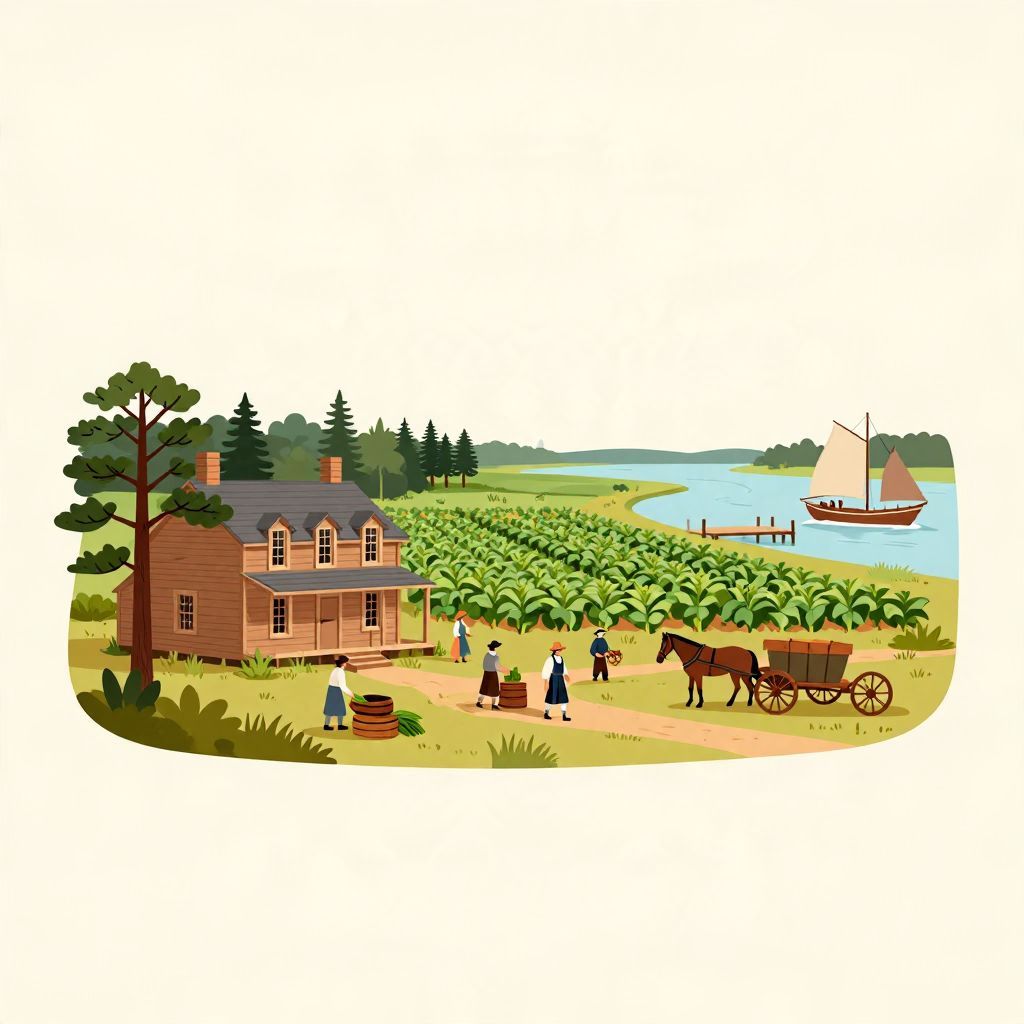
What are the Southern Colonies? In early American history, the term refers to the group of English colonies that developed along the southern Atlantic coast of North America, especially Virginia, Maryland, the Carolinas, and Georgia. They became known for plantation agriculture, enslaved labor, and a social order shaped by land, race, religion, and export crops.
The phrase is most useful for describing the colonial era before the American Revolution, when regional differences among the colonies became increasingly clear. The Southern Colonies were not identical, but they shared enough geography, economy, and political structure to be studied as one region.
What Are the Southern Colonies?
The Southern Colonies were the English settlements in the Chesapeake and southern Atlantic regions of colonial North America: Virginia, Maryland, North Carolina, South Carolina, and Georgia. They were founded between 1607 and 1733 and became heavily dependent on plantation farming, especially tobacco, rice, indigo, and later other cash crops.
Which colonies were considered the Southern Colonies?
Historians usually include Virginia, Maryland, North Carolina, South Carolina, and Georgia. Some school materials group them into three colonial regions—New England, Middle, and Southern—because these colonies shared a warm climate, long growing season, and economy centered on agriculture rather than trade or manufacturing.
Why these colonies fit together
They were linked by more than geography. Their economies relied on export agriculture, their populations were spread out across rural plantations and farms, and political power often rested with wealthy landowners. At the same time, each colony had its own founding story and local culture, so “Southern Colonies” is a regional label, not a single unified government.
How and why were the Southern Colonies founded?
The Southern Colonies emerged from English expansion in the 17th and early 18th centuries. Some were founded for profit, some for religious or political reasons, and some as strategic buffer zones. Over time, economic opportunity—especially access to land and cash crops—became the strongest attraction for many settlers.
Virginia: the first permanent English colony
Virginia began with Jamestown in 1607, the first permanent English settlement in North America. The colony survived after years of hardship and eventually found stability through tobacco cultivation. Tobacco transformed Virginia’s economy and encouraged the growth of large plantations, indentured servitude, and later slavery.
Maryland: a proprietary colony with a religious purpose
Maryland was founded in 1634 under the Calvert family as a proprietary colony. It was intended in part as a refuge for English Catholics, though it remained home to Protestants as well. Like Virginia, Maryland developed a tobacco economy and a plantation society, especially along the Chesapeake Bay.
The Carolinas: land, labor, and plantation expansion
The Carolina colony was granted in 1663, though settlement developed unevenly. South Carolina became a major plantation colony with Charleston as its commercial center, while North Carolina developed more slowly and had more small farms. Rice and indigo became especially important in South Carolina, and enslaved African labor was central to that economy.
Georgia: the newest colony
Georgia was founded in 1733 as the last of the British mainland colonies. It was originally intended as a buffer against Spanish Florida and as a place for debtors and the poor to start over. In practice, Georgia eventually joined the plantation economy of the region, especially after restrictions on slavery were relaxed.
What made the Southern Colonies different from other colonies?
The Southern Colonies differed from New England and the Middle Colonies in climate, settlement patterns, religion, and economy. Warm weather and fertile land encouraged large-scale farming. Because plantations required extensive labor, the region developed a more hierarchical society and became the center of slavery in British mainland North America.
Climate and geography
The South’s longer growing season made it ideal for cash crops. Coastal plains, river systems, and navigable bays made it easier to transport goods to Atlantic markets. This geography encouraged plantation agriculture more than dense towns or diversified industry.
Economy based on cash crops
The region’s economy depended on crops grown for sale rather than local consumption. Tobacco dominated Virginia and Maryland. Rice became crucial in South Carolina and Georgia, while indigo also brought profit from dye production. These crops connected the colonies to Atlantic trade networks and to European demand.
Labor systems
Early Southern colonies used a mix of indentured servitude, enslaved African labor, and family farming. Over time, slavery became the dominant labor system, especially in the plantation colonies. This shift had enormous consequences: it created wealth for planters, deepened racial inequality, and shaped Southern society for generations.
What was life like in the Southern Colonies?
Life in the Southern Colonies varied sharply by class and status. Wealthy planters lived on large estates and controlled local politics. Small farmers worked their own land with fewer resources. Enslaved Africans and African Americans did the most difficult labor and endured violence, family separation, and legal oppression.
Plantation society
Plantations were not simply large farms; they were economic and social systems. A planter family might own hundreds or thousands of acres, along with mills, docks, and many enslaved workers. The plantation household often functioned as the center of local authority, especially in areas where towns were few and far between.
Town life and ports
Although the South was mostly rural, port towns such as Charleston and Norfolk played important roles in trade and government. These towns linked colonial producers to merchants, ship captains, and markets in Britain and the Caribbean. They were also places where ideas, news, and political tensions circulated.
Religion and culture
Unlike New England, the Southern Colonies were not dominated by one religious tradition. The Church of England had influence in several colonies, but many settlers were Anglican, Baptist, Presbyterian, Quaker, Catholic, or belonged to other groups. Religious diversity increased over time, especially in the backcountry.
How did slavery shape the Southern Colonies?
Slavery was one of the defining features of the Southern Colonies. Enslaved Africans were brought in increasing numbers during the 17th and 18th centuries, especially as plantation agriculture expanded. By the mid-18th century, slavery was deeply embedded in law, labor, and social hierarchy across much of the region.
The rise of racial slavery
In the early colonial period, labor systems were still fluid. Some Africans arrived as servants or in ambiguous legal conditions. Over time, colonial laws hardened racial distinctions and made slavery hereditary. This meant that children born to enslaved women were also enslaved, creating a self-reproducing system of bondage.
Resistance and survival
Enslaved people resisted slavery in many ways: through running away, slowing work, preserving family and cultural traditions, and sometimes open revolt. Their labor made plantation wealth possible, but their resistance also shaped colonial law and fear. The history of the Southern Colonies cannot be understood without recognizing enslaved people as central historical actors.
What role did the Southern Colonies play in British America?
The Southern Colonies were economically vital to the British Empire. Their export crops fed Atlantic commerce, generated customs revenue, and tied colonial prosperity to European markets. They also became politically important because plantation elites gained influence in colonial assemblies and local government.
Trade across the Atlantic
Southern crops moved through a larger Atlantic world that connected Britain, Africa, the Caribbean, and mainland North America. Manufactured goods came into the colonies, while tobacco, rice, and other commodities went out. This trade enriched merchants and planters, but it also tied the region to imperial policies and conflicts.
Relations with Native peoples
Expansion into Native lands was a constant feature of Southern colonial history. Colonists pushed westward and inland, often through warfare, trade pressure, disease, and broken agreements. Native nations such as the Powhatan, Cherokee, Yamasee, and Creek shaped the region’s history as much as European settlers did.
How did the Southern Colonies change over time?
From the early 1600s to the eve of the American Revolution, the Southern Colonies changed from fragile settlements into a powerful plantation region. Their growth was driven by immigration, forced labor, land expansion, and the rising value of export crops. At the same time, inequality and conflict deepened.
Important developments in sequence
- 1607: Jamestown is founded in Virginia.
- 1634: Maryland is established.
- 1663: Carolina is chartered by the English crown.
- 1670: Charles Town is founded in South Carolina.
- 1733: Georgia is founded.
- Mid-1700s: plantation slavery expands across much of the region.
- 1770s: the colonies join the movement toward independence.
Political development
Colonial assemblies gave many white male landowners a voice in government, but power remained limited and unequal. Wealthy planters often dominated politics. As tensions with Britain increased in the 1760s and 1770s, Southern colonists joined wider protests over taxation, trade regulation, and imperial authority, though not always for the same reasons as northern colonists.
Why does the term “Southern Colonies” still matter?
The term remains useful because it highlights regional patterns in early American history. It helps explain why the future United States developed with sharp differences in labor, wealth, politics, and race. The Southern Colonies laid the foundations for the plantation South, and those foundations had long-lasting consequences after independence.
Lasting significance
The colonial South helped shape American slavery, landholding patterns, and racial inequality. It also contributed major export crops and important ports to the Atlantic economy. Understanding the Southern Colonies shows how early American history was regional from the start, not uniform across all settlements.
In short, the Southern Colonies were the English colonies of Virginia, Maryland, the Carolinas, and Georgia, defined by plantation agriculture, slavery, and a rural social order. If you want to explore the wider colonial world, you may also find it useful to read about why colonists came to America and the Sugar Act.