
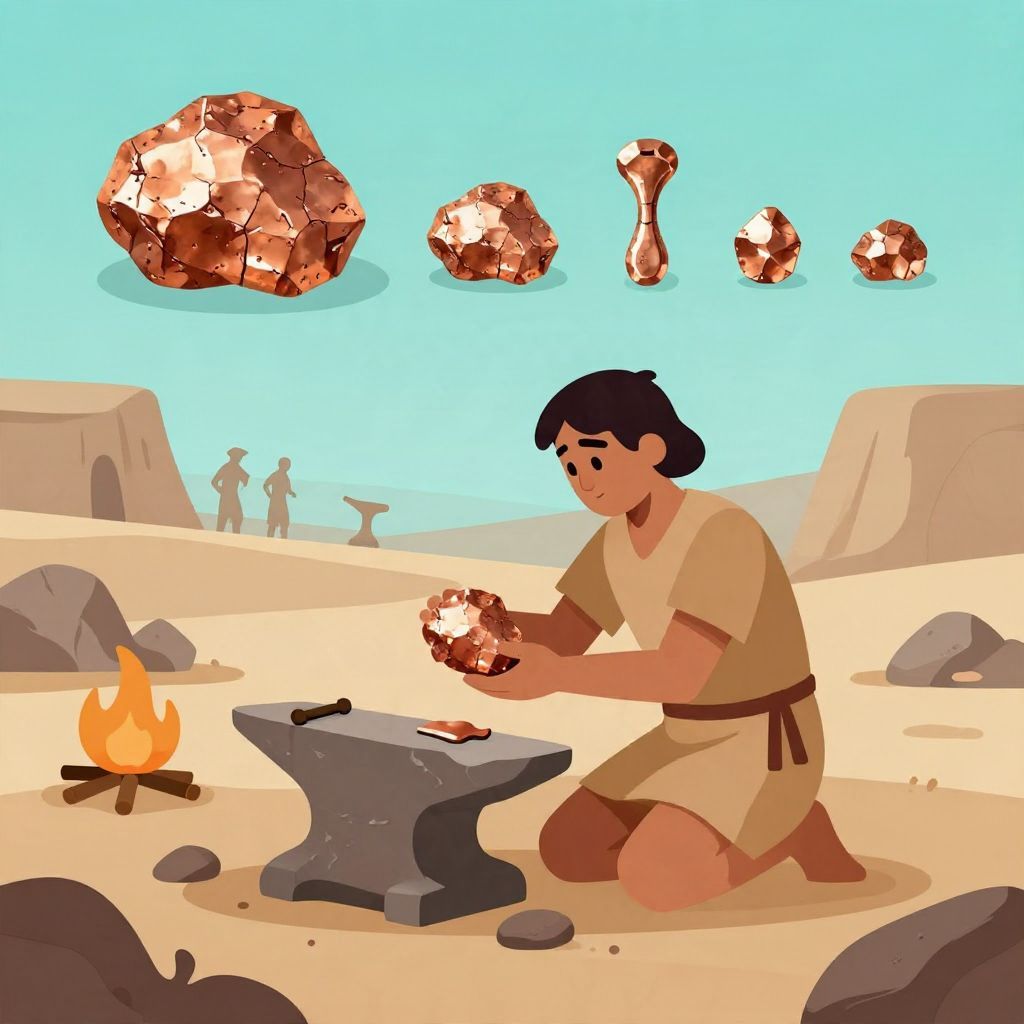
When was copper discovered? There is no single discovery date, because copper was not “discovered” in one moment by one person. Humans likely encountered native copper very early in prehistory, then learned to shape it, heat it, and eventually smelt it from ore over thousands of years.
The answer depends on what “discovered” means: first found in nature, first used, or first extracted from rock. Archaeology shows copper use began in the Neolithic and expanded dramatically in the Chalcolithic, or Copper Age, before becoming central to Bronze Age civilization.
When Was Copper Discovered?
Copper was probably first noticed in its native, metallic form in prehistoric times, long before written records. The earliest known worked copper objects date to around 9000–8000 BCE, while smelting copper from ore appears by about 5000–4000 BCE in parts of the Near East and Balkans. So copper was not discovered on one date; it was gradually found, used, and transformed by early humans.
How Humans First Encountered Copper
Unlike gold, which is often found as shiny nuggets, copper can appear naturally as a reddish metal in the ground. Early people may have found pieces of native copper in riverbeds, exposed rock, or weathered outcrops. Because it is soft enough to hammer, copper was one of the first metals humans could shape without advanced technology.
Native copper came before metallurgy
At first, people did not “mine” copper in the later sense. They likely collected natural pieces and cold-hammered them into beads, awls, hooks, and small ornaments. This stage belongs to the broader transition from stone tools to early metal use. The metal itself was known before humans understood how to extract it from ore.
The Earliest Archaeological Evidence for Copper Use
The earliest secure evidence for copper objects comes from the Near East and southeastern Europe. Small copper beads and ornaments have been found at prehistoric sites dating to roughly 9000–8000 BCE. These early items were rare and symbolic rather than everyday tools, which suggests copper began as a prestige material before becoming more common.
Key early regions
- Anatolia and the broader Near East, where early settled communities experimented with metal.
- The Balkans, where prehistoric communities later developed advanced copper working.
- Mesopotamia and neighboring areas, where copper became important in early urban societies.
These regions mattered because they had access to copper-bearing ores and increasingly complex settlements. Once people settled in villages and towns, they had the time, labor, and exchange networks needed to experiment with new materials.
When Did Humans Learn to Smelt Copper?
Smelting is the process of heating ore to separate metal from rock. This was a major technological leap. Evidence suggests copper smelting emerged by about 5000–4000 BCE, though the exact timing varies by region. This was the true beginning of copper metallurgy, because it allowed people to produce metal on purpose rather than relying only on naturally occurring nuggets.
Why smelting changed everything
Smelting made copper more available, more useful, and more consistent in quality. It also encouraged mining, specialization, trade, and experimentation with alloys. Once people could produce copper from ore, metalworking became a major craft rather than a lucky find.
The Copper Age: A Turning Point in Prehistory
Historians often call the period between the Stone Age and the Bronze Age the Copper Age or Chalcolithic. This era did not begin everywhere at once, but it is generally associated with the 5th to 4th millennia BCE in many parts of Eurasia. During this time, humans used copper alongside stone tools, not instead of them.
What made the Copper Age distinct?
The Copper Age was not simply “the age of copper.” Stone remained important, but copper introduced new possibilities. It could be hammered into shapes, cast in molds, and later alloyed with tin to make bronze. This period marks a technological bridge between Neolithic farming communities and the more complex metal-based societies of the Bronze Age.
Important Early Copper Sites and Cultures
Several archaeological sites help historians trace copper’s early history. These finds do not give us a single discovery date, but they show how copper use spread and matured across different societies.
Examples of early copper development
- Çatalhöyük in Anatolia: known for early experimentation with copper ornaments and other craft traditions.
- Belovode in Serbia: often cited in discussions of early smelting evidence in Europe.
- Varna cemetery in Bulgaria: famous for a rich collection of early gold and copper objects, showing social inequality and elite display.
These sites show that copper was not just a technical innovation. It also became a social one. People used it to signal status, wealth, ritual importance, and access to long-distance trade.
Why Copper Was So Important to Early Civilizations
Copper mattered because it was useful, beautiful, and relatively easy to work. It does not rust in the same way iron does, and it can be recycled repeatedly. Early societies used it for ornaments, tools, weapons, ritual objects, and later for trade goods and coinage.
Practical and symbolic uses
In early civilizations, copper served both everyday and elite purposes. It could be made into hooks, pins, chisels, mirrors, and decorative items. Because it was rarer than stone and more difficult to produce than simple clay goods, it often carried prestige. That made copper valuable not just as a material, but as a marker of power.
From Copper to Bronze
Copper alone has limits. It is softer than bronze, which is an alloy of copper and tin. Around the late 4th millennium BCE and into the 3rd millennium BCE, many societies began making bronze, which was harder and better suited for tools and weapons. This shift did not erase copper; instead, it expanded what metalworkers could do.
Why bronze replaced pure copper in many uses
Bronze held an edge better and was more durable for cutting and combat. Copper remained valuable for vessels, ornaments, and specialized objects, but bronze became the defining metal of a major historical age. In that sense, copper discovery was the first step toward a much larger metallurgical revolution.
Copper in the Ancient World
By the time of the great ancient civilizations, copper was already well established. Egyptians, Mesopotamians, Indus Valley communities, and later Mediterranean societies all used copper extensively. They mined it, traded it, and developed increasingly sophisticated methods of casting and alloying.
Trade and empire increased copper production
As states grew, so did demand for metal. Copper mines became strategic assets, and long-distance trade networks expanded to supply tin, copper, and finished goods. This helped connect distant regions and made metallurgy part of state power, warfare, and administration.
Was Copper Ever “Invented”?
No. Copper was not invented; it was discovered and then transformed by human skill. The metal existed naturally long before humans used it. What humans invented were the methods of working it: hammering, annealing, smelting, casting, and alloying. The history of copper is therefore a history of discovery plus innovation.
Discovery versus technological mastery
This distinction matters. A natural resource may exist for millions of years, but it becomes historically significant only when people learn how to use it. Copper’s story is less about a single moment of discovery than about a long sequence of human advances.
Timeline of Copper Discovery and Early Use
- Before 9000 BCE: Native copper exists in nature and may occasionally be noticed by prehistoric peoples.
- 9000–8000 BCE: Earliest known worked copper objects appear in the archaeological record.
- 5000–4000 BCE: Copper smelting develops in parts of the Near East and southeastern Europe.
- 5th–4th millennia BCE: The Copper Age expands in several regions.
- Late 4th–3rd millennia BCE: Bronze becomes more common, though copper remains important.
Why the Exact Date Is Hard to Pin Down
There is no exact “discovery date” for copper because prehistoric people left no written record of the first time they saw or used it. Archaeologists can date the oldest surviving objects, but those are only the earliest known examples, not necessarily the first ever made. New finds can always push the timeline earlier.
What scholars can say with confidence
Scholars are confident that copper use is extremely ancient, that native copper was worked before smelting, and that deliberate copper production emerged in the prehistoric Near East and Europe thousands of years before written history. What remains uncertain is the identity of the first person, place, or community to discover it.
Copper was not discovered in a single year, but it was one of humanity’s earliest metals, first worked in the prehistoric world and later smelted into a foundation of civilization. Its history marks the moment when people began turning natural materials into durable technology, setting the stage for the Bronze Age and beyond. For related context, see when gold was discovered and the history of copper pennies.