
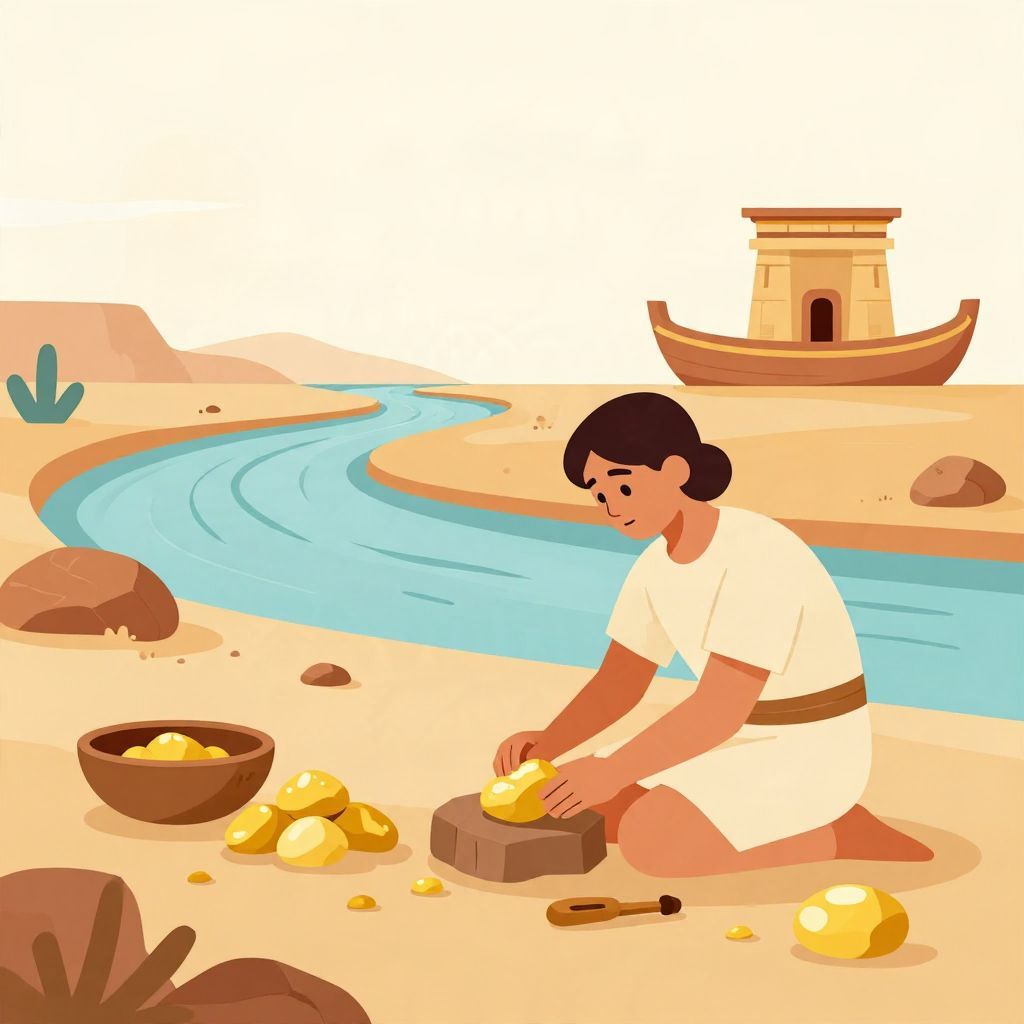
When was gold discovered? The short answer is that gold was not “discovered” once, in one place, by one person. Humans likely encountered native gold in multiple parts of the world in prehistory, long before written records. What we can date more confidently is when gold began to be mined, worked, and used as a prestige metal by ancient civilizations.
By around 4000–3000 BCE, gold was already being shaped into ornaments in parts of the ancient Near East and Egypt, and by the third millennium BCE it had become a major material of kingship, religion, and trade.
When was gold discovered?
Gold was probably first noticed by prehistoric people thousands of years before recorded history, because it can be found in nature as a bright, heavy, yellow metal in riverbeds and exposed rock. There is no single documented “discovery date.” The earliest clear evidence of gold use comes from the Neolithic and Bronze Age, especially in the Balkans, Mesopotamia, Egypt, and later the Indus Valley and China.
Why there is no single discovery date
Gold is one of the few metals that can be found in a nearly pure, native form. Unlike iron or copper, it does not need to be smelted from ore before it can be recognized. A person in prehistory could simply pick up a glittering nugget or gold dust from a stream and understand that it was special. Because of this, gold was likely “discovered” many times, independently, wherever people encountered it.
Native gold in the natural world
Gold occurs as nuggets, flakes, grains, and veins. It is soft, does not rust, and keeps its shine. Those qualities made it stand out from stone and other metals. Early humans may first have valued it as a rare decorative material rather than a practical one, since it was too soft for many tools.
What historians can and cannot prove
Archaeologists can date the use of gold objects, mines, and workshops, but not the exact moment a person first noticed gold in nature. So when historians answer “when was gold discovered,” they usually mean: when did people first begin to recognize, collect, and work with gold in ways that left evidence?
Earliest evidence of gold use
The earliest known gold artifacts date to the late Neolithic and early Bronze Age, roughly the 5th to 4th millennium BCE. Some of the oldest surviving gold objects come from southeastern Europe, including the Varna Necropolis in present-day Bulgaria, dated to around 4500–4200 BCE. These finds show that gold was already associated with status and ritual long before the great empires of the ancient world.
The Varna Necropolis and early prestige
Burials at Varna included a remarkable quantity of gold ornaments, beads, and decorative items. This suggests that gold had already become a marker of wealth and social rank. It is one of the strongest pieces of evidence that gold was not merely collected casually, but was being integrated into complex social systems.
Gold in ancient Egypt
By the 4th millennium BCE, gold was known in Egypt and Nubia. Egyptian rulers later linked gold with divine kingship and the gods, especially because of its imperishable appearance. The famous wealth of ancient Egypt depended in part on gold from Nubia, south of Egypt, where mining became increasingly important during the Old and Middle Kingdom periods.
A brief timeline of gold in human history
Because gold was discovered gradually and independently in different regions, a timeline works better than a single date. The following sequence shows how its role changed over time.
- Prehistory: People likely notice native gold in riverbeds and outcrops wherever it occurs naturally.
- c. 4500–4200 BCE: Gold objects appear in the Varna culture of southeastern Europe.
- c. 4000–3000 BCE: Goldworking spreads in Egypt, Mesopotamia, and surrounding regions.
- 3rd millennium BCE: Gold becomes a major elite material in early states and burial traditions.
- 2nd millennium BCE: Large-scale mining and international trade in gold expand across the ancient Near East and Egypt.
- 1st millennium BCE and later: Gold coinage, imperial treasure, and long-distance trade make gold central to political power.
How ancient people found gold
Ancient gold was usually found in one of three ways: by collecting nuggets or flakes from rivers, by digging into gold-bearing rock, or by reworking old deposits. River gold was often the easiest to notice because water naturally separates heavier particles from lighter sediment.
Placer gold and riverbeds
Placer deposits form when erosion washes gold out of veins and concentrates it in streams. This type of gold is easier to gather than hard-rock gold. It likely provided the first encounter with gold for many early communities, since it could be collected without advanced mining technology.
Early mining and processing
As societies grew more complex, people learned to dig shafts, crush ore, wash sediment, and heat materials to separate gold from other minerals. These methods required labor, organization, and technical knowledge. Gold was no longer just found; it was produced through coordinated human effort.
Why gold mattered so much in ancient history
Gold became important not because it was useful in everyday life, but because it was rare, durable, and visually striking. It did not corrode, and it could be hammered into thin sheets or shaped into ornaments. That made it ideal for symbols of authority, sacred objects, and elite display.
Gold and power
In many early societies, gold helped rulers demonstrate control over labor and territory. A king who could command gold mines, trade routes, or tribute could display wealth in a way that ordinary materials could not match. Gold thus became tied to legitimacy and prestige.
Gold and religion
Many cultures associated gold with the sun, divinity, or immortality. In Egypt, gold was especially linked to the gods because it seemed eternal. In other regions, gold objects appeared in temples, tombs, and ritual contexts. The metal’s physical properties encouraged spiritual meanings.
Gold in the ancient world beyond Egypt
Gold use spread across Eurasia and the Mediterranean as trade networks expanded. By the Bronze Age, gold was being worked in Mesopotamia, Anatolia, the Aegean, and the Indus Valley. Later, Chinese dynasties and civilizations across Africa and the Americas also developed their own gold traditions, often independently.
Mesopotamia and the Near East
In Mesopotamia, gold was imported and used for elite art, jewelry, and ceremonial objects. Because the region lacked abundant local gold sources, it relied heavily on exchange networks. This made gold a marker not only of wealth but of long-distance connections.
The Indus Valley and early Asia
Gold artifacts from the Indus Valley Civilization show that goldworking was part of urban life by the 3rd millennium BCE. In China, gold became more prominent later, especially in elite contexts and during periods of expanding state power. The metal’s prestige crossed cultural boundaries with ease.
Gold in myth and legend
Popular stories often blur the line between history and legend. The “Golden Fleece,” King Midas, and El Dorado are famous examples. These stories do not tell us when gold was first discovered, but they do reveal how deeply gold captured the human imagination.
Myth versus evidence
Myths about gold often symbolize greed, divine favor, or impossible wealth. Archaeology, by contrast, shows a slower and more practical story: people first encountered gold in nature, then learned to collect, shape, trade, and mine it. The mythic aura of gold grew from its real historical importance.
When did gold become valuable?
Gold became valuable very early, but its value changed over time. At first, it was valued mainly for appearance and rarity. Later, as states formed and trade expanded, gold became a store of wealth, a diplomatic gift, and a political resource. Its value was social as much as material.
From ornament to currency
One of the biggest turning points came when gold was used in coinage. In the ancient Mediterranean, gold coins helped standardize value and support large economies. That development did not create gold’s worth, but it made its worth easier to measure and transfer.
Gold as a global standard
In later centuries, gold became central to imperial finance, global trade, and eventually modern monetary systems. Even after societies moved away from gold-backed currencies, the metal retained symbolic power as a universal sign of wealth and security.
So, what is the best answer?
If you want the most accurate historical answer, gold was probably first noticed by humans in prehistory, but the earliest surviving evidence of deliberate gold use dates to around 4500–4200 BCE. By 4000–3000 BCE, gold was already established as a prized material in several ancient civilizations.
In other words, gold was not discovered once; it was repeatedly recognized, gathered, and transformed by different peoples over thousands of years. Its history is really the history of how humans turned a naturally occurring metal into one of the world’s most enduring symbols of value. For more historical context, you may also be interested in when Columbus sailed the ocean blue and when the USA was founded.