
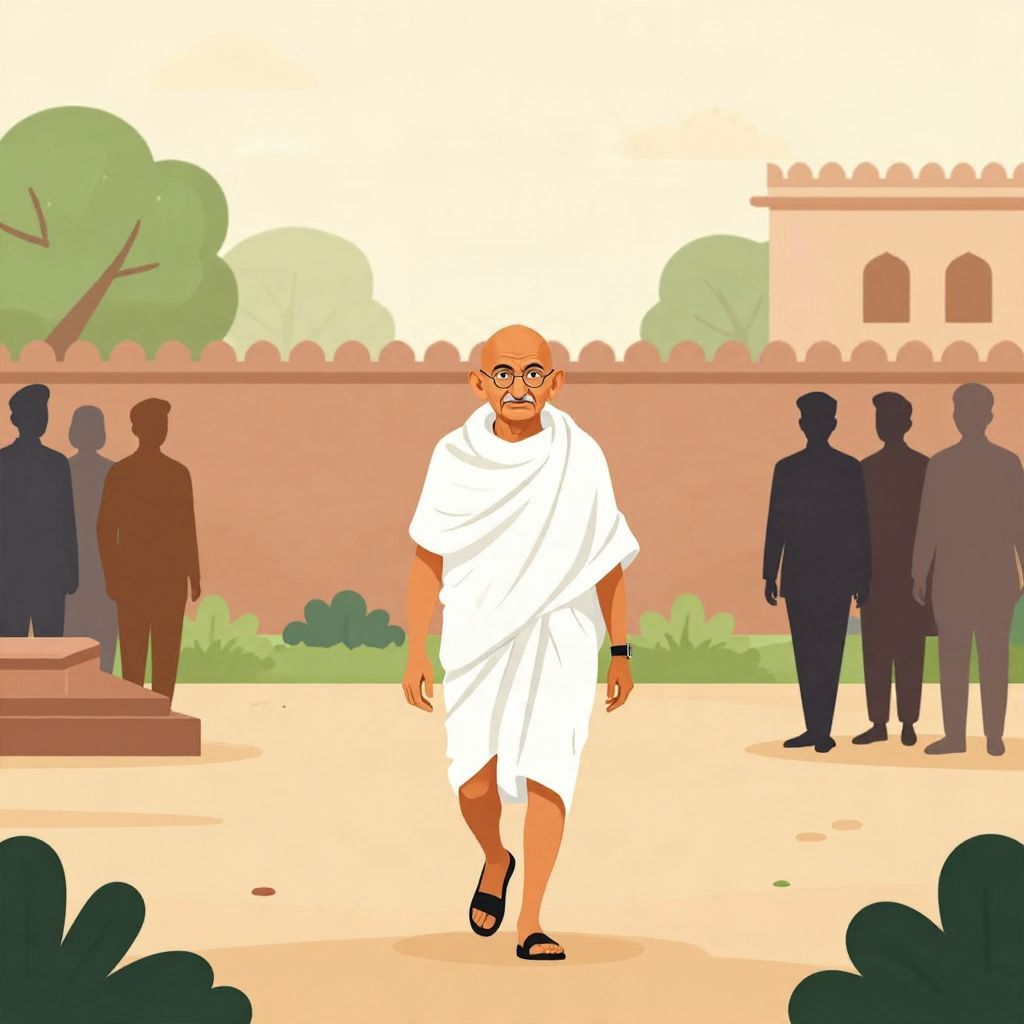
The question “Why I Killed Gandhi” usually points to the motives behind the assassination of Mohandas Karamchand Gandhi on 30 January 1948, not to any single simple cause. Gandhi was murdered by Nathuram Vinayak Godse, a Hindu nationalist who believed Gandhi had weakened Hindu interests and favored compromise with Muslims during the upheaval of Partition.
To understand the killing, it is necessary to look at the violence of Partition, the politics of Hindu nationalism, and Godse’s own ideological radicalization. The assassination was not an isolated act of personal hatred; it emerged from a broader crisis in postcolonial India, where religious fear, political anger, and national trauma collided.
Why was Gandhi killed?
Gandhi was killed because Nathuram Godse believed Gandhi’s politics harmed Hindu interests and made India too conciliatory toward Muslims at a time of intense communal violence. Godse saw Gandhi as an obstacle to a hardline Hindu nationalist vision of India. His decision was shaped by Partition, anger over the transfer of funds to Pakistan, and his rejection of Gandhi’s nonviolence and pluralism.
The historical setting: Partition and communal violence
The assassination cannot be separated from the catastrophe of Partition in 1947. When British India was divided into India and Pakistan, millions were displaced and large-scale communal violence broke out across the subcontinent. Hindus, Muslims, and Sikhs suffered massacres, abductions, and forced migration. In that atmosphere, political language became increasingly extreme.
Gandhi spent his final months trying to reduce violence, protect minorities, and urge reconciliation. But many Hindu nationalists believed he was too soft on Muslims and too willing to pressure Hindu society for the sake of peace. To them, his moral authority was not a source of unity but a threat to their political goals.
Partition as a turning point
Partition created a sense of humiliation and fear among many Indians, especially in regions torn by violence. For some Hindu activists, the creation of Pakistan seemed to prove that Muslims had received a separate homeland, while Hindus had been left to absorb the burden of refugee suffering and insecurity. Gandhi’s appeals for restraint were seen by extremists as betrayal rather than statesmanship.
Who was Nathuram Godse?
Nathuram Godse was a Hindu nationalist activist and journalist associated with the Hindu Mahasabha milieu and earlier with the Rashtriya Swayamsevak Sangh, though the exact political and organizational relationships of the period are sometimes debated in public memory. What is clear is that he embraced a militant Hindu political outlook and came to regard Gandhi as an enemy of Hindu national interests.
Godse was not acting in a vacuum. He moved in circles where anti-Muslim resentment, fears of appeasement, and admiration for a more assertive Hindu politics were common. His later statements show that he saw the assassination as a political act, not a spontaneous outburst.
His ideological worldview
Godse rejected Gandhi’s emphasis on nonviolence, interfaith coexistence, and compromise. He believed Gandhi’s influence had weakened Hindu society by asking it to endure sacrifice without asserting power. In Godse’s mind, Gandhi’s moral leadership had become politically dangerous because it constrained the majoritarian nationalism Godse wanted to defend.
The immediate causes Godse cited
Godse’s own explanation, given in court and in later published forms, centered on several grievances. He objected to Gandhi’s support for Muslim rights, his insistence on communal harmony, and his role in urging the Indian government to release funds to Pakistan. These were the issues Godse said pushed him toward murder, though historians treat his reasoning as an ideological justification rather than a balanced account.
- Opposition to Gandhi’s appeals for Hindu-Muslim unity during Partition violence.
- Anger over the transfer of money to Pakistan, which Godse and others saw as unfair during conflict.
- Rejection of Gandhi’s nonviolent politics, which Godse considered ineffective and politically submissive.
- Belief that Gandhi favored Muslims too strongly in the tense post-Partition environment.
It is important to note that these were Godse’s justifications, not objective historical truths. Gandhi’s actions were aimed at preventing further bloodshed and preserving India’s secular foundations. Godse interpreted those same actions as hostile to Hindu interests.
What happened on 30 January 1948?
Gandhi was shot in the grounds of Birla House in New Delhi while walking to his evening prayer meeting. Godse approached him and fired at close range. Gandhi died almost immediately. The killing shocked India and the world, especially because Gandhi had become globally associated with peace, moral resistance, and anti-colonial struggle.
The assassination was swift, but its political meaning was enormous. It exposed the fragility of the new Indian state and the depth of communal and ideological conflict left behind by independence and Partition.
Was Gandhi targeted only for one reason?
No. Historians generally see the assassination as the result of multiple overlapping causes rather than a single grievance. Godse’s hatred of Gandhi was ideological, emotional, and political. It grew from a wider atmosphere in which some Hindu nationalists believed that India’s future required a stronger, less conciliatory Hindu state.
Broader political tensions
Gandhi had long been a controversial figure among extremists because he rejected revenge politics and insisted on moral discipline. His efforts to protect Muslims in 1947 and 1948 made him especially unpopular with those who saw the post-Partition moment as one of Hindu assertion. In that sense, the assassination was tied to the struggle over what independent India would become.
Personal conviction and political violence
Godse was also personally committed to the idea that violence could solve what he saw as a national emergency. This is one reason historians treat the assassination as both a political murder and an act of extremist conviction. He did not kill Gandhi simply because of one policy dispute; he killed him because he believed Gandhi embodied a political vision he wanted destroyed.
How historians interpret the assassination
Most historians place the assassination within the history of Hindu nationalism, Partition trauma, and the crisis of decolonization. Gandhi’s murder was not inevitable, but it became possible in a climate where political hatred had been normalized and where some activists viewed assassination as a legitimate form of intervention.
At the same time, historians are careful not to reduce the event to a single ideology alone. The late 1940s were marked by state formation, refugee crises, revenge killings, and uncertainty about citizenship and belonging. Gandhi’s death symbolized the failure of moral persuasion to contain the violence unleashed by Partition.
What the assassination did not mean
It did not mean all Hindus supported Godse. It did not mean Gandhi’s ideas had failed completely. Nor did it mean that India abandoned secularism immediately. Instead, the assassination revealed how contested the meaning of independence was from the very beginning.
The trial and Godse’s explanation
After the assassination, Godse and his accomplices were arrested and tried. During the trial, Godse presented a long defense of his actions, arguing that Gandhi’s policies endangered Hindu interests and national unity. His statements are historically important because they reveal the mindset of an extremist nationalist, but they should not be mistaken for an impartial account of events.
In historical terms, the trial confirmed that the murder was deliberate, politically motivated, and connected to a network of conspirators. It also showed how assassination can be framed by perpetrators as patriotic duty, even when it is in fact an attack on democratic and pluralist politics.
Why Gandhi mattered enough to be targeted
Gandhi was not just a political leader; he was a moral symbol whose authority reached far beyond party politics. He could mobilize public opinion, shame governments, and influence debates on religion, caste, and national identity. For extremists, that made him especially dangerous. Killing Gandhi was an attempt to silence a voice that could still shape the future of India.
His death was therefore meant to do more than eliminate one man. It was intended to strike at a political ethic based on nonviolence, accommodation, and interreligious coexistence. That is why the murder remains one of the most consequential political assassinations in modern history.
Lasting significance
Gandhi’s assassination became a defining moment in independent India. It intensified public grief, discredited some extremist currents, and elevated Gandhi into an even more powerful symbol of moral resistance. At the same time, it left unresolved the tensions between secular nationalism and religious majoritarianism that continue to shape South Asian politics.
In the end, “Why I Killed Gandhi” is best answered as a question about ideology, fear, and the violent politics of Partition. Godse killed Gandhi because he believed Gandhi stood in the way of a Hindu nationalist future. The deeper historical lesson is that when political communities are fractured by communal hatred, even the most revered public figures can become targets. For related reading, see why Malcolm X was assassinated and why the Crusades happened.