
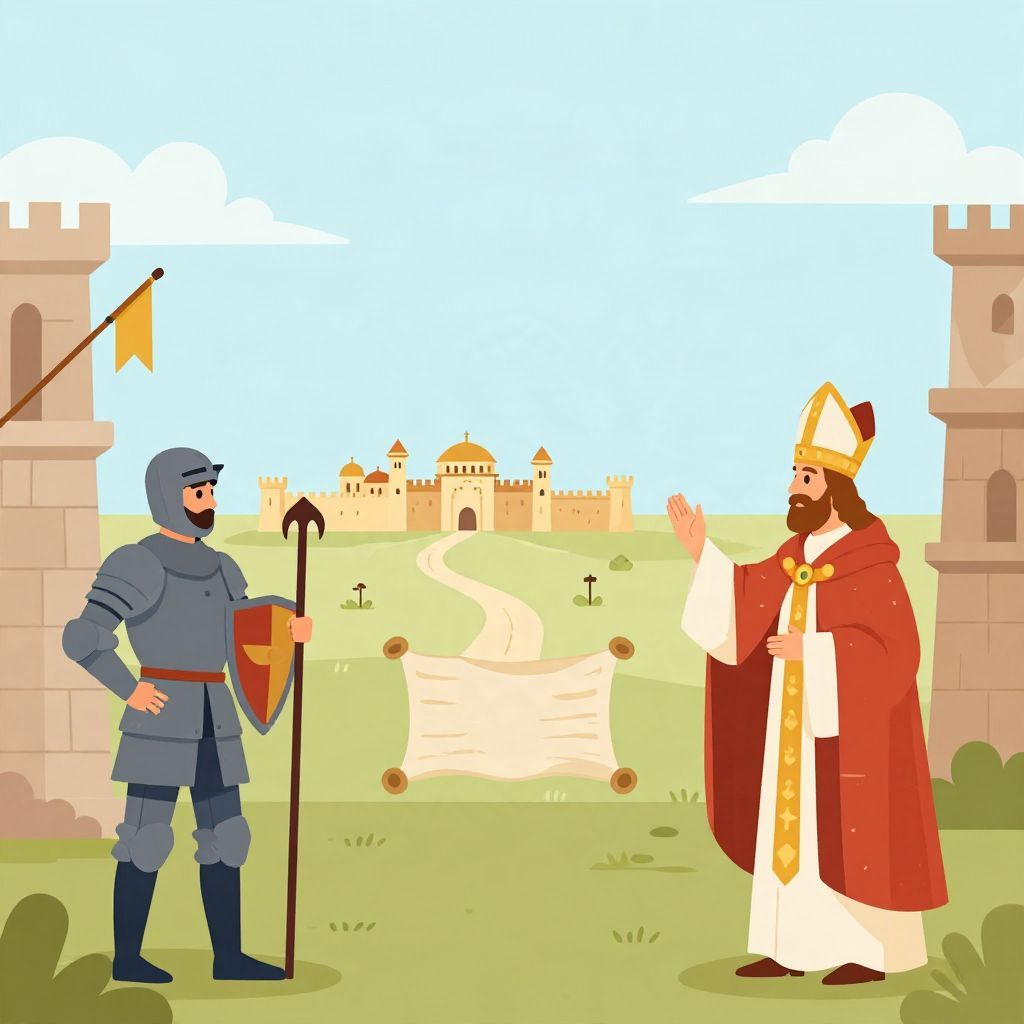
The Crusades happened because medieval rulers, popes, and ordinary believers in Latin Christendom saw a mix of religious duty, political opportunity, and military threat in the eastern Mediterranean. The first crusade was launched in 1095, but the wider crusading movement lasted for centuries and changed shape over time.
At its core, the Crusades were a response to calls for armed pilgrimage, the desire to defend or recover Christian holy places, and the ambitions of powerful elites. They were not caused by one single event, but by a convergence of long-term tensions and immediate crises.
Why Did The Crusades Happen?
The Crusades happened because the medieval Latin Church promised spiritual rewards for fighting in the name of Christianity, while popes and rulers also saw an opportunity to expand influence, redirect violence, and respond to Muslim political control in the eastern Mediterranean. Religious belief was central, but politics, economics, and social pressures all helped drive the movement.
The Religious Cause: Holy War and Pilgrimage
Religion was the strongest and most visible reason the Crusades began. Medieval Christians believed Jerusalem and other holy sites had immense sacred importance because they were linked to the life, death, and resurrection of Jesus. Fighting to protect or recover these places could be framed as an act of devotion, especially when the pope granted spiritual rewards.
Jerusalem and the Holy Land
Jerusalem mattered far beyond its size. For Christians, it was the center of sacred history, and pilgrimage to the Holy Land had become an important part of medieval religious life. When access to those places seemed threatened or politically uncertain, many Europeans felt that armed action could be justified as a defense of the faith.
The Idea of Indulgence
One major innovation behind the Crusades was the promise of spiritual remission for those who took part. Pope Urban II, at the Council of Clermont in 1095, offered a powerful religious incentive: participation in the expedition could bring forgiveness of sins. This did not mean crusaders were guaranteed salvation, but it gave the campaign extraordinary spiritual appeal.
The Political Cause: Papal Leadership and Power
The papacy played a decisive role in turning religious concern into a large military movement. By the late 11th century, popes were trying to strengthen their authority over Christian society and assert leadership over kings and nobles. The Crusades gave the pope a way to direct violence outward rather than let it continue in Europe.
Urban II and the First Crusade
The First Crusade began after Byzantine Emperor Alexios I Komnenos asked the West for military help against the Seljuk Turks. Urban II responded by calling western Christians to aid eastern Christians and recover holy places. His appeal worked because it linked papal authority, pilgrimage, penance, and military service into one compelling message.
Redirecting Noble Violence
Medieval Europe had many armed nobles whose private warfare caused instability. Church leaders had long tried to restrain this violence through movements such as the Peace and Truce of God. Crusading offered a new solution: instead of fighting neighbors, knights could fight for a sacred cause under papal blessing.
The Military Cause: Byzantine Weakness and Seljuk Expansion
The immediate background to the First Crusade included conflict in the eastern Mediterranean. The Byzantine Empire, though still powerful, had suffered military setbacks in the 11th century. At the same time, Seljuk Turkish forces had expanded into areas once controlled by Byzantium, including parts of Anatolia.
The Battle of Manzikert and Its Aftermath
In 1071, the Byzantine defeat at Manzikert weakened imperial control in Anatolia. This loss did not by itself cause the Crusades, but it contributed to the sense that the eastern Christian world was under pressure. When Byzantium asked for help, western leaders were already primed to see a larger religious and military crisis.
Not Simply a “Muslim Attack on Europe”
It is important not to oversimplify the situation. The Muslim world was not a single unified enemy, and the Crusades were not launched because Islam suddenly appeared as a monolithic threat to Europe. Instead, the eastern Mediterranean was a contested region with shifting alliances, rival dynasties, and competing powers. The crusading movement emerged from that complex political landscape.
The Social Cause: Knights, Land, and Status
Many crusaders were motivated by more than devotion. Younger sons, land-hungry nobles, and ambitious knights saw the Crusades as a chance for advancement. In a society where inheritance often favored the eldest son, military expeditions offered opportunities for wealth, reputation, and new lordships.
Feudal Society and Opportunity
Western Europe in the 11th century was a patchwork of lordships and local power struggles. A crusade could be a path to honor and material gain. Some participants hoped for land in the East, while others expected plunder or ransom. These motives did not cancel religious belief; they often worked together.
Penitence and Adventure
For some men, crusading was both a spiritual act and a life-changing adventure. The journey itself was dangerous, expensive, and uncertain. Yet the combination of penitence, prestige, and the possibility of reward made crusading attractive to many who might otherwise have remained at home.
The Economic Cause: Trade, Routes, and Mediterranean Competition
Economic motives mattered, especially for Italian maritime cities such as Venice, Genoa, and Pisa. These powers benefited from access to eastern trade routes and often supported crusading expeditions with ships, supplies, and transport. Their involvement helped sustain the movement over time.
Trade Was Not the Original Cause, But It Became Important
It would be misleading to say the Crusades were launched simply to gain trade. The first crusaders were not primarily merchants. However, once the movement began, control of ports, routes, and coastal strongholds became increasingly important. Commercial interests and crusading goals often overlapped.
Supply, Transport, and Profit
Moving large armies across the Mediterranean required ships, food, and logistical support. Italian city-states profited from supplying crusaders and later from establishing trading privileges in crusader states. This economic dimension did not create the Crusades on its own, but it helped shape their long-term development.
The Cultural Cause: A Medieval Worldview of Us and Them
Medieval people did not think in modern national terms. Their loyalties were shaped by religion, lordship, and local identity. The Crusades made sense within a worldview that divided the world into communities of belief and saw warfare as morally meaningful when authorized by the Church.
Preaching and Popular Response
Preachers spread the crusading message through sermons, stories, and public rituals. The call to crusade could stir deep emotion because it offered ordinary people a role in a sacred drama. Even those who never reached the Holy Land could feel they were participating in a divine mission.
Fear, Hope, and Apocalyptic Thinking
Some crusaders were influenced by fear of judgment, hope for salvation, and expectations that history was moving toward a decisive religious climax. Not everyone thought in apocalyptic terms, but the emotional power of crusading was strengthened by the belief that the struggle had eternal significance.
What Actually Triggered the First Crusade?
The immediate trigger was the combination of Byzantine appeals for aid and Pope Urban II’s call at Clermont in 1095. Urban’s message transformed a regional military request into a major western movement. He presented the expedition as both a defense of fellow Christians and a penitential journey to liberate Jerusalem.
From Local Crisis to Pan-European Movement
What made the First Crusade unusual was its scale. Nobles, knights, peasants, and clergy from different regions answered the call. The movement crossed political boundaries and created a shared purpose that was rare in medieval Europe. That broad response was possible only because the religious and political conditions had already been building for decades.
Why Did the Crusades Continue After the First One?
The Crusades did not end with the capture of Jerusalem in 1099. They continued because the original goals proved difficult to sustain, crusader states needed defense, and popes kept using crusading as a tool of policy. Once the idea existed, it could be applied to new enemies and new regions.
Defense of Crusader States
Latin Christian states were established in the eastern Mediterranean, but they were vulnerable and often short-lived. Their survival required repeated military support from Europe. This turned crusading from a single expedition into a recurring institution.
Expansion of the Crusading Idea
Over time, crusades were launched not only to the Holy Land but also in Iberia, in the Baltic region, and against political or religious enemies within Europe. This expansion shows that crusading became more than one war; it became a broader form of sacred warfare endorsed by the Church.
What the Crusades Were Not
It is easy to misunderstand the Crusades if they are reduced to one motive or one side. They were not simply a clash of civilizations, nor were they only about greed. They were also not a single unified war with one consistent purpose. The motives changed across time, place, and participant.
Multiple Motives at Once
- Religious: defense of sacred places, penance, and salvation.
- Political: papal authority, Byzantine appeals, and noble ambition.
- Military: response to territorial conflict and frontier warfare.
- Economic: transport, trade, and access to resources.
- Social: status, land, and the management of knightly violence.
Lasting Consequences of the Crusades
The Crusades reshaped relations between Christian and Muslim powers, deepened hostility in some regions, and left a lasting mark on European religious and political life. They also influenced trade, diplomacy, military organization, and ideas about holy war. Their legacy was complex and often tragic.
Historically, the Crusades happened because medieval Europe combined intense religious devotion with political ambition, military insecurity, and social pressure. The movement began with a specific crisis in the eastern Mediterranean, but it grew into a long-lasting institution that reflected the values and conflicts of the medieval world. For related context, see how Islam spread and how long the Ottoman Empire lasted.