
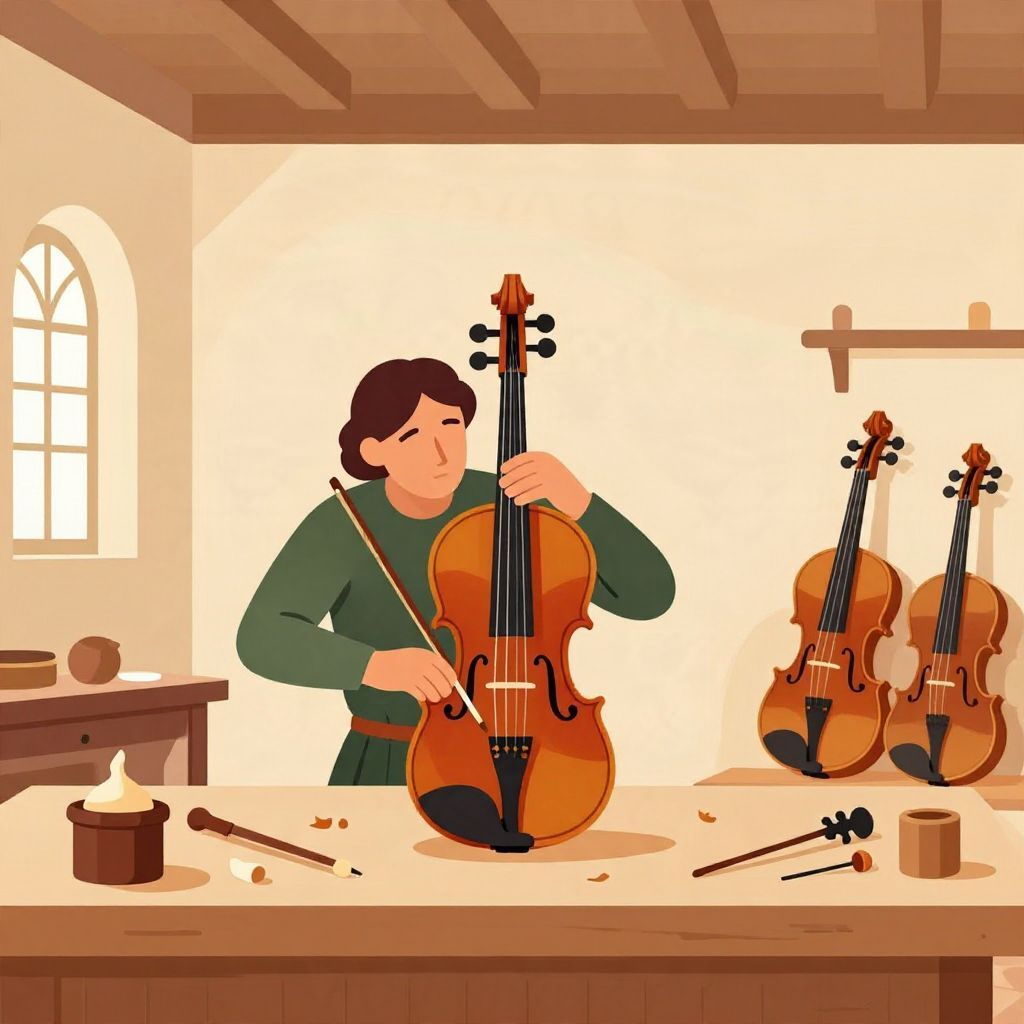
The violin was invented in early 16th-century Italy, most likely in the 1520s or 1530s. It did not appear all at once from a single inventor, but evolved from earlier bowed string instruments such as the rebec, lira da braccio, and viola da gamba family.
By the mid-1500s, the violin had taken recognizable form in northern Italy, especially in the workshops of Cremona, Brescia, and nearby centers. Its rise was tied to court music, dance, and the growing demand for a louder, more agile instrument than its predecessors.
When was the violin invented?
The violin was invented in Italy around the early 1500s, with the earliest surviving examples and documentary references appearing by the mid-16th century. Historians generally place its development between about 1520 and 1550, though the instrument emerged gradually rather than in a single year.
How the violin developed from earlier instruments
The violin did not come from nowhere. It was the product of centuries of experimentation with bowed string instruments in Europe and the Islamic world. Medieval fiddles, rebecs, and Renaissance viols all contributed features that makers adapted into the violin’s smaller body, curved shape, tuned strings, and bright sound.
Important predecessors
- Rebec – a small bowed instrument common in medieval Europe, often with a pear-shaped body.
- Lira da braccio – a Renaissance bowed instrument played on the arm, important in Italian court culture.
- Viola da gamba – a family of bowed instruments held between the legs; related, but structurally different from the violin family.
The violin’s design solved practical musical problems. It projected sound more effectively than many earlier instruments, supported faster melodic playing, and fit the needs of dance music and ensemble performance. That made it especially attractive in the lively musical culture of Renaissance Italy.
The earliest violin makers and centers of invention
There is no single universally accepted “inventor” of the violin. Instead, historians point to a cluster of makers in northern Italy. The earliest surviving violins are usually associated with Andrea Amati of Cremona, whose workshop helped establish the instrument’s standard form in the 16th century.
Andrea Amati and Cremona
Andrea Amati is often called the first great violin maker because his instruments survive and show the violin’s early mature form. By the 1560s, he had built violins for the French court of Charles IX, showing that the instrument had already gained prestige beyond local Italian use.
Other early centers
Brescia also played a major role in the violin’s early history. Makers such as Gasparo da Salò are important because surviving instruments and workshop traditions suggest that the violin was being refined in several places at once, not invented in isolation by one craftsman.
A simple timeline of the violin’s invention
The violin’s history is best understood as a process of gradual emergence. Here is the broad chronology historians use:
- Medieval period – Europe uses many bowed string instruments, including fiddles and rebecs.
- Late 1400s to early 1500s – Italian makers begin shaping instruments that resemble the violin more closely.
- 1520s–1530s – The violin likely takes recognizable form in northern Italy.
- Mid-1500s – Surviving violins and written references confirm the instrument’s existence and growing use.
- Late 1500s – The violin becomes established in courts, dance music, and instrumental ensembles.
- 1600s – The violin family expands and becomes central to European art music.
Why Italy was the birthplace of the violin
Renaissance Italy was the ideal environment for the violin’s creation. City-states such as Cremona, Brescia, Florence, and Venice supported wealthy courts, professional musicians, and skilled artisans. Competition among makers encouraged innovation, while changing musical tastes created demand for instruments that were louder, more flexible, and better suited to new styles.
Musical needs shaped the design
In the 16th century, music was becoming more public, more social, and more varied. Dances, court spectacles, and ensemble playing required instruments that could carry over other sounds. The violin’s tuning, string length, and body shape made it especially effective for melodic lines and rhythmic energy.
What the first violins were like
The earliest violins were smaller and somewhat different from modern instruments, but the basic idea was already there: four strings, a bowed playing style, and a compact wooden body with curved bouts. Over time, makers refined the neck angle, bridge, bass bar, and stringing system to improve volume and responsiveness.
From early form to modern standard
Modern violin construction developed over several centuries. The instrument’s shape became more standardized in the 17th and 18th centuries, especially through the work of later Cremonese makers such as the Stradivari and Guarneri families. These later changes did not invent the violin, but they helped define its modern sound and appearance.
Did one person invent the violin?
No single person can be credited with inventing the violin in the way one might credit a modern patent holder. The instrument was a collective creation, shaped by generations of musicians and makers. Andrea Amati is among the most important early names, but he was building on existing traditions rather than creating the violin from nothing.
This is why historians usually speak of the violin’s development rather than a precise invention date. The question “when was the violin invented?” has a useful answer, but it also requires acknowledging that instruments often evolve gradually through craft practice, performance needs, and regional experimentation.
How the violin spread across Europe
Once established in Italy, the violin spread quickly. Its portability and expressive range made it attractive to royal courts, theater musicians, and professional ensembles across France, Germany, England, and beyond. By the 17th century, it was becoming one of the most important instruments in Europe.
Its lasting historical significance
The violin helped transform Western music. It became central to chamber music, orchestras, solo repertoire, and folk traditions. Its success also influenced instrument making more broadly, setting standards for craftsmanship, acoustics, and design that remain influential today.
Historical facts worth remembering
- The violin was invented in 16th-century Italy, not in ancient times.
- Its development was gradual, likely beginning in the 1520s or 1530s.
- Andrea Amati is the best-known early maker associated with the instrument’s first mature form.
- The violin emerged from earlier bowed instruments, especially the rebec and lira da braccio.
- By the mid-1500s, the violin was already being used in elite European musical settings.
So, when was the violin invented? The best historical answer is that it emerged in early 16th-century Italy, most likely around the 1520s–1530s, and became clearly established by the mid-1500s. Its story is not one of a single inventor, but of gradual innovation that produced one of the most influential instruments in music history.