
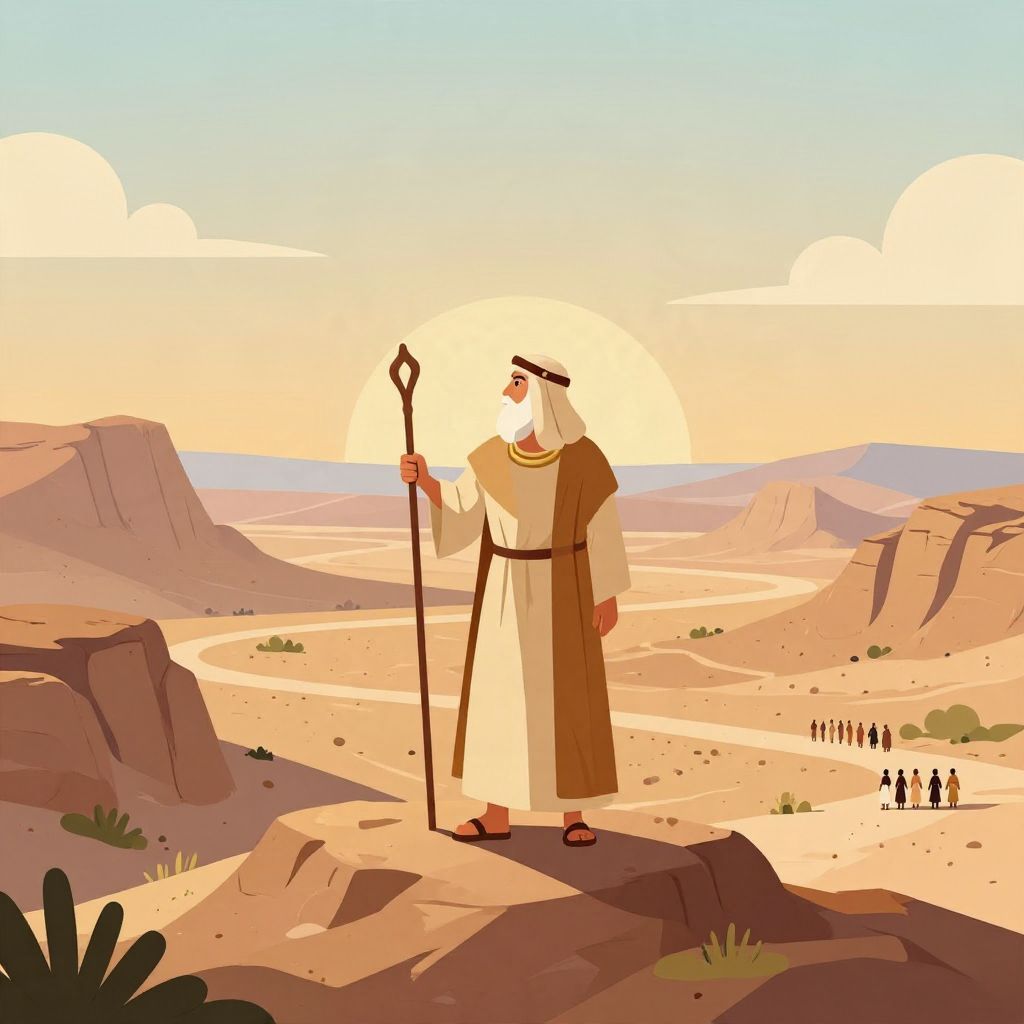
How did Moses die? In the biblical tradition, Moses did not die in battle, from illness, or by execution. According to the Hebrew Bible, he died on Mount Nebo in Moab, after God showed him the Promised Land that he himself would not enter. The text presents his death as a divinely ordained end to a long leadership story.
Historically, that account is the main source for Moses’s death, though scholars treat Moses as a figure rooted in religious tradition rather than a fully recoverable historical person. The story has shaped Jewish, Christian, and Islamic memory for centuries, making his death one of the most significant endings in biblical history.
How Did Moses Die?
According to Deuteronomy 34, Moses died in Moab at the age of 120, after viewing the land of Canaan from Mount Nebo. The Bible says he was buried in an unknown place, and “no one knows his burial place to this day.” In the biblical narrative, his death was peaceful, solitary, and directly tied to God’s judgment that he would not cross into the Promised Land.
The Biblical Account of Moses’s Death
Mount Nebo and the final view of Canaan
The book of Deuteronomy places Moses at the end of the wilderness journey. From Mount Nebo, he is shown the land promised to Israel: Gilead, Jericho, and the wider region beyond the Jordan. The scene is important because Moses sees the goal of the Exodus but does not personally enter it. His death closes the wilderness generation’s story and opens the way for Joshua to lead the people forward.
Why Moses was not allowed to enter the land
The Bible links Moses’s exclusion to an earlier incident at Meribah, where he struck the rock to bring forth water instead of speaking to it as commanded. Different biblical passages frame the reason slightly differently, but the central idea is consistent: Moses, despite his extraordinary leadership, was not exempt from divine discipline. His death therefore carries a moral and theological message about obedience, responsibility, and limits on even the greatest leader.
Was Moses’s death natural?
The text does not describe a violent death or a specific disease. It simply says that Moses died there, in the land of Moab, after the Lord showed him the land. Because the Bible gives no medical detail, historians cannot identify a physical cause of death. In historical terms, the only secure answer is that the tradition presents his death as a natural end under divine decree, not as an event with a documented earthly cause.
What the Sources Say About Moses’s Death
The Hebrew Bible as the primary source
The strongest textual evidence comes from Deuteronomy 34, with supporting references in other biblical books that recall Moses’s death and burial. These texts are not neutral biographies in the modern sense; they are religious narratives designed to explain Israel’s history and covenant identity. That means the account is best read as theology expressed through history, rather than as a forensic report.
Jewish, Christian, and Islamic traditions
Later traditions expanded the story in different ways. In Judaism, Moses’s death is often treated with deep reverence, and later interpretations explore the mystery of his burial. In Christianity, Moses’s death is frequently read as a symbol of the Law’s completion and the transition to Joshua. In Islam, Musa is honored as a major prophet, though the Qur’an does not recount his death in the same detailed way as Deuteronomy. These traditions preserve Moses’s importance, even when they emphasize different aspects of his final moments.
Historical Context: Moses, the Exodus, and the Wilderness Tradition
When did Moses live?
The date of Moses’s life is uncertain. Many scholars place the biblical setting of the Exodus tradition somewhere in the second millennium BCE, but there is no consensus on a precise historical date, and some historians view the Exodus story as a blend of memory, tradition, and later national identity formation. Because of that uncertainty, Moses’s death cannot be dated with confidence in absolute historical terms.
Why the death scene matters in the larger story
Moses’s death is not just an ending; it is a narrative turning point. The wilderness generation passes away, Joshua takes command, and Israel moves from wandering to settlement. The death on Mount Nebo also reinforces a major biblical theme: leaders are important, but the covenant and the people’s future do not depend on one man alone. Moses can guide, intercede, and teach, but he cannot control the final destination.
The significance of an unknown grave
The Bible says Moses was buried in an unknown place. That detail has been interpreted in several ways. It may prevent the creation of a cult around his tomb, or it may underscore that Moses belongs to God in a unique way. Historically, the unknown grave also means there is no archaeological evidence that can confirm the burial site. The absence of a known tomb has helped keep Moses’s memory focused on his role rather than on a physical shrine.
Did Moses Really Die at 120?
The Bible states that Moses was 120 years old when he died, and it adds that his eyesight was undimmed and his vigor unimpaired. This is often read as a literary and theological statement, not necessarily a modern demographic record. In ancient texts, large ages can signal completeness, blessing, or exceptional status. Whether taken literally or symbolically, the number emphasizes that Moses reached the end of a full and honored life.
How Ancient Readers Understood Moses’s Death
A leader who finished the journey but did not cross over
For ancient readers, Moses’s death would have carried a powerful lesson about faithfulness and human limitation. He had confronted Pharaoh, led the people out of Egypt, mediated the covenant at Sinai, and guided Israel through years of hardship. Yet he still died outside the land. That contrast made his story memorable: the greatest prophet of Israel was also a man who experienced unfinished longing.
Connection to Joshua’s leadership
The death of Moses prepares the rise of Joshua. Deuteronomy presents Joshua as Moses’s successor, showing continuity rather than rupture. The transition matters historically because it marks the movement from charismatic wilderness leadership to a new phase of national life. Even if the exact historical process is difficult to reconstruct, the literary sequence is clear: Moses ends, Joshua begins, and Israel’s story continues.
Popular Questions and Common Misunderstandings
Was Moses killed by someone?
No biblical text says Moses was murdered. The traditional account describes him dying under God’s direction after seeing the land from Mount Nebo. Some later legends and speculative retellings imagine dramatic alternatives, but these are not part of the core historical-religious source tradition.
Was Moses buried in Egypt?
No. The biblical account places his death and burial in Moab, east of the Jordan River, not in Egypt. Egypt is central to Moses’s early life and the Exodus story, but it is not the location of his death.
Why do people still ask how Moses died?
People ask because Moses is one of the most important figures in religious history, and his death is unusual in the biblical narrative. He dies after seeing the destination but before entering it. That unresolved ending has invited centuries of interpretation, from theology and sermon literature to historical inquiry and literary analysis.
What Moses’s Death Means in History
Moses’s death matters because it completes one of the foundational stories of the ancient Near East and of biblical religion. In the tradition, he is both lawgiver and prophet, liberator and teacher. His death on Mount Nebo turns him into a figure of memory rather than possession: he belongs to the story, not to a tomb. That is one reason his ending has remained so influential.
So, how did Moses die? In the biblical account, he died peacefully on Mount Nebo in Moab, after viewing the Promised Land, and was buried in an unknown place. Historically, that is the tradition we can document; beyond it, the exact physical cause of death is not known. For related context, see how old Moses was and when Moses was born.