
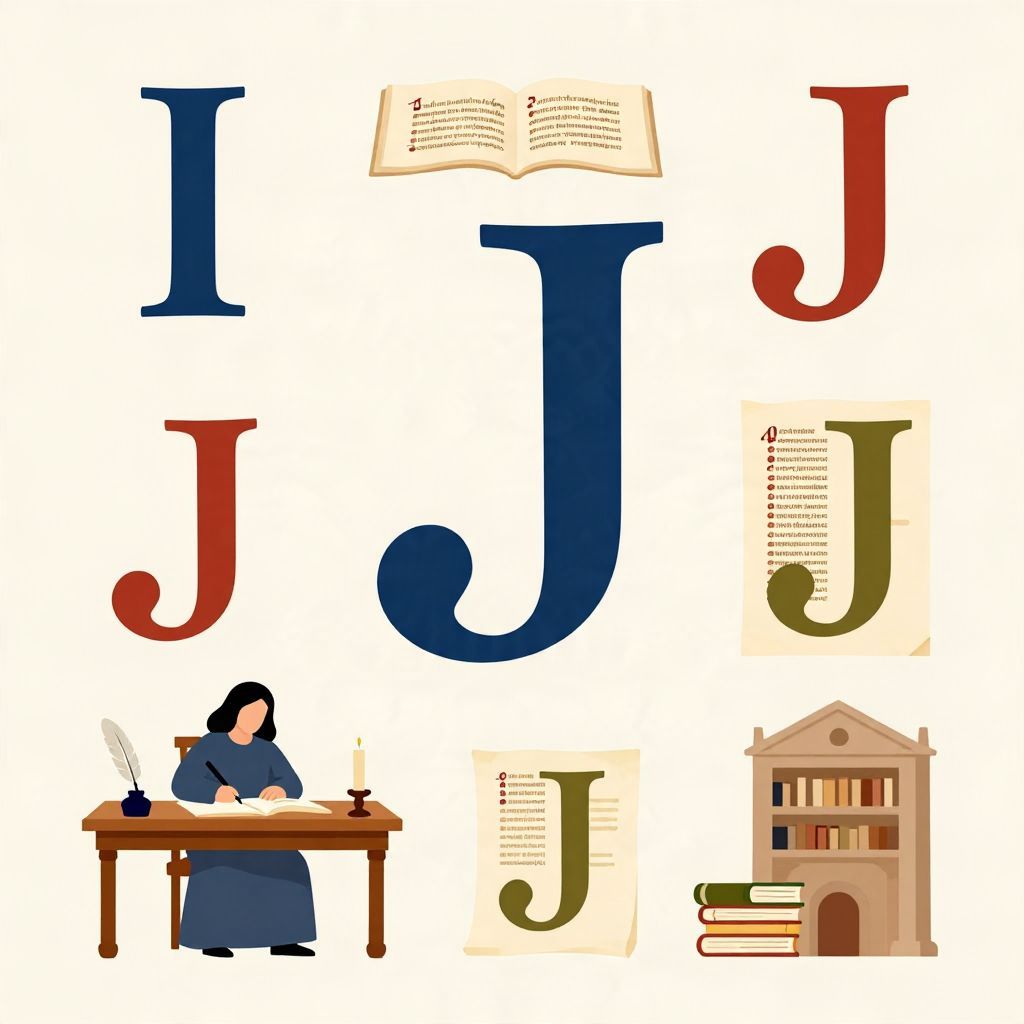
When was the letter J invented? The short answer is that J emerged gradually in late medieval and Renaissance Europe, but it was not recognized as a separate letter until the 16th and 17th centuries. Before that, the same written character was usually just a variant form of I, used in different positions or for different sounds.
So the “invention” of J was really a slow process of separation: scribes, printers, and scholars began treating i and j as distinct letters, and modern alphabets eventually followed. The result was a new letter in practice, even though its roots go back to the ancient alphabet traditions that produced both I and J.
When Was the Letter J Invented?
J was not invented all at once. It developed from the letter I in the Latin alphabet and became a distinct letter during the 1500s, with wider acceptance in the 1600s. In other words, the letter J is a relatively recent addition to the alphabet compared with the ancient Roman letters, and its modern status came from gradual spelling reform rather than a single inventor.
How J Emerged From the Letter I
The story begins in ancient Rome, where Latin used the letter I for both the vowel sound in words like machine and the consonant sound that later became English j in words like jam. Roman writing did not distinguish these sounds with separate letters. Instead, context told readers how to pronounce the word.
Over time, especially in medieval manuscripts, scribes began to write the consonantal form of i with a longer tail or flourish at the bottom. This was not yet a new letter, but it created a visual difference. That small stylistic habit eventually helped turn J into a separate character.
Key stages in the development
- Ancient Latin: I represented both vowel and consonant sounds.
- Medieval writing: scribes sometimes lengthened the consonantal form of I.
- Renaissance printing: printers and scholars began separating the two forms more consistently.
- 17th century: J became widely accepted as its own letter in many European alphabets.
The Historical Timeline of J
The history of J is best understood as a timeline of gradual change rather than a single invention date. Different languages adopted the distinction at different speeds, and spelling conventions varied by region. Still, several milestones stand out clearly in the historical record.
- Classical antiquity: Latin uses I for both vowel and consonant sounds.
- Middle Ages: scribes begin distinguishing the consonantal form of I in handwriting.
- Early 1500s: scholars such as Gian Giorgio Trissino help promote a clearer distinction between I and J in writing.
- 1600s: J becomes more standard in printed books and dictionaries.
- Later centuries: most modern European alphabets settle into the familiar I/J separation.
Why the 1500s matter
The 16th century is often treated as the key turning point because Renaissance scholars were actively trying to regularize spelling and grammar. One of the most important figures was the Italian humanist Gian Giorgio Trissino, who is often credited with helping to formalize the use of J to represent a consonant sound distinct from I. He did not “invent” the sound, but he helped define the letter as a separate written symbol.
Was There a Single Inventor of the Letter J?
No single person invented J in the way someone invents a machine or a modern trademark. The letter developed through collective writing practices, then became standardized by printers and scholars. Trissino is important in the history of J, but he was part of a broader movement rather than the sole creator.
This is common in alphabet history. Letters often evolve from earlier symbols, change shape over centuries, and only later become fixed by educational and printing traditions. J is one of the clearest examples of a letter whose “birthday” is really a period of standardization.
Why Did J Become a Separate Letter?
The separation of J from I was driven by a practical need: readers and writers wanted a clearer way to show different sounds. As Latin evolved into the Romance languages and as scholars compared languages across Europe, the old single-letter system became less convenient. Distinguishing the consonant from the vowel improved readability and helped standardize spelling.
Printing also mattered. Once books were mass-produced, consistent typefaces became important. Printers increasingly used different forms for I and J, which made the distinction more visible and encouraged its spread. In this sense, the rise of J was tied to the broader history of literacy, scholarship, and print culture.
Sound change and spelling change
- Sound change: spoken Latin and later European languages developed new consonant sounds.
- Writing habits: scribes used a longer or more decorative form of I in certain positions.
- Printing: type design helped freeze the difference into a standard form.
- Schooling: grammar books and dictionaries reinforced the new letter.
How J Was Used in Different Languages
One reason the history of J can be confusing is that its pronunciation differs from language to language. In English, J usually represents the sound in jam. In many other languages, especially those influenced by Latin spelling traditions, J can sound closer to y or a soft consonant. This shows that the letter’s shape and its sound have never been exactly the same thing.
For example, in classical Latin-based traditions, the same letter family could serve different phonetic needs. That is why J’s history is not just about one alphabet but about the adaptation of alphabetic writing across Europe.
Examples of pronunciation differences
- English: J in judge has a hard affricate sound.
- Spanish: J often has a strong guttural sound, as in jota.
- German and some other languages: J is often pronounced like English y.
J in Relation to the Roman Alphabet
The Roman alphabet did not originally include a separate J. It had a smaller set of letters, and some modern distinctions had not yet been created. Over centuries, the alphabet expanded and specialized as European languages changed. J is therefore a later refinement of the Latin script, not an original Roman letter.
This matters because people often assume the alphabet has always looked the way it does now. In fact, the familiar sequence I and J is the result of centuries of adjustment. The same is true of other letters that changed form, sound, or status over time.
Why the History of J Matters
The invention of J shows how alphabets evolve in response to use. Letters are not fixed forever; they are shaped by speech, writing habits, education, and technology. J’s story also reminds us that many “new” letters are really old forms that were reinterpreted and standardized.
In historical terms, J is a good example of how the written word adapts to human needs. A small visual variation in manuscripts eventually became a permanent part of the alphabet, influencing spelling systems across the modern world.
So, When Was the Letter J Invented?
J was invented, or more accurately separated from I, during the 16th century and became widely established in the 17th century. It began as a variant form of I in Latin writing, was promoted by Renaissance scholars, and was later fixed by printers and language reformers. There is no single exact birthday, but the best historical answer is that J became a distinct letter in early modern Europe.
For readers interested in the broader background, the history of J connects closely to the development of Latin and Roman speech traditions. You may also want to explore what language the Romans spoke and where Latin originated to see how the alphabet evolved alongside the language itself.