
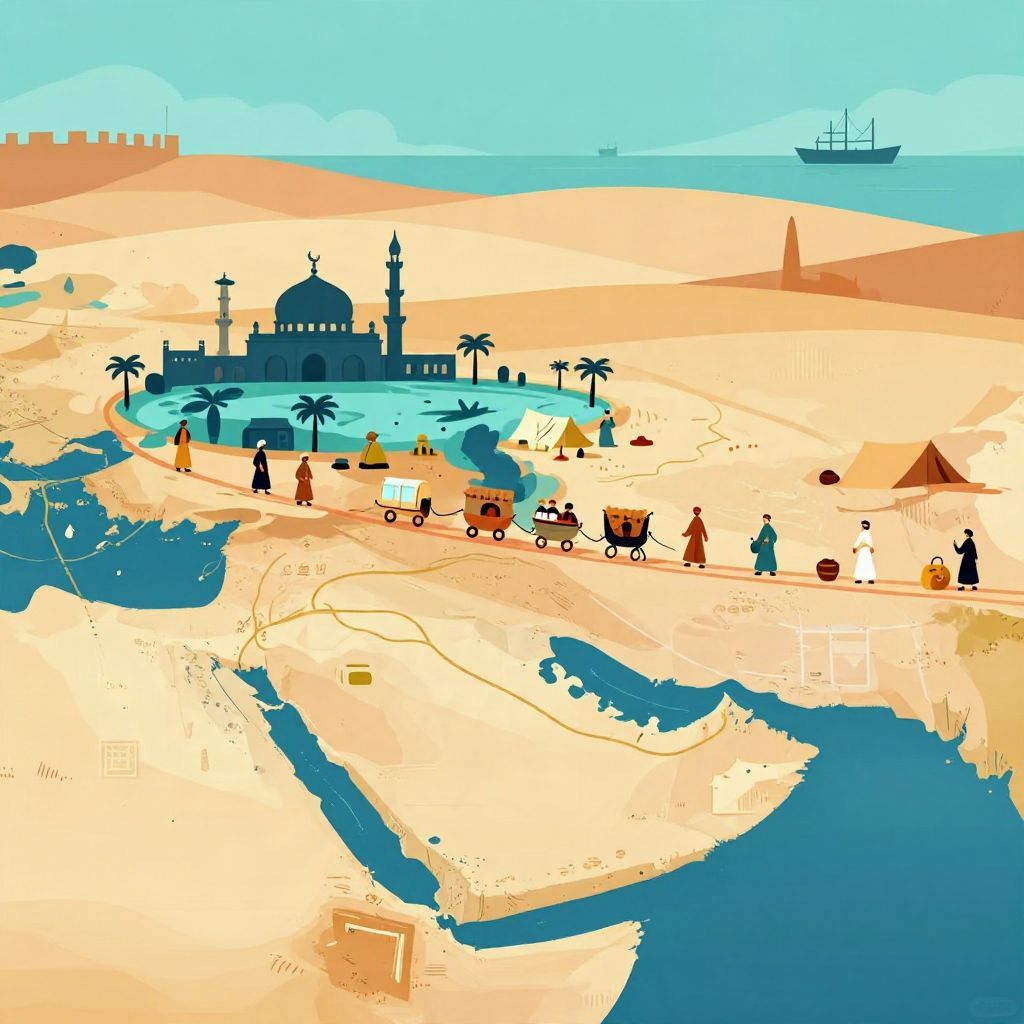
How did Islam spread across the Middle East, Africa, Asia, and beyond? The short answer is that it spread through a combination of preaching, trade, conquest, migration, diplomacy, and the appeal of a new religious and social order. Its expansion was not a single event but a long historical process that began in 7th-century Arabia and continued for centuries.
Understanding that process means looking at both the early Islamic conquests and the slower, more peaceful spread of Muslim communities and ideas through merchants, scholars, rulers, and Sufi teachers.
How Did Islam Spread?
Islam spread first through the life and preaching of the Prophet Muhammad in western Arabia, then through the rapid expansion of the early caliphates after his death in 632 CE. Over time, it also spread by trade, intermarriage, migration, state patronage, and voluntary conversion, especially in Africa, Central Asia, South Asia, and Southeast Asia.
The Origins of Islam in 7th-Century Arabia
Islam began in the Arabian Peninsula in the early 600s CE, in the city of Mecca. Muhammad, whom Muslims regard as the final prophet, preached belief in one God, moral accountability, charity, and social justice. His message first attracted followers in Mecca and later in Medina after the Hijra in 622 CE, the migration that marks the start of the Islamic calendar.
Why the message spread locally
Early Islam spread among tribes and communities because it offered a powerful religious vision and a new form of unity beyond kinship ties. In a region shaped by tribal alliances, trade routes, and local rivalries, Islam created a shared identity for believers. Muhammad’s leadership in Medina also gave the new community political and military organization.
The Early Caliphates and Rapid Expansion
After Muhammad died in 632 CE, leadership passed to the caliphs, beginning with the Rashidun caliphs. Under their rule, Muslim armies expanded beyond Arabia into the Byzantine and Sasanian empires. This was one of the most dramatic territorial expansions in late antiquity, but it did not happen because every conquered person immediately became Muslim.
Key early conquests
- 633–640s CE: Muslim forces took much of Syria, Palestine, and Egypt from the Byzantine Empire.
- 633–650s CE: They overran much of Iraq and Iran, ending the Sasanian Empire.
- Mid-600s CE: Muslim rule also reached parts of North Africa.
These victories were helped by several factors: the exhaustion of the Byzantine and Sasanian empires after decades of war, local political divisions, and the mobility of Arab tribal armies. Historians generally stress that the early Islamic conquests were not just religious wars; they were also imperial campaigns shaped by the weaknesses of neighboring states.
Conquest did not mean immediate conversion
In the first centuries, most people in conquered lands remained Christians, Jews, Zoroastrians, or followers of other local traditions. Muslim rulers usually allowed “People of the Book” to practice their religion in exchange for taxes and political submission. Conversion to Islam often happened gradually over generations, not overnight.
Why People Converted to Islam
There was no single reason people became Muslim. Conversion was usually gradual and varied by region. Some people were drawn by faith, others by social mobility, legal status, or the advantages of joining the ruling community. In many places, conversion became more common when Muslim institutions became firmly established.
Religious and social motivations
For many converts, Islam’s message of monotheism, prayer, and moral discipline was compelling in its own right. Others were attracted by the chance to join a wider community that crossed tribal and ethnic lines. In some regions, conversion could also improve access to government, commerce, learning, or patronage.
Political and economic incentives
In early Islamic states, Muslims often enjoyed closer ties to rulers and access to administrative networks. Over time, conversion could reduce tax burdens in certain contexts, though local practice varied and historians caution against oversimplifying this point. Economic and political incentives mattered, but they worked alongside belief, family ties, and cultural change.
Trade Routes and the Peaceful Spread of Islam
One of the most important answers to “How did Islam spread?” is trade. Muslim merchants carried Islam along the Indian Ocean, the Sahara, and the Silk Roads. In many places, merchants did not conquer territory; instead, they built communities, married locally, and introduced Islamic practices through everyday contact.
The Indian Ocean world
From East Africa to India and Southeast Asia, Muslim traders connected port cities through commerce in spices, textiles, gold, and ceramics. Because trade depended on trust, shared law, and social networks, Islam often spread first in coastal cities. Over time, local elites sometimes adopted Islam to strengthen commercial and diplomatic ties.
West Africa and the trans-Saharan trade
Islam reached West Africa through North African traders and scholars crossing the Sahara. It spread among rulers and urban elites in places linked to trade routes such as Ghana, Mali, and later Songhai. Famous centers like Timbuktu became associated with Islamic learning, but rural conversion often took much longer than elite adoption.
Southeast Asia
In Indonesia and Malaysia, Islam spread largely through trade, intermarriage, and the influence of Sufi teachers and local rulers from roughly the 13th century onward. Rather than arriving through a single conquest, it spread through port cities and then inland, often blending with existing customs.
The Role of Sufis, Scholars, and Missionaries
Sufism, the mystical dimension of Islam, played a major role in the religion’s spread in many regions. Sufi teachers emphasized devotion, spiritual discipline, and personal example. Their flexible methods often made Islam more accessible to communities with different languages and traditions.
Why Sufis mattered
Sufi lodges, teachers, and brotherhoods often traveled with merchants or settled in frontier regions. They helped translate Islamic ideas into local cultures without necessarily erasing older customs at once. In many places, Sufis were among the most effective agents of conversion because they combined learning, piety, and social service.
Scholars and institutions
Mosques, madrasas, and courts also helped Islam spread by teaching Arabic literacy, law, and theology. Once rulers sponsored Islamic institutions, they created durable centers of learning that influenced administration, education, and public life. This institutional spread was especially important in urban societies.
State Power and the Spread of Islam
Rulers often accelerated Islam’s spread by adopting it themselves. When kings, sultans, or emirs converted, their courts, armies, and officials frequently followed. State support could make Islam the religion of administration, law, and legitimacy, even when the broader population converted slowly.
Examples of ruler-led adoption
- North Africa and al-Andalus: Muslim rule established Islamic institutions across large territories after the 7th and 8th centuries.
- West African kingdoms: Some rulers adopted Islam to strengthen trade and political authority.
- Delhi Sultanate and later Mughal India: Muslim-ruled states helped expand Islamic culture, though India remained religiously diverse.
- Ottoman Empire: Islam shaped imperial law, education, and identity across southeastern Europe, Anatolia, and the Middle East.
Still, state power did not guarantee uniform conversion. Many empires ruled over mixed populations for centuries. Islam spread unevenly, often more quickly in cities and trade centers than in remote rural areas.
Military Conquest Versus Gradual Conversion
It is important to distinguish between the spread of Islamic rule and the spread of Islam as a religion. Military conquest expanded Muslim political control, but religious conversion usually took longer. In some places, such as parts of the Middle East and North Africa, Islam became dominant relatively early. In others, such as Southeast Asia or sub-Saharan Africa, the process was slower and more localized.
What historians emphasize
Modern historians generally reject a simple “spread by the sword” explanation. Conquest mattered greatly in the first century of Islam, but conversion was usually a much longer social process. The religion spread through a mix of force, incentives, persuasion, mobility, and cultural adaptation.
How Islam Spread Across Different Regions
The history of Islam’s spread looks different depending on where you study it. A single explanation does not fit every region, because local politics, trade networks, and existing religions shaped the outcome.
- Arabia: through Muhammad’s preaching and the first Muslim community.
- Levant, Egypt, and Persia: through early conquest and gradual cultural change.
- North and West Africa: through conquest in the north and trade plus scholarship in the west.
- Central Asia and South Asia: through conquest, migration, Sufi activity, and court patronage.
- Southeast Asia: mainly through commerce, intermarriage, and local rulers’ adoption of Islam.
Lasting Effects of Islam’s Spread
The spread of Islam transformed law, language, architecture, education, and politics across a vast region. Arabic became a major language of religion and scholarship, even where it was not the everyday spoken language. New cities, trade connections, and intellectual traditions emerged across Afro-Eurasia, linking distant societies in shared networks of faith and exchange.
At the same time, Islam’s spread did not erase diversity. Muslim societies included many ethnic groups, legal traditions, and local customs. In many regions, Islamic practices blended with older cultural forms, creating rich and varied traditions rather than a single uniform model.
So, how did Islam spread? It spread first through revelation, preaching, and community in Arabia; then through conquest, governance, and imperial expansion; and later through merchants, scholars, Sufis, and rulers who carried Islam along the world’s great trade routes. If you want to explore more connected topics, see related history articles on world history and civilizations.