
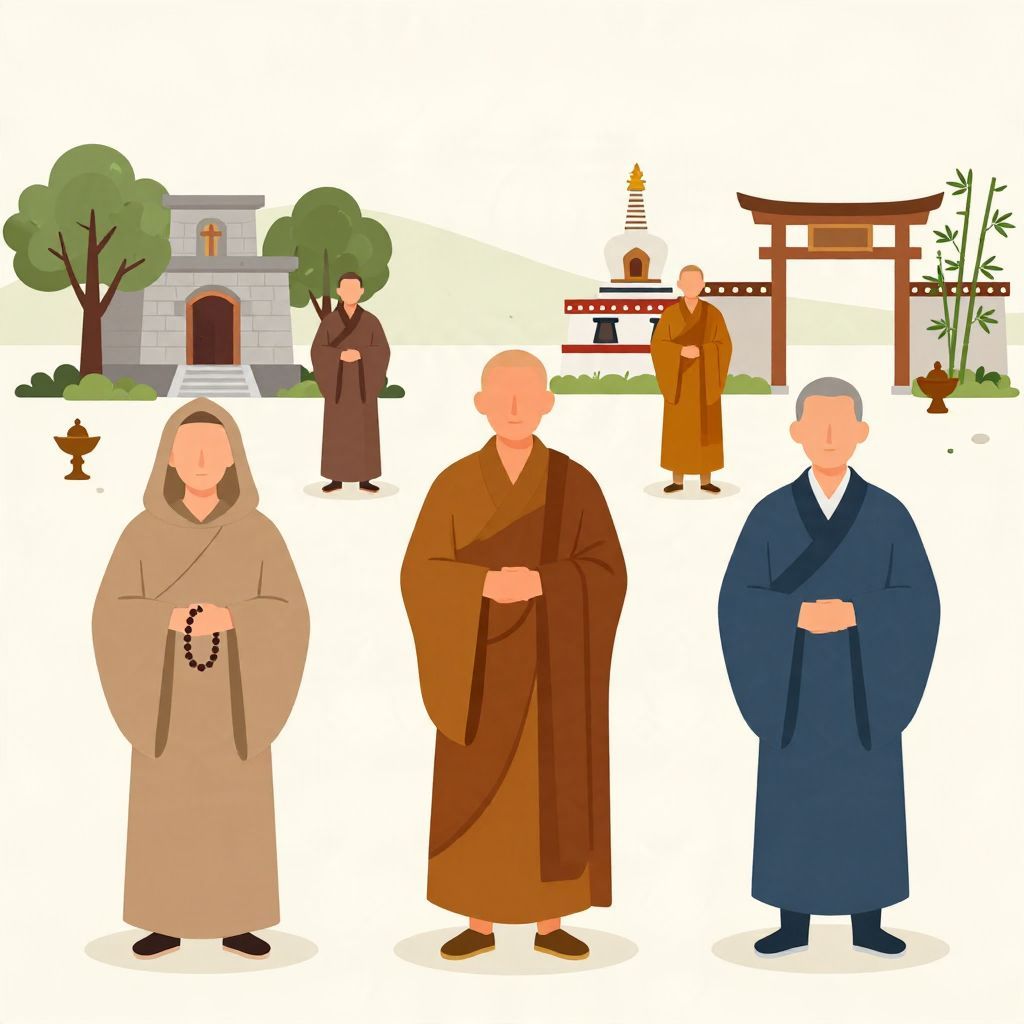
When people ask, “Where are monks from?” they are usually asking about the origin of monks as a religious way of life, not a single nationality or modern country. The short answer is that monks first emerged in several ancient religious traditions, especially in South Asia and the Eastern Mediterranean, and later spread across Asia, Europe, and beyond.
Monastic life developed as men and women withdrew from ordinary society to pursue prayer, discipline, study, and spiritual perfection. Because different religions created monastic traditions at different times, the history of monks is really a history of multiple origins, not one birthplace.
Where Are Monks From?
Monks are not from one place. The earliest well-documented monastic communities arose in India with Buddhism and Jainism, and in the Roman Empire’s eastern provinces with early Christianity. From there, monasticism spread to Tibet, China, Korea, Japan, Southeast Asia, Ireland, France, Italy, and many other regions. “Monk” describes a religious role that appeared independently in several cultures.
The earliest monastic traditions
India and the beginnings of Buddhist monasticism
The oldest major monastic tradition generally associated with monks is Buddhism, which began in northern India around the 5th century BCE. After the Buddha’s lifetime, his followers formed the sangha, a community of monks and nuns who lived by vows of celibacy, simplicity, and discipline. These communities were not isolated in the modern sense; they often depended on lay supporters for food and shelter.
Early Buddhist monastic life grew out of a broader Indian culture of renunciation. In ancient India, some religious seekers rejected household life in favor of ascetic practice, meditation, and spiritual liberation. Buddhism adapted this older pattern but organized it into a durable institution with rules, ordination, and communal life.
Jain monasticism in ancient India
Jainism also developed a strong monastic tradition in India, likely around the same broad period as early Buddhism. Jain monks and nuns practiced intense nonviolence, austerity, and detachment from possessions. Their communities helped shape the wider South Asian idea that spiritual authority could come from disciplined withdrawal from ordinary life.
Christian monasticism in Egypt and the eastern Mediterranean
Christian monasticism arose later, in the late 3rd and early 4th centuries CE, especially in Egypt, Syria, and nearby regions of the Roman Empire. Early Christian monks were often inspired by the desire to imitate Christ through prayer, fasting, and solitude. Some lived as hermits in the desert; others formed communal monasteries.
Figures such as Anthony of Egypt became famous in Christian tradition as early desert ascetics. Whether every later story about them is historically exact is uncertain, but the broad pattern is well established: monasticism became a major Christian institution in the eastern Roman world before spreading westward.
Why did monks appear in different places?
Monks emerged in several regions because many religions developed similar answers to similar spiritual questions. People sought holiness, insight, and freedom from worldly distractions. In societies where religious merit, salvation, or liberation mattered deeply, some believers concluded that leaving family life and possessions behind was the best path. This made monasticism a recurring historical pattern rather than a one-time invention.
Common reasons monastic life developed
- Spiritual discipline: strict routines helped monks focus on prayer, meditation, or study.
- Renunciation: giving up property and family ties symbolized detachment from worldly desire.
- Community: monasteries gave structure to religious life and preserved teachings.
- Authority and learning: monks often became teachers, scribes, and guardians of texts.
How monasticism spread across Asia
From India to Central and East Asia
Buddhist monasticism traveled along trade routes such as the Silk Roads. As Buddhism spread into Central Asia, China, Korea, Japan, and Tibet, monasteries adapted to local cultures and political systems. In China, monasteries became centers of translation, scholarship, and ritual. In Tibet, monastic institutions later became central to religious and political life. In Japan, Buddhist monastic traditions were shaped by local patronage and different schools of thought.
This spread was not a simple copy-and-paste movement. Monastic rules, architecture, and daily practices changed as Buddhism entered new societies. Still, the core idea remained recognizable: a community set apart for religious training and devotion.
Southeast Asia and Theravada monasticism
In Sri Lanka and mainland Southeast Asia, Theravada Buddhism developed strong monastic institutions that remain influential today. Monks in countries such as Thailand, Myanmar, Cambodia, and Laos have long played important roles in education, ritual life, and public morality. In many places, young men have temporarily entered monastic life, making the monastery part of ordinary social experience rather than a rare vocation.
Monks in Europe: a different but related tradition
From the desert to the monastery
Christian monasticism spread from Egypt and the eastern Mediterranean into Europe during late antiquity and the early Middle Ages. By the 5th and 6th centuries, monasteries were appearing across Italy, Gaul, Ireland, and other regions. The Rule of St. Benedict, written in the 6th century, became one of the most important guides for Western monastic life.
European monasteries were often more than places of prayer. They preserved manuscripts, trained clergy, managed land, and sometimes served as centers of agriculture and local authority. In the medieval West, monks became important cultural workers as well as religious specialists.
Irish, Benedictine, and later monastic traditions
Irish monasticism developed distinctive practices and helped spread learning across early medieval Europe. Benedictine monasteries later became the most influential model in the Latin West. Over time, new orders such as the Cistercians, Franciscans, and Dominicans added fresh forms of religious life, though not all of them were strictly “monks” in the narrow sense. The term is often used broadly, but historians distinguish between monks, friars, and other religious orders.
What does the word “monk” actually mean?
The English word “monk” comes through Old English and ultimately from Greek and Latin terms meaning “solitary” or “single.” That etymology reflects one of the earliest forms of monastic life: the hermit or solitary ascetic. But many monks lived in communities, not alone. So the word points to an ideal of separation from ordinary life, even when actual monastic practice was communal.
Monks, nuns, and ascetics
Monks are usually male religious specialists, while nuns are female monastics. Both belong to broader ascetic traditions found in many religions. Ascetics may live alone or in groups, and not every ascetic is a monk. The key historical feature is disciplined religious withdrawal, whether in a cave, a monastery, or a temple complex.
Were monks always religious?
In historical usage, yes: monks are religious figures. However, the idea of a monk can vary by tradition. In Buddhism, monks may be ordained members of a monastic order who follow detailed rules. In Christianity, monks are members of religious communities devoted to prayer and obedience. In Jainism, monks are known for extreme austerity. The shared thread is a vowed life set apart from ordinary household existence.
How historians understand monastic origins
Historians generally avoid saying there was one single “first monk.” Instead, they identify several early monastic movements that arose independently or with limited influence on one another. The best-supported origins are:
- Ancient India for Buddhist and Jain monasticism, beginning around the 5th century BCE.
- Egypt and the eastern Roman world for Christian monasticism, especially in the 3rd and 4th centuries CE.
- Later regional adaptations across Asia and Europe as these traditions spread.
This matters because “monk” is not a label tied to one ethnicity or nation. It is a religious institution that developed in different historical settings, then traveled widely.
Why the question matters today
Asking where monks are from opens a larger historical story about how religions organize devotion, education, and community. Monasteries preserved texts, trained leaders, and shaped art, architecture, and politics. They also show how ideas can arise independently in different places when societies wrestle with the same spiritual questions.
So, monks are “from” several places at once: ancient India, the early Christian East, and the many regions that later adopted monastic life. Their history is global, layered, and still visible in living traditions today. If you are interested in related historical origins, you may also enjoy reading about where Samoans are from and where karate is from.