
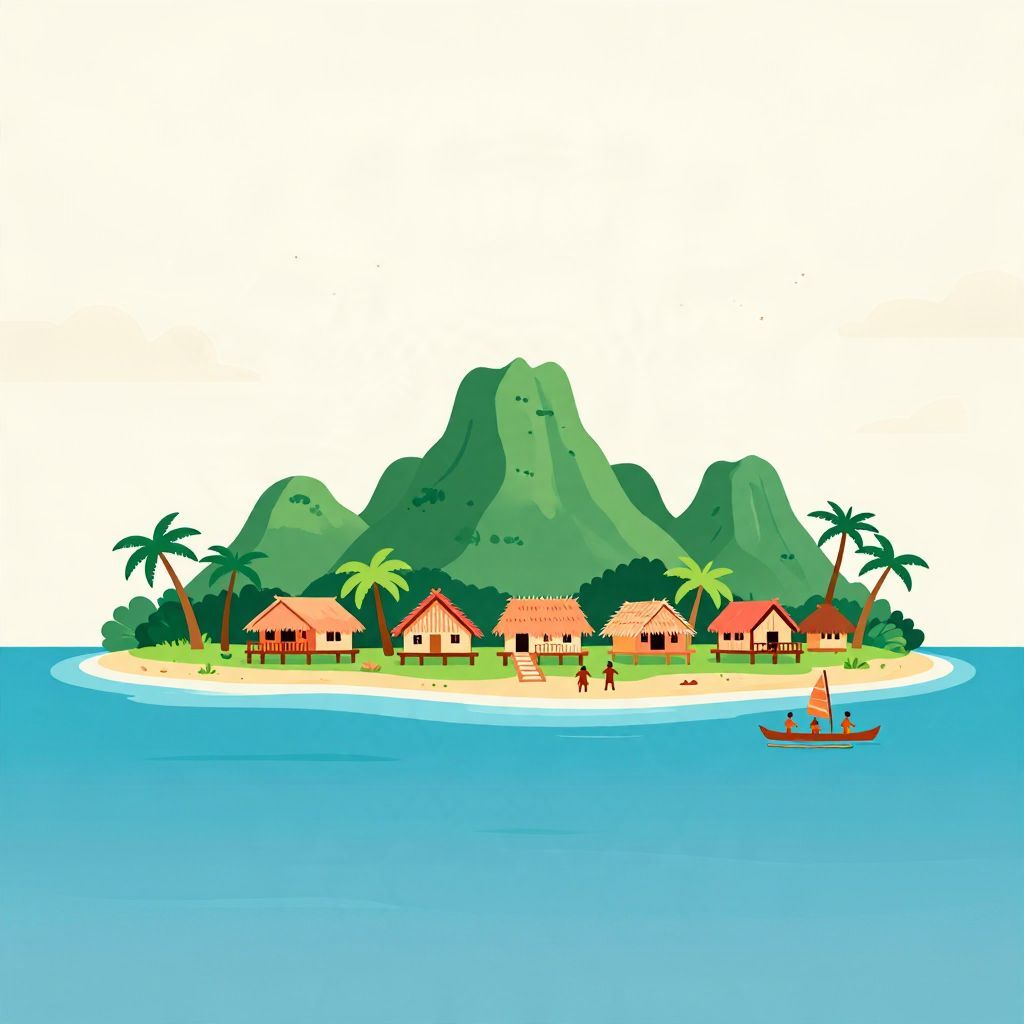
Where are Samoans from? The short answer is that Samoans are from Samoa, a Polynesian archipelago in the central South Pacific. Their ancestors settled these islands thousands of years ago, and Samoan history is tied to wider Polynesian migration, ocean navigation, and the development of a distinct island culture.
Because Samoa’s people also live in large diaspora communities today, the question can mean both a geographic origin and a historical one. To answer it fully, we need to look at the islands themselves, the ancient settlement of Polynesia, and the later political changes that shaped modern Samoan identity.
Where are Samoans from?
Samoans are from the islands of Samoa in Polynesia, in the central South Pacific Ocean. Their ancestral homeland is the Samoan archipelago, which includes the independent state of Samoa and American Samoa. Archaeological and linguistic evidence shows that Samoan culture developed in these islands over many centuries, with roots in the wider Austronesian migration across the Pacific.
The Samoan homeland in the Pacific
Samoa lies roughly halfway between Hawaii and New Zealand, east of Fiji and west of the Cook Islands. The archipelago’s location helped shape Samoan history: it was remote enough to develop its own social and political traditions, but connected enough by canoe travel to remain part of a broader Polynesian world.
What islands make up Samoa?
- Upolu – the most populated island and home to Apia, the capital of independent Samoa
- Savai‘i – the largest island, known for its volcanic landscapes and strong cultural traditions
- Manono and Apolima – smaller inhabited islands
- Several smaller islets and reefs across the archipelago
Today, the name “Samoa” can refer either to the independent country of Samoa or to the broader island group that also includes American Samoa. Historically, however, the islands were understood as a single cultural and geographic region long before modern borders divided them.
How did Samoans first arrive there?
The first settlers of Samoa were part of the great Austronesian expansion, a long process of migration that began in Island Southeast Asia and moved eastward across the Pacific. Most scholars place the settlement of Samoa in the late second millennium BCE, around the time of the Lapita culture, though exact dates are still debated and refined by ongoing research.
The Lapita connection
Lapita people are known for their distinctive pottery, seafaring skills, and role in the early settlement of many Pacific islands. In Samoa, archaeological evidence suggests that these early voyagers brought farming, fishing knowledge, domestic animals, and the foundations of later Polynesian society. Over time, their descendants developed into the distinct Polynesian peoples of Samoa, Tonga, and nearby island groups.
It is important not to imagine a single “arrival” in the modern sense. Settlement was likely gradual, involving exploration, repeated voyages, and the establishment of permanent communities. Samoa was not simply discovered; it was inhabited, adapted to, and culturally transformed by generations of Pacific Islanders.
How Samoan culture developed in the islands
Once settled, Samoa became one of the key centers of early Polynesian civilization. Over centuries, Samoans developed a social system based on extended families, chiefly authority, communal landholding, and strong obligations of service and reciprocity. These traditions remain central to Samoan life today.
Key features of traditional Samoan society
- ‘Aiga – the extended family unit, which remains the basis of social organization
- Matai – chiefly titles held by leaders who represent family groups
- Fa‘a Samoa – “the Samoan way,” a term for cultural values, etiquette, and social order
- Village life – communities organized around kinship, leadership, and shared responsibility
These institutions were not static. They evolved through local experience, competition between chiefly lineages, and contact with neighboring Polynesian societies. Samoa was both deeply rooted in tradition and open to long-distance exchange across the ocean.
Samoa in wider Polynesian history
Samoa played a major role in the formation of Polynesian identity. Many scholars see Samoa and Tonga as especially important in the emergence of early Polynesian political and cultural systems. From these island centers, people, ideas, and chiefly lineages moved across the Pacific, helping shape societies as far away as Hawai‘i, Aotearoa New Zealand, and Rapa Nui.
This does not mean that all Polynesian peoples “came from” Samoa in a simple one-directional sense. Rather, Samoa was one of the key homelands where distinctive Polynesian culture matured. Language, navigation, kinship, and ritual practices developed through interaction among several island societies over long periods.
Language and identity
The Samoan language belongs to the Polynesian branch of the Austronesian language family. It is closely related to Tongan, Tokelauan, and other Polynesian languages. Language evidence supports the idea that Samoans share deep ancestral ties with other Pacific peoples, while also maintaining a distinct linguistic and cultural identity.
European contact and colonial change
European contact began in the eighteenth century, but it was in the nineteenth century that foreign influence intensified. Missionaries, traders, and colonial powers increasingly shaped Samoan politics and economics. Christianity spread widely, and new forms of education, commerce, and government altered island life.
The colonial division of Samoa
In the late nineteenth and early twentieth centuries, rival foreign powers competed for influence in Samoa. The islands were eventually divided in 1899: the eastern islands became American Samoa, while the western islands later became German Samoa and then, after World War I, a New Zealand-administered territory. This division created the modern political split between Samoa and American Samoa.
The split matters when answering “Where are Samoans from?” because many Samoans today live under different national governments, yet share a common historical and cultural heritage. The border is modern; the people and culture are older than the border by many centuries.
Modern Samoa and the Samoan diaspora
In 1962, Western Samoa became the first independent Pacific island nation in the twentieth century. It later shortened its name to Samoa in 1997. American Samoa remains an unincorporated territory of the United States. Despite this political separation, Samoan identity continues to cross borders.
Large Samoan communities now live in New Zealand, Australia, the United States, and elsewhere. Migration has created a global Samoan diaspora, but diaspora communities still often trace identity, family ties, and cultural authority back to villages and chiefly lineages in the islands.
Why many Samoans live outside Samoa
- Labor migration and educational opportunities
- Family reunification and transnational kinship networks
- Economic ties between the islands and larger Pacific economies
- Historical links formed during colonial and postcolonial periods
For many families, “from Samoa” can mean more than birthplace. It can mean ancestry, village affiliation, language, and participation in Samoan customs, even if a person was born abroad.
What is the best historical answer?
If the question is geographical, Samoans are from the Samoan islands in Polynesia. If the question is historical, they descend from ancient Pacific settlers who arrived during the Austronesian expansion and developed a distinct culture in Samoa over many centuries. If the question is cultural, Samoan identity also extends far beyond the islands through migration and diaspora.
So the most accurate answer is this: Samoans are a Polynesian people whose homeland is Samoa, and whose history begins with ancient oceanic settlement, continues through the growth of a distinctive island society, and extends into a modern global diaspora. That long history is what makes Samoan identity both deeply local and widely connected across the Pacific.