
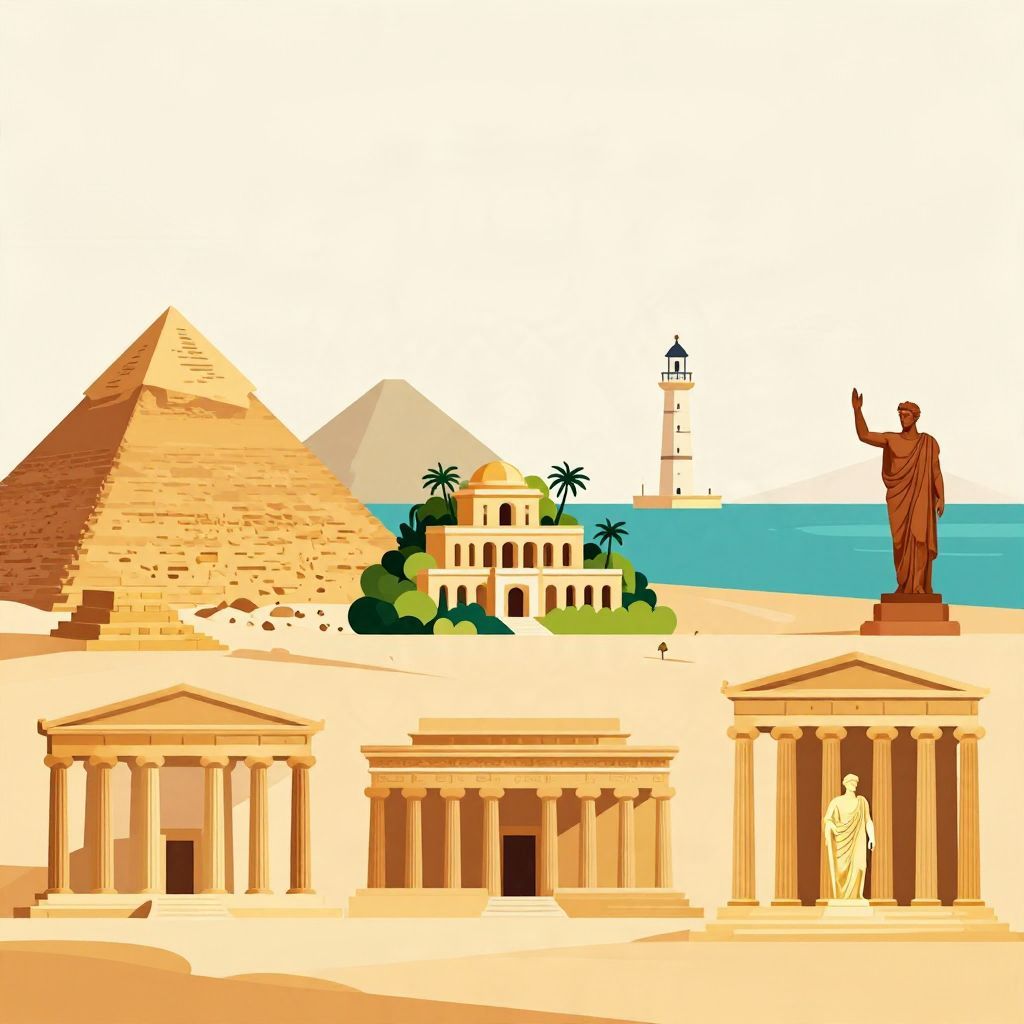
What are the Seven Wonders? The phrase usually refers to the Seven Wonders of the Ancient World, a famous list of extraordinary monuments admired by Greek writers in antiquity. These were not chosen by a formal authority; they emerged from travel writing, storytelling, and cultural admiration for the achievements of the eastern Mediterranean and Near East.
Over time, the list became a symbol of human ingenuity, artistic ambition, and the fragility of great works. Only one of the original wonders survives today, but the idea of “the seven wonders” has lasted for more than two millennia.
What Are the Seven Wonders?
The Seven Wonders are the Great Pyramid of Giza, the Hanging Gardens of Babylon, the Statue of Zeus at Olympia, the Temple of Artemis at Ephesus, the Mausoleum at Halicarnassus, the Colossus of Rhodes, and the Lighthouse of Alexandria. They were celebrated in ancient Greek and Hellenistic literature as the most remarkable monuments known to educated travelers.
Where Did the Idea of the Seven Wonders Come From?
The concept developed in the Greek-speaking world after Alexander the Great’s conquests opened travel and cultural exchange across the eastern Mediterranean and Near East. Greek authors began compiling lists of notable sights, often calling them theamata or wonders, to guide educated travelers and celebrate human achievement. The number seven mattered because it carried symbolic importance in Greek and Near Eastern traditions.
Why seven?
Seven was widely regarded in antiquity as a complete or auspicious number. It appears often in religion, myth, and cosmology. The “seven wonders” were therefore not just a random count; the number helped turn a collection of impressive monuments into a memorable cultural canon.
Who made the list?
No single ancient author invented the list in one moment. Different versions circulated, but writers such as Philo of Byzantium, Antipater of Sidon, and later Strabo helped shape the tradition. Their lists reflected Greek perspectives, especially admiration for monumental architecture and engineering.
The Seven Ancient Wonders Explained
Each wonder was famous for a different reason: size, beauty, engineering, religious significance, or artistic skill. Some were admired in person; others were known through reports, since not every traveler could reach every site. Together, they formed a map of the ancient world’s most astonishing achievements.
1. Great Pyramid of Giza
Built around c. 2580–2560 BCE for Pharaoh Khufu, the Great Pyramid is the oldest and only surviving ancient wonder. It was the tallest human-made structure in the world for nearly 4,000 years. Its precision, scale, and durability made it a marvel even to ancient visitors.
2. Hanging Gardens of Babylon
The Hanging Gardens are the most uncertain of the seven. Ancient writers described a terraced garden of extraordinary beauty in Babylon, but archaeologists have not confirmed its existence there. Some scholars think the story may have been based on later legend, or even confused with gardens elsewhere in Mesopotamia or Assyria.
3. Statue of Zeus at Olympia
Created by the sculptor Phidias around 435 BCE, this massive seated statue of Zeus was made of ivory and gold. It stood inside the Temple of Zeus at Olympia, the site of the ancient Olympic Games. The statue represented both religious devotion and the artistic power of classical Greek sculpture.
4. Temple of Artemis at Ephesus
This grand temple, rebuilt in the 6th and 4th centuries BCE, was dedicated to Artemis, goddess of the hunt and fertility. It was renowned for its size and elaborate decoration. The temple was destroyed and rebuilt more than once, showing how sacred architecture could become a target in war and a symbol of civic pride.
5. Mausoleum at Halicarnassus
Constructed after 353 BCE for Mausolus, a local ruler in Caria, this tomb gave us the word mausoleum. It combined Greek, Egyptian, and Anatolian artistic styles. Ancient observers admired it as both a royal burial monument and a masterpiece of sculpture and architecture.
6. Colossus of Rhodes
The Colossus was a giant bronze statue of the sun god Helios, erected around 280 BCE after Rhodes successfully resisted siege. It stood for only a few decades before an earthquake toppled it. Even in ruins, it remained famous as a symbol of civic triumph and technical daring.
7. Lighthouse of Alexandria
Built on the island of Pharos in Egypt around the 3rd century BCE, the Lighthouse of Alexandria guided ships into a dangerous harbor. It was one of the tallest structures of the ancient world and a practical monument as well as a spectacular one. Earthquakes eventually damaged and destroyed it over centuries.
Why Were These Monuments So Admired?
The Seven Wonders were admired because they represented the highest achievements of the ancient world in engineering, sculpture, religion, and royal power. They were not all the biggest structures ever built, but they were among the most impressive to Greek observers, who valued proportion, craftsmanship, and public display.
Architecture as power
Many wonders were tied to rulers, cities, or sanctuaries seeking prestige. Monumental building communicated wealth, legitimacy, and cultural sophistication. A temple or tomb could serve political purposes as much as religious ones, while also leaving a lasting memory of the patron’s name.
Travel and memory
The wonders were also part of ancient travel culture. Greek and Roman visitors wrote about them because they were worth seeing, describing them as landmarks of a wider known world. In that sense, the list was an early form of cultural tourism, shaped by elite curiosity and literary taste.
What Happened to the Original Seven Wonders?
Most of the ancient wonders were destroyed by earthquakes, fires, war, neglect, or the gradual disappearance of the societies that maintained them. Their loss shows how vulnerable even the grandest monuments can be over long periods. Only the Great Pyramid of Giza remains substantially intact.
A brief fate of each wonder
- Great Pyramid of Giza — still standing, though stripped of much of its casing stones.
- Hanging Gardens of Babylon — existence uncertain; no confirmed remains.
- Statue of Zeus at Olympia — lost, likely destroyed in late antiquity.
- Temple of Artemis at Ephesus — destroyed and rebuilt multiple times; now mostly ruins.
- Mausoleum at Halicarnassus — damaged by earthquakes and later dismantled.
- Colossus of Rhodes — collapsed in an earthquake around 226 BCE.
- Lighthouse of Alexandria — ruined by earthquakes over the medieval period.
How Did the Seven Wonders Shape Later History?
The ancient list became a model for later generations. Medieval and modern writers repeatedly revived the idea of “wonders” to describe the greatest achievements of their own age. The list also influenced how people think about heritage: some monuments are not only useful or beautiful, but worth preserving because they embody human creativity.
From ancient list to modern lists
In modern times, many “seven wonders” lists have been proposed, including lists of natural wonders and new human-made wonders. These are modern cultural projects, not ancient continuations. They show the enduring appeal of ranking extraordinary places, but they should not be confused with the original ancient tradition.
Why the ancient wonders still matter
The original list survives because it captures a powerful historical idea: that human beings can build things so remarkable they outlast their creators in memory, even when the structures themselves disappear. The wonders are therefore as much about ancient identity and storytelling as they are about architecture.
What Is the Historical Meaning of the Seven Wonders?
Historically, the Seven Wonders tell us three important things. First, they reveal what educated Greeks and later Romans admired in the wider world. Second, they show how monuments could symbolize political authority, religious devotion, and technical skill. Third, they remind us that fame and survival are not the same thing: a structure can be legendary even after it is gone.
So, What Are the Seven Wonders Today?
Today, when people ask “What are the Seven Wonders,” they usually mean the ancient list, though the phrase is also used for modern wonders and natural wonders. The original Seven Wonders of the Ancient World remain a cornerstone of historical memory because they connect architecture, empire, religion, and travel in one enduring tradition. If you want to go deeper into ancient monumental history, you may also enjoy reading about what happened to Babylon and which country has the most pyramids.