
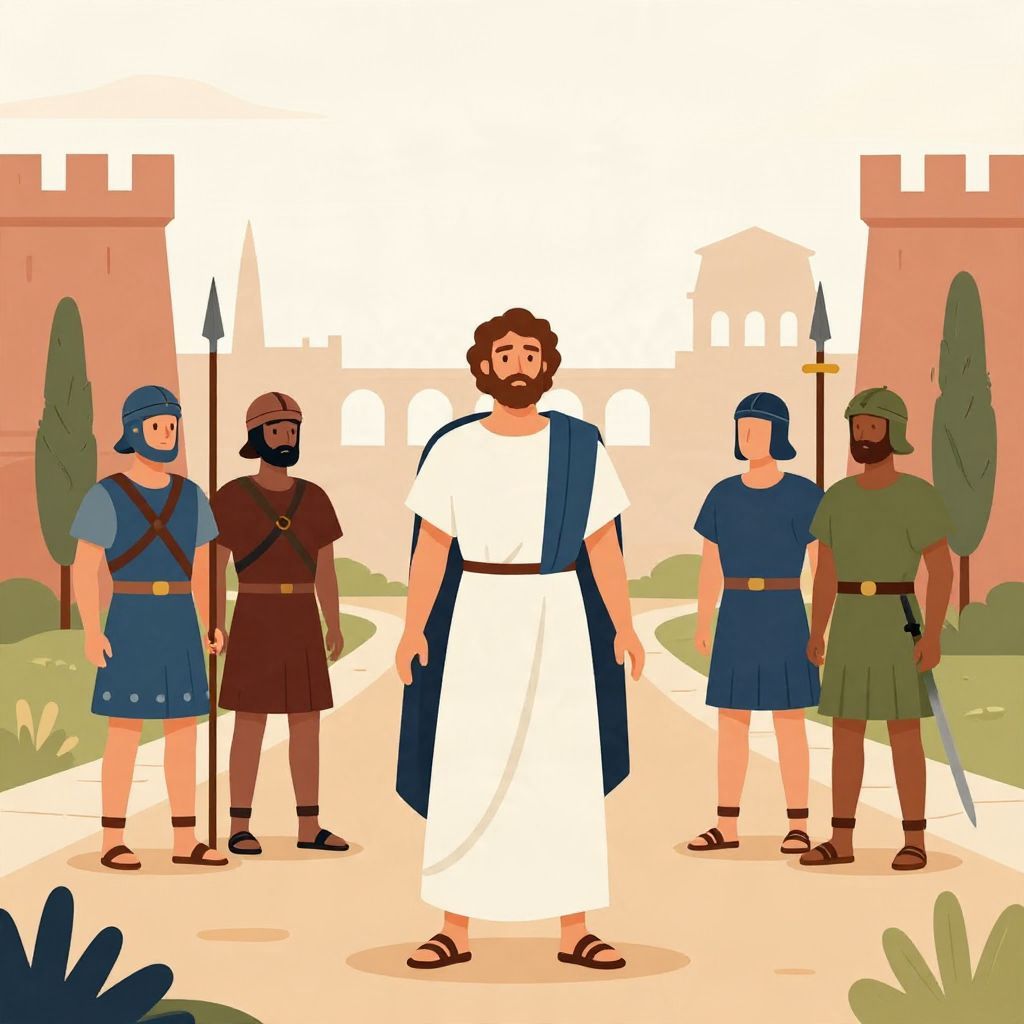
How did Apostle Paul die? The short historical answer is that Paul was probably executed in Rome, most likely by beheading, during the persecution of Christians under Emperor Nero, around the mid-60s CE. That conclusion comes from early Christian tradition rather than from a surviving Roman execution record.
Because Paul’s death is not described in the New Testament, historians rely on later ancient sources and the political context of Nero’s reign. The result is a well-supported tradition, but not absolute certainty.
How Did Apostle Paul Die?
Apostle Paul most likely died by beheading in Rome, around 64–67 CE, during Nero’s persecution of Christians. This is the most widely accepted historical reconstruction, based on early church tradition and Paul’s status as a Roman citizen. While the exact date is uncertain, the tradition of martyrdom in Rome is ancient and influential.
What We Know About Paul’s Final Years
Paul’s last years are pieced together from his letters, the Acts of the Apostles, and later Christian memory. He spent much of his ministry traveling through the eastern Roman Empire, founding communities and writing to them. At some point, he was arrested and eventually taken to Rome, where tradition says he was tried and executed.
Paul’s imprisonment
The New Testament shows Paul under arrest more than once. Acts describes him in custody in Caesarea and then transported to Rome as a prisoner. Some scholars think Paul may have been released after an earlier Roman imprisonment and later arrested again. Others think the Roman journey in Acts already reflects the final phase of his life. The evidence does not allow a completely secure reconstruction.
Why Rome matters
Rome was the center of imperial power, and execution there would have carried symbolic weight. If Paul was indeed killed in Rome, it would fit the broader pattern of how the Roman state dealt with perceived religious or political disturbances. Christians were not yet a legally separate religion in the modern sense, but they could still be punished if seen as socially disruptive or disloyal.
Why Historians Think Paul Was Beheaded
The beheading tradition is linked to Paul’s Roman citizenship. In Roman practice, citizens were often granted a more “honorable” death than crucifixion, which was reserved for non-citizens and slaves. Beheading was a common method of execution for citizens, especially in cases involving treason or serious offenses.
Roman citizenship and execution
Paul repeatedly identifies himself as a Roman citizen in Acts. If that detail is historically reliable, it makes beheading a plausible method of execution. It does not prove the exact manner of death, but it helps explain why later Christians remembered Paul’s end differently from that of Peter, whose martyrdom was associated with crucifixion or another harsher death.
The tradition of martyrdom
Early Christian writers strongly associated Paul with martyrdom in Rome. One of the earliest testimonies comes from 1 Clement, a late first-century Christian text that refers to Paul’s sufferings and witness, though it does not describe his death in detail. Later traditions become more explicit, placing his martyrdom in Rome under Nero.
What Ancient Sources Say
No surviving Roman document records Paul’s execution directly. Instead, the historical picture comes from Christian texts written after his lifetime. These sources are important, but they must be read carefully because they reflect memory, theology, and community tradition as well as history.
1 Clement
1 Clement, usually dated to around the end of the first century, praises Paul as a model of endurance and suffering. It suggests that Paul had already died and was remembered as a faithful witness. Because it is relatively early, historians treat it as significant evidence that Paul’s death was already understood as martyrdom by this time.
Later church tradition
By the second and third centuries, Christian writers more clearly place Paul’s death in Rome and connect it to Nero’s persecution. These later accounts are not eyewitness records, but they show that a stable tradition had formed. The details vary, yet the core claim remains consistent: Paul died as a Christian martyr in the imperial capital.
Acts and Paul’s letters
The New Testament does not narrate Paul’s death. Acts ends with Paul alive in Rome under house arrest, preaching the gospel. His letters also stop before any account of his final moments. That silence is one reason historians must rely on later tradition rather than direct testimony.
When Did Paul Die?
The most common estimate places Paul’s death between 64 and 67 CE, though some scholars prefer a slightly broader range. The usual dating depends on how one reconstructs Paul’s imprisonments and how one connects them to Nero’s persecution after the great fire of Rome in 64 CE.
Connection to Nero’s persecution
After the fire of Rome in 64 CE, Nero reportedly blamed Christians and launched a severe persecution in the city. If Paul was in Rome at that time, he may have been caught up in this crackdown. That is why many historians place his death in the mid-60s, even though the exact year cannot be proven.
Why the date remains uncertain
Ancient chronology is often incomplete. Paul’s movements after his final appearance in Acts are not fully traceable, and later traditions do not always agree on the timeline. As a result, the date of his death is best understood as an informed historical estimate rather than a fixed certainty.
Was Paul Executed for His Faith?
In Christian tradition, yes: Paul died because of his allegiance to Christ and his missionary work. From a Roman perspective, however, the situation may have looked more complex. He could have been treated as a troublesome prisoner, a public nuisance, or someone whose movement attracted suspicion. The motives behind Roman punishment were often political, social, and religious at once.
Martyrdom in the early church
For early Christians, martyrdom meant bearing witness to faith even unto death. Paul became one of the great examples of this ideal. His death was remembered not simply as an execution, but as the final testimony of a man who had spent his life preaching under hardship, imprisonment, and conflict.
Historical caution
It is important not to confuse theological meaning with documentary proof. The claim that Paul died for his faith is historically plausible and deeply rooted in Christian memory, but the exact legal charge against him is unknown. He may have been condemned under general anti-Christian suspicion rather than a specific formal indictment.
Paul’s Death Compared with Peter’s
Early Christian tradition often pairs Paul and Peter as martyrs of Rome. Peter is commonly associated with crucifixion, while Paul is linked to beheading. The contrast likely reflects both social status and symbolic memory: Peter as the apostle to the Jewish-Christian community and Paul as the missionary to the Gentiles.
Why the two deaths are remembered together
By the second century, Rome had become the central place of martyr memory for both apostles. Their deaths were remembered as part of the same era of persecution, even if the precise details differ. This pairing helped shape the authority of the Roman church in later Christian tradition.
What Happened After Paul’s Death?
Paul’s death did not end his influence. His letters circulated among Christian communities and became foundational texts for later theology, ethics, and church organization. His martyrdom also strengthened his authority in Christian memory, turning him into a model of perseverance and fidelity.
Impact on Christianity
Paul’s writings helped define how early Christians understood grace, law, salvation, and the relationship between Jewish and Gentile believers. His death in Rome added a powerful narrative layer: the missionary who had crossed the empire for the gospel was believed to have sealed his witness in the empire’s heart.
Why his death matters historically
Paul’s death matters because it marks the transition from apostolic mission to institutional memory. The church preserved his letters, honored his suffering, and built traditions around his final days. Even where the evidence is incomplete, the historical significance is clear.
The Historical Bottom Line
So, how did Apostle Paul die? The best historical answer is that Paul was probably executed in Rome by beheading, likely during Nero’s persecution in the mid-60s CE. The exact year and legal details are uncertain, but the tradition of his martyrdom is early, widespread, and historically plausible. For readers interested in related apostolic traditions, you may also want to explore how Matthew the Apostle died.