
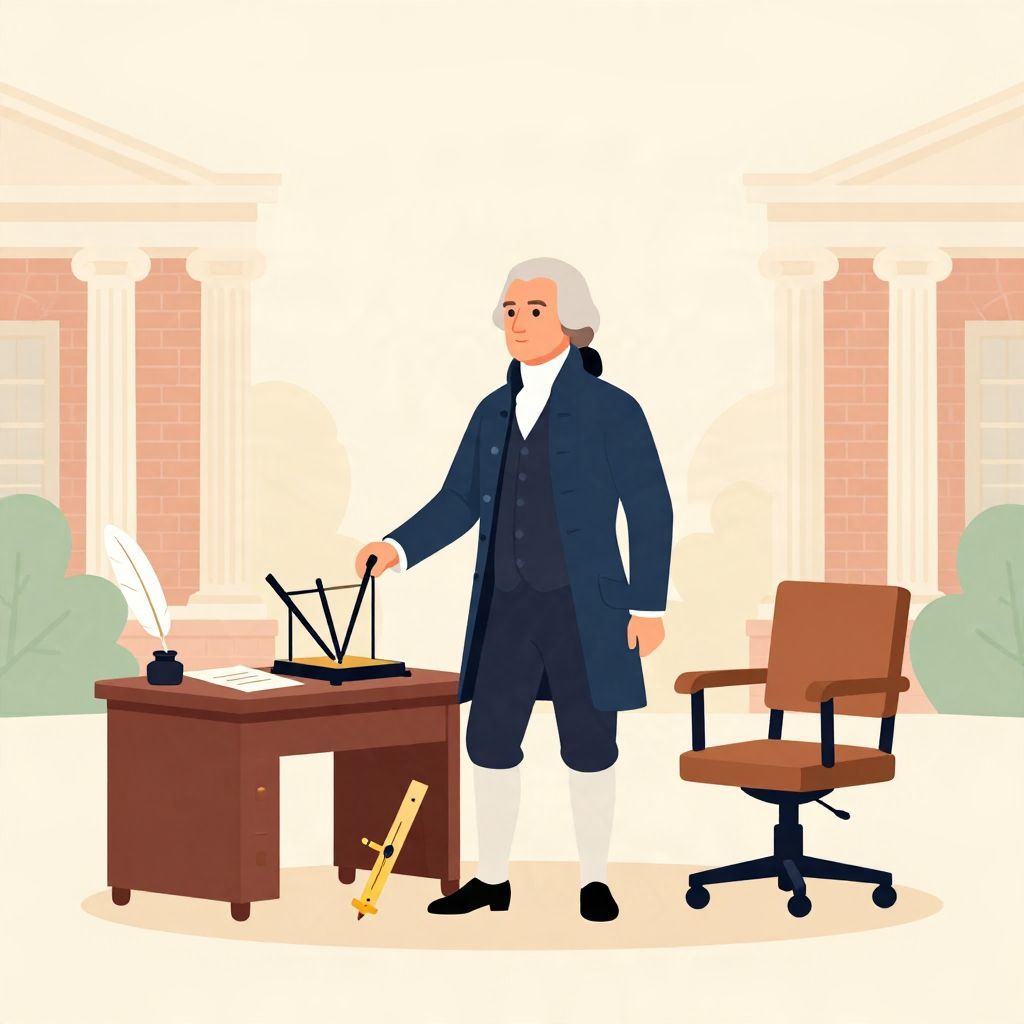
What did Thomas Jefferson invent? The short answer is that Jefferson was not a professional inventor in the modern sense, but he did design, improve, and popularize several practical devices and ideas. His best-known creation is the revolving “polygraph” copying machine, along with improvements to the swivel chair, dumbwaiter, and other household and agricultural tools.
He also helped shape American institutions through ideas rather than gadgets, so the question is really about both inventions and innovations. Jefferson’s legacy includes a mix of mechanical tinkering, scientific curiosity, and political design that reflected the Enlightenment world in which he lived.
What did Thomas Jefferson invent?
Thomas Jefferson invented or improved a small number of practical devices, most famously the polygraph, a machine that copied handwriting in real time. He also made notable improvements to the swivel chair, the dumbwaiter, and farm tools such as the plow. His importance lies less in mass-produced inventions than in his inventive habit of adapting useful ideas.
The clearest answer: Jefferson as an inventor and improver
Jefferson was a hands-on experimenter who kept notes on architecture, agriculture, mechanics, and natural science. He did not leave behind a long list of patented inventions, and many claims about him are exaggerated. But several devices are well documented, especially the polygraph, which he used extensively in the early 1800s to copy letters while writing them.
Why Jefferson’s inventions matter
Jefferson lived in an age when educated elites often mixed politics, science, and practical mechanics. He saw invention as part of improvement: making work easier, communication faster, and daily life more efficient. That mindset helps explain why his contributions were often refinements of existing tools rather than entirely new machines.
The polygraph: Jefferson’s best-known invention
The most famous device associated with Jefferson is the polygraph, a letter-copying machine he adopted in 1804 after seeing an improved version developed by John Isaac Hawkins and refined with the help of Charles Willson Peale. Jefferson became an enthusiastic user and promoter of the machine, which duplicated a letter as it was written. In historical terms, this is the invention most securely linked to him.
How the polygraph worked
The machine used two linked pens. When Jefferson wrote with one pen, the second pen traced the same movements on another sheet. This allowed him to keep an exact copy of outgoing correspondence without rewriting it by hand. In an era before photocopiers, that was a major practical advantage for a busy statesman managing enormous correspondence.
Why it was important
The polygraph mattered because it improved recordkeeping, administration, and personal efficiency. Jefferson wrote thousands of letters over his lifetime, and the ability to preserve copies helped him manage political, diplomatic, and intellectual work. The device also shows how early American leaders often relied on mechanical aids to handle the growing demands of government and private life.
Jefferson’s other practical inventions and improvements
Jefferson’s inventive reputation rests on several smaller but well-known improvements. Some were his own ideas; others were adaptations of existing designs. Historians are careful here because Jefferson often refined tools rather than claiming sole authorship in the modern patent sense.
The swivel chair
Jefferson is commonly credited with adapting the swivel chair while working on the Declaration of Independence in Philadelphia in 1776. The chair was not a brand-new invention, but Jefferson modified it by adding a central spindle that allowed the seat to turn. The design suited his habit of moving between papers and work surfaces while writing.
The dumbwaiter
Jefferson also improved the dumbwaiter, a small serving lift used to move food or objects between floors. In his home at Monticello, he used mechanical systems to reduce labor in domestic service. This fits a broader pattern in Jefferson’s life: he liked devices that saved time and made household operations more orderly.
Improved plows and agricultural tools
Jefferson was deeply interested in farming and experimented with agricultural equipment, especially plow design. He sought ways to reduce soil erosion and make cultivation more efficient. His ideas were part of a larger early American effort to modernize agriculture, though he did not create a single universally adopted “Jefferson plow.”
Other mechanical ideas
Jefferson also sketched or discussed improvements to items such as wheelbarrows, clocks, and bookstands. Some of these remained private experiments or were never built in durable form. In other words, Jefferson was an inventor in spirit, but only a few of his designs became historically significant enough to remember by name.
What Jefferson did not invent
Popular culture sometimes credits Jefferson with far more than the evidence supports. He did not invent the Declaration of Independence, the University of Virginia, the American political system, or the concept of religious liberty from scratch. He also did not create the first plow, the first swivel chair, or the first copying device. His role was usually that of improver, designer, or promoter.
Separating myth from evidence
Jefferson’s fame makes him a magnet for exaggerated claims. Some later writers treated nearly every clever object at Monticello as his personal invention. Historians, however, distinguish between documented inventions, borrowed designs, and household adaptations. That distinction matters because it gives a more accurate picture of Jefferson’s real strengths: observation, refinement, and practical problem-solving.
Jefferson’s inventive mind in context
Jefferson lived during the Enlightenment, when many educated Americans believed that reason and experimentation could improve society. He read widely in science and mechanics and corresponded with inventors, farmers, architects, and instrument makers. His inventive activity was part of a broader intellectual culture that valued improvement as much as originality.
Monticello as a workshop of ideas
Jefferson’s home at Monticello was not just a plantation house; it was also a laboratory of sorts. He designed architectural features, tested household conveniences, and organized the estate around efficiency. The famous “dumbwaiter” and other devices at Monticello reflected his desire to reduce repetitive labor and maximize order, though the labor system itself depended on enslaved people—a crucial and often uncomfortable part of the story.
Innovation and slavery
Jefferson’s inventive interests existed alongside his ownership of enslaved laborers. Many of the efficiencies he pursued at Monticello were built into a plantation economy that relied on forced labor rather than free labor-saving technology. Any historical account of Jefferson’s inventions should therefore avoid romanticizing his ingenuity without acknowledging the human cost of the world that supported it.
A brief timeline of Jefferson’s inventions and improvements
Jefferson’s inventive work unfolded over decades rather than in a single burst. The following sequence shows how his practical interests developed over time:
- 1770s: Jefferson experiments with furniture and writing tools, including the swivel chair tradition associated with 1776.
- 1780s–1790s: He continues to study architecture, agriculture, and mechanical improvements while serving in public life.
- 1804: Jefferson begins using the polygraph and becomes one of its strongest advocates.
- Early 1800s: He refines household devices at Monticello and pursues agricultural improvements.
- Later life: He remains a devoted correspondent and experimenter, preserving his reputation as a practical thinker.
Why Jefferson’s inventions still interest historians
Jefferson’s inventions are important not because they transformed industry on their own, but because they reveal how he thought. He approached the world as something that could be improved through design, measurement, and experimentation. That habit shaped his politics as well: he believed institutions, like tools, could be arranged more intelligently.
From mechanical improvement to political design
This connection between invention and statecraft is one reason Jefferson remains such a compelling historical figure. He helped draft political ideas and institutions with the same confidence that he brought to a chair, a plow, or a copying machine. Even when he was not inventing in the strict sense, he was always trying to make systems work better.
So, what did Thomas Jefferson invent?
Thomas Jefferson is best known for the polygraph, a real-time letter-copying machine, and for practical improvements to objects such as the swivel chair, dumbwaiter, and plow. He was more an inventive improver than a lone genius inventor. His real historical significance lies in the way he combined curiosity, design, and public life into a distinctly Enlightenment style of innovation.
If you want to explore Jefferson’s wider historical world, it also helps to read about the Northwest Ordinance and the broader changes of the Market Revolution, both of which shaped the era in which his ideas and inventions took form.