
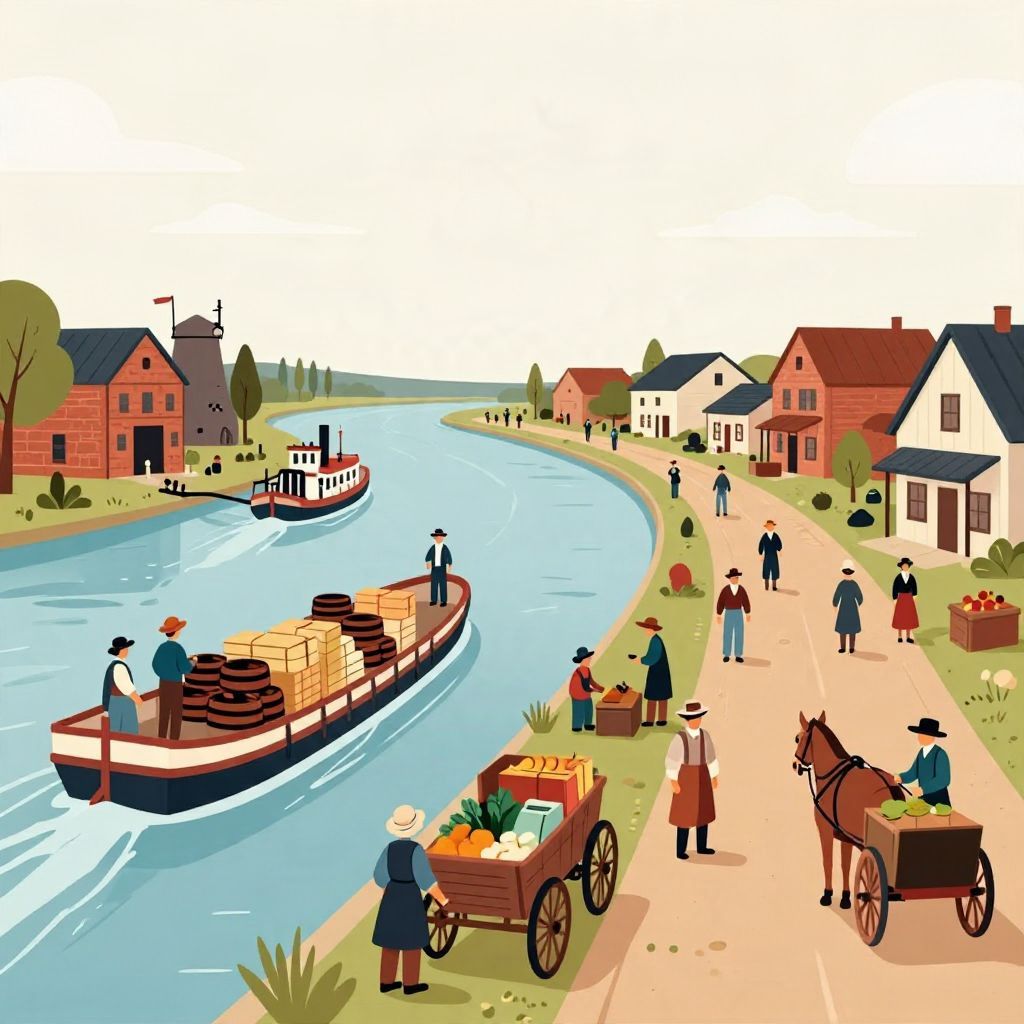
The Market Revolution was a major transformation in the United States during the late 18th and early 19th centuries, when many Americans shifted from local, household-based production toward a more connected, commercial economy. It changed how goods were made, sold, and transported, and it reshaped work, family life, politics, and regional development.
Historians use the term to describe a broad process rather than a single event. It is most often associated with the decades after the War of 1812, when roads, canals, banks, factories, and new business practices helped turn the young republic into a more market-oriented society.
What Is the Market Revolution?
The Market Revolution was the early 19th-century shift in the United States from subsistence and local exchange to production for distant markets. It involved transportation improvements, commercial farming, wage labor, and expanding finance. The result was a faster, more interconnected economy that altered everyday life and widened regional differences.
Origins of the Market Revolution
The Market Revolution did not begin all at once. Its roots lay in the late colonial and Revolutionary eras, when trade networks, land expansion, and changing ideas about economic opportunity started to loosen older patterns of household production. After independence, Americans increasingly pursued profit, mobility, and commercial growth.
Why did it happen?
Several forces pushed the change forward. Population growth created demand for food, clothing, and land. New technologies and transport systems lowered the cost of moving goods. At the same time, political independence encouraged Americans to think of economic development as a national goal rather than a colonial dependency.
- Population growth: More people meant more consumers and more workers.
- Transportation improvements: Roads, turnpikes, canals, and later railroads linked distant regions.
- Financial expansion: Banks, credit, and investment made larger-scale commerce possible.
- Industrial change: Factories began to replace some forms of household manufacturing.
- Land expansion: Western settlement opened new farmland and new markets.
How the Market Revolution Changed the Economy
The most visible change was the rise of production for sale rather than for direct household use. Farmers increasingly grew crops for market, artisans competed with factory-made goods, and merchants linked rural producers to urban consumers. The economy became more specialized, more competitive, and more dependent on cash and credit.
From household production to wage labor
Before the Market Revolution, many families produced much of what they needed at home or in local communities. Over time, however, more workers left household production and entered wage labor. This was especially true in textiles, where factory systems employed women and children in large numbers, most famously in New England mill towns.
Transportation and communication
Infrastructure was essential to the new economy. The Erie Canal, completed in 1825, is one of the best-known examples because it dramatically reduced shipping costs between the Great Lakes and the Atlantic coast. Roads, steamboats, and later railroads helped connect farms, towns, and cities into a larger commercial system.
These improvements mattered not just because they moved goods faster, but because they changed where people could live and work. Farmers could ship grain or livestock farther away. Merchants could reach new customers. Cities grew as hubs of finance, manufacturing, and distribution.
What Regions Were Most Affected?
The Market Revolution affected the United States unevenly. The Northeast industrialized more rapidly, the Midwest became a major agricultural supplier, and the South expanded plantation slavery to meet global demand for cotton. Rather than creating one uniform economy, the Market Revolution intensified regional specialization.
The Northeast
In New England and nearby states, factories, mills, and commercial centers grew quickly. Textile production became especially important, and towns such as Lowell, Massachusetts, became symbols of early industrialization. Many young women worked for wages in these mills, a significant change from older expectations of labor within the household.
The Midwest and the expanding West
As settlers moved westward, they transformed the Old Northwest and other frontier regions into commercial farming zones. Wheat, corn, pork, and other products flowed eastward through canals and roads. This expansion was tied to land policy, migration, and the creation of new states, all of which deepened national economic integration.
The South
The Market Revolution did not weaken slavery; in many ways, it strengthened it. The rise of cotton as a profitable global crop after the invention of the cotton gin and the growth of textile demand in Britain and the North made enslaved labor even more valuable to Southern planters. The South became more tightly bound to market forces while remaining socially and politically committed to slavery.
Social and Cultural Consequences
The Market Revolution changed more than commerce. It altered family structures, gender roles, class relations, and ideas about independence. As work moved out of the household and into factories, shops, and farms tied to cash markets, people experienced both new opportunities and new forms of insecurity.
Women and work
For many women, especially in the North, the new economy created wage-earning opportunities that had not existed before on the same scale. Mill work gave some young women a degree of income and mobility, though under strict supervision and demanding conditions. At the same time, middle-class ideals increasingly emphasized domesticity, separating women’s supposed moral role from men’s public economic life.
Class and inequality
The Market Revolution also widened economic inequality. Some merchants, manufacturers, and landowners prospered, but many workers faced unstable wages, debt, and the pressure of competition. Economic growth did not mean shared prosperity. In many communities, the shift to market dependence made families more vulnerable to price swings and financial crises.
Changing ideas of freedom
Americans increasingly debated what freedom meant in a commercial society. For some, freedom meant the chance to buy, sell, and improve one’s economic position. For others, especially workers and antislavery critics, market dependence could feel like a new form of constraint. These tensions became central to 19th-century political and social life.
Politics, Reform, and Resistance
The Market Revolution helped shape politics by encouraging debates over banks, tariffs, internal improvements, and the role of government in economic development. Some Americans wanted a stronger state to support commerce and infrastructure, while others feared concentrated power and corporate privilege. These disputes became a defining feature of the early republic.
Support and criticism
Supporters argued that roads, canals, and banks would promote national prosperity. Critics worried that market growth would enrich elites, undermine republican virtue, and increase dependence. Religious and reform movements also responded to the social disruptions of the era, including temperance, abolitionism, and moral reform campaigns.
Labor unrest and protest
Workers did not passively accept the new order. Artisans protested wage cuts and mechanization, while farmers resisted debt and market pressures. Enslaved people resisted in far more dangerous conditions through escape, rebellion, and everyday acts of defiance. The Market Revolution was therefore not only a story of growth, but also of conflict.
How Historians Understand the Market Revolution
Historians use the term “Market Revolution” to capture a real and important transformation, but they also debate its scope and meaning. Some emphasize economic modernization and national integration. Others stress that the process was uneven, regionally varied, and deeply tied to slavery, dispossession of Native peoples, and class conflict. It was not a smooth or universally beneficial transition.
In other words, the Market Revolution was not simply the arrival of progress. It was a period when older local economies and social arrangements were reorganized by commerce, transportation, and industrial change. The benefits were substantial for some Americans, but the costs were also significant, especially for enslaved people, displaced Native communities, and workers exposed to new market pressures.
Why the Market Revolution Matters
The Market Revolution matters because it helped create the modern United States economy. It linked distant regions, encouraged industrialization, expanded capitalism, and deepened sectional divisions that would later contribute to the Civil War. It also changed how Americans worked, traveled, shopped, and imagined success.
Just as importantly, the Market Revolution shows that economic change is never purely economic. It affects politics, family life, social hierarchy, and ideas about freedom. Understanding it helps explain why the early 19th century was such a turning point in American history.
In short, the Market Revolution was the shift that turned the early United States from a mostly local, household-based society into a more commercial and interconnected nation. For related background, see when the Market Revolution took place and what the Northwest Ordinance was.