
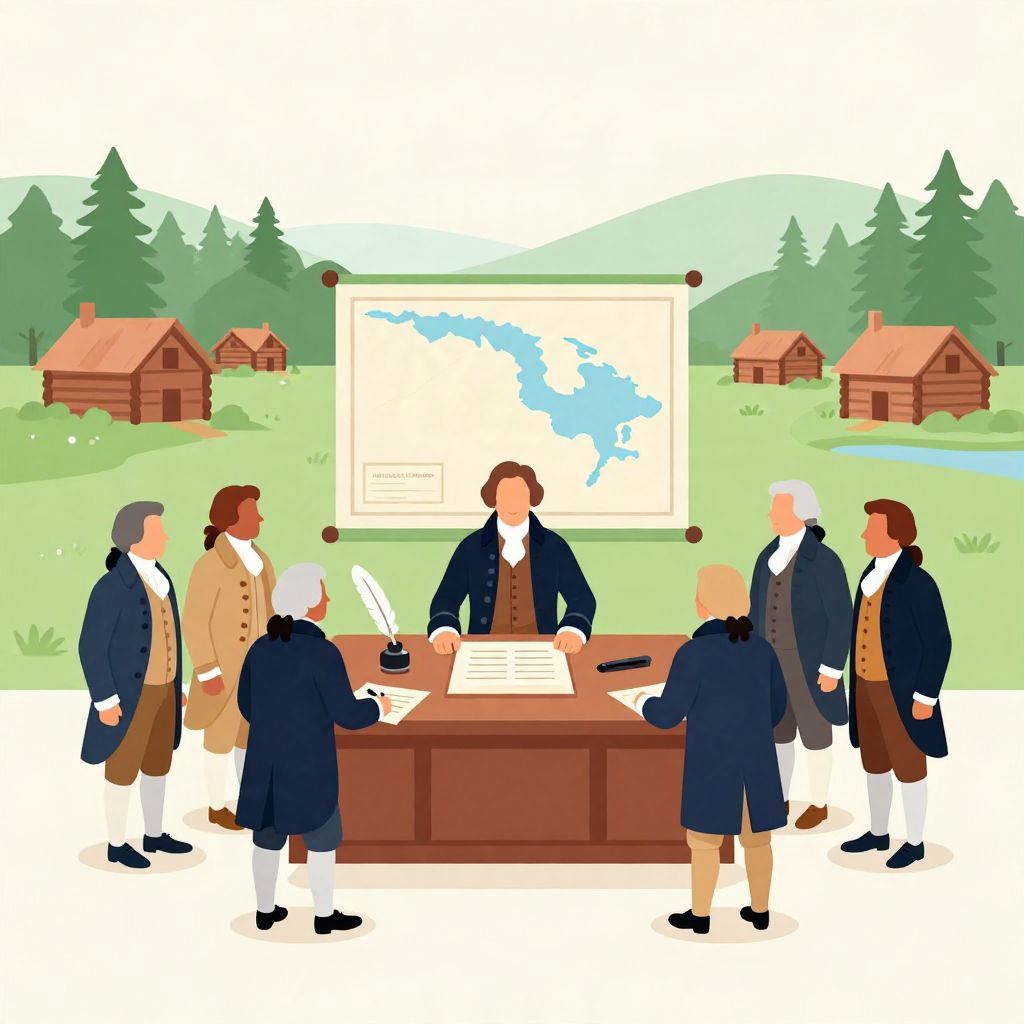
What was the Northwest Ordinance, and why does it still matter in American history? Passed by the Confederation Congress in 1787, it was the law that organized the Northwest Territory—land north of the Ohio River and east of the Mississippi—and set rules for settlement, government, and eventual statehood.
It also limited slavery in the territory, protected certain civil liberties, and created a model for how the United States would expand westward. In many ways, the ordinance became one of the most important early frameworks for turning frontier land into states.
What Was the Northwest Ordinance?
The Northwest Ordinance was a major law adopted on July 13, 1787, by the Congress of the Confederation. It established a governing system for the Northwest Territory, which included the future states of Ohio, Indiana, Illinois, Michigan, Wisconsin, and part of Minnesota. It also laid out a process for creating new states and banned slavery in the territory.
Why Was the Northwest Ordinance Created?
After the American Revolution, the new nation faced a practical problem: it had acquired vast western lands but no clear plan for governing them. Several states claimed overlapping western territories, and Congress needed a way to manage settlement, prevent conflict, and turn frontier land into stable political communities.
The ordinance grew out of that need. It was designed to replace confusion with an orderly system. Rather than allowing the western lands to become a patchwork of private claims, military outposts, or competing state ambitions, Congress created a territorial structure that could eventually produce equal states.
The land question after independence
Britain ceded the region to the United States at the end of the Revolutionary War, but the new government was weak under the Articles of Confederation. Congress had limited power, yet it needed to assert authority over the West. The ordinance helped do that by setting federal rules for land and governance.
Influence of earlier land policy
The law was not created in a vacuum. It drew on earlier proposals and debates about how to divide and govern western lands. Thomas Jefferson’s 1784 land proposal and later congressional discussions helped shape the idea that new western territories should eventually become states rather than colonies.
What Did the Ordinance Actually Do?
The Northwest Ordinance did several things at once: it created a territorial government, established a path to statehood, protected some rights, and restricted slavery. Its significance lies not in one clause alone but in the way it tied expansion to constitutional order.
1. It organized territorial government
At first, the territory would be governed by a federally appointed governor, secretary, and judges. Once the population grew, residents could elect a territorial legislature. This staged approach helped Congress manage frontier settlement without giving immediate full self-government.
2. It created a route to statehood
The ordinance set a three-stage process. When a territory reached a certain population threshold, it could elect a legislature. When it reached a larger population, it could draft a state constitution and ask for admission to the Union. This became a lasting model for U.S. expansion.
3. It protected civil and religious liberties
The ordinance included a bill of rights for the territory. It protected freedom of religion, trial by jury, habeas corpus, and other legal principles. These protections reflected Revolutionary-era ideals and helped define what many Americans believed republican government should look like.
4. It banned slavery in the territory
One of the ordinance’s most famous provisions prohibited slavery in the Northwest Territory, though it allowed the return of fugitive enslaved people who had escaped from states where slavery was legal. This made the ordinance an early federal restriction on slavery’s expansion, but it did not end slavery everywhere or settle the national debate.
Who Made the Northwest Ordinance?
The ordinance was passed by the Confederation Congress, and several prominent figures helped shape the broader debate over western lands. Manasseh Cutler, a New England minister and land speculator, played a major role in lobbying for the law. Nathan Dane is often credited with drafting much of the final version.
It is important not to oversimplify authorship. Like many major laws, the ordinance was the product of negotiation, amendment, and compromise. It reflected competing interests: settlers, land companies, anti-slavery advocates, and politicians who wanted an orderly national expansion.
What Land Did the Northwest Ordinance Cover?
The Northwest Territory was the region north of the Ohio River, east of the Mississippi River, and south of the Great Lakes. In modern terms, it included most of Ohio, Indiana, Illinois, Michigan, Wisconsin, and the northeastern corner of Minnesota.
This was not empty land. Indigenous nations had lived there for centuries, including the Shawnee, Miami, Delaware, Wyandot, Ojibwe, Potawatomi, and others. The ordinance treated the region as federal territory to be surveyed and settled, but Native peoples were not consulted in any meaningful way. That omission would lead to conflict and dispossession in the decades that followed.
Why Was the Ordinance So Important in U.S. History?
The Northwest Ordinance mattered because it became a blueprint for American expansion. It showed that the United States could grow beyond its original thirteen states without simply annexing land as colonies. Instead, territories could move through a defined process toward equal statehood.
That idea became central to the nation’s political development. The ordinance helped establish the principle that new states would enter the Union on an equal footing with the original states. This was a powerful concept in a young republic still deciding whether it would be a loose confederation of regions or a more unified nation.
A model for later territorial expansion
Later territorial laws borrowed from the Northwest Ordinance’s structure. As the United States expanded westward, Congress repeatedly used territorial government, population thresholds, and statehood procedures similar to those first outlined in 1787.
A precedent in the slavery debate
The slavery restriction gave the ordinance long-term political importance. In the early republic, the question of whether slavery would expand into new territories became one of the central issues in American politics. The ordinance did not settle that conflict, but it established a precedent that anti-slavery lawmakers would later invoke.
How Did the Northwest Ordinance Affect Native Peoples?
From the perspective of Indigenous nations, the ordinance was part of a larger process of U.S. expansion that threatened their homelands. Although the law organized American settlement, it did not recognize Native sovereignty in any meaningful way. The federal government claimed the right to govern and distribute the land even though many Native nations already occupied it.
That disconnect produced war and displacement. In the Northwest Territory, U.S. expansion triggered a series of conflicts in the 1790s, including the Northwest Indian War. The ordinance’s promise of orderly settlement looked very different on the ground, where land hunger, broken treaties, and military pressure reshaped Native life.
What Happened After the Ordinance?
The ordinance was not a one-time event; it shaped the next century of American growth. The first states created from the Northwest Territory entered the Union in the early 19th century, beginning with Ohio in 1803. Indiana, Illinois, Michigan, Wisconsin, and part of Minnesota followed later.
Its political legacy lasted even longer. The Northwest Ordinance became a touchstone for debates over federal authority, slavery, and the meaning of state equality. It also influenced the way Americans imagined the West: not as a permanent frontier, but as a sequence of territories destined for statehood.
Key outcomes
- Established a federal territorial system for the Old Northwest
- Set a path from territory to statehood
- Protected certain civil liberties in the region
- Prohibited slavery in the territory
- Created a lasting model for U.S. westward expansion
Was the Northwest Ordinance a Success?
In administrative terms, yes. It gave the new nation a workable method for governing western lands and admitting new states. In constitutional and political terms, it was one of the most successful early laws in American history. It helped transform a fragile confederation into a republic capable of territorial growth.
But its success had limits. The ordinance did not prevent violence, dispossession, or later sectional conflict over slavery. It organized American expansion while leaving Native peoples outside the political system and postponing deeper national questions about race, land, and power.
What Is the Historical Meaning of the Northwest Ordinance?
The Northwest Ordinance is best understood as a founding document of American expansion. It was not the Constitution, but it was nearly as important in practice for shaping how the United States would grow. It linked land policy, republican government, and state formation in one framework.
Its enduring significance lies in that combination: it was a law about territory, but it also expressed an idea of the nation itself. The United States would expand, but ideally through law, settlement, and eventual equality among states. That ideal was never fully realized, yet it became one of the most influential principles in early American history.
If you want to place the Northwest Ordinance in the broader story of the early republic, it helps to explore the nation’s founding era and the political system that emerged after independence. You may also find related background useful in American history overviews and in discussions of when the United States was founded.