
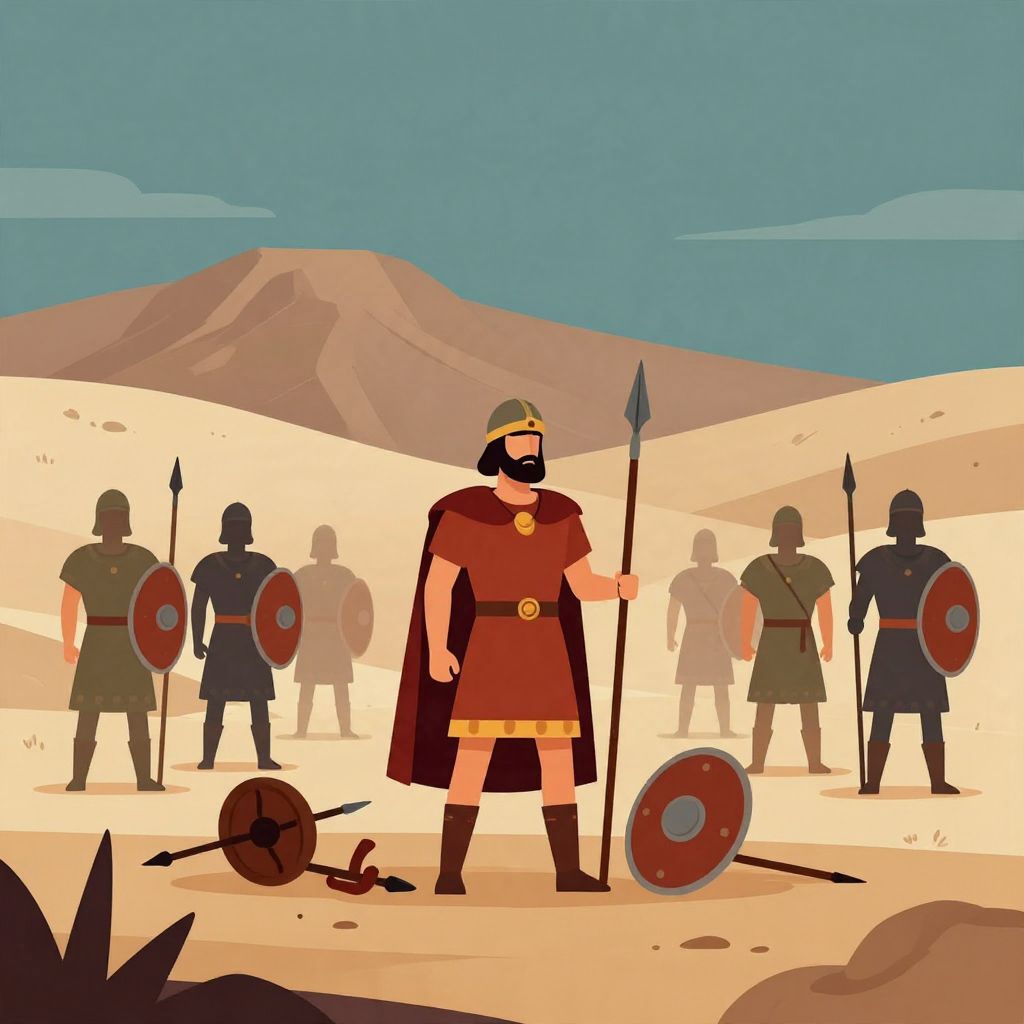
What happened to King Saul is one of the most important turning points in the biblical history of ancient Israel. Saul, the first king of the Israelites, rose to power in a period of tribal instability, but his reign ended in military defeat, personal tragedy, and political collapse.
According to the biblical narrative, Saul died in battle against the Philistines on Mount Gilboa, around the early 10th century BCE. His death opened the way for David’s rise and marked the transition from Israel’s first monarchy to a more stable royal dynasty.
What happened to King Saul?
King Saul died during a Philistine battle at Mount Gilboa after Israel’s forces were overwhelmed. The biblical account says Saul was wounded, feared capture and humiliation, and fell on his own sword. His death ended his reign, led to the deaths of his sons, and cleared the path for David to become king.
Saul’s rise as Israel’s first king
Saul appears in the biblical books of 1 Samuel as Israel’s first monarch, chosen at a time when the Israelite tribes were loosely organized and often threatened by neighboring powers. The monarchy was meant to provide stronger military leadership and political unity. Saul’s early reign was marked by success, but also by tension with the prophet Samuel and growing instability within his court.
Why Israel wanted a king
The biblical text presents the demand for a king as a response to insecurity. The tribes faced external enemies, especially the Philistines, and lacked a centralized government. Saul’s kingship represented a major political change: Israel was moving from a tribal confederation toward a monarchy.
Saul’s early achievements
Saul is remembered as a capable military leader in the beginning. He fought enemies on Israel’s borders and helped unify the tribes in war. Yet the narrative also shows that his authority was never fully secure. Religious disobedience, strained relations with Samuel, and fear of rivals weakened his position over time.
The road to Saul’s downfall
Saul’s decline was not caused by one event alone. In the biblical account, it was a combination of military pressure, political anxiety, and spiritual rejection. His conflicts with David are especially important, because David’s success made Saul increasingly suspicious and unstable.
Saul and David
David first appears as a gifted young warrior and musician who enters Saul’s service. After David’s victory over Goliath, his popularity grew, and Saul began to see him as a threat. The text describes repeated attempts by Saul to kill David, reflecting a court divided by fear and rivalry. Whether read historically or theologically, this conflict is central to understanding Saul’s collapse.
Military pressure from the Philistines
The Philistines were among Israel’s most serious enemies in this period. Their military strength and control of strategically important areas made them a constant threat. Saul’s final battle took place in this broader struggle for survival, and his defeat suggests that Israel’s early monarchy was still fragile.
How did King Saul die?
Saul died in battle on Mount Gilboa, according to 1 Samuel 31. The Philistines defeated Israel’s army, Saul’s sons were killed, and Saul himself was badly wounded by archers. Fearing capture and abuse, he asked his armor-bearer to kill him. When the armor-bearer refused, Saul fell on his sword. The armor-bearer then did the same.
The biblical account of his death
The story is stark and tragic. Saul’s defeat is presented as total: the army is routed, the royal line suffers heavy losses, and the king dies by suicide rather than surrender. His body is later displayed by the Philistines, a humiliating act meant to signal victory and dominance.
A note on historical certainty
Because Saul belongs to the early Iron Age and the main narrative comes from biblical literature, historians cannot verify every detail independently. The battle at Mount Gilboa may reflect a real conflict remembered and shaped by later writers. What is secure is that Saul’s death symbolizes the end of an unstable first monarchy and the beginning of David’s rise.
What happened immediately after Saul died?
Saul’s death created a political vacuum. His son Ish-bosheth became king over part of Israel, while David was first established as king in Judah. This division shows that Saul’s kingdom did not simply pass smoothly to a successor. Instead, Israel entered a period of fragmentation and civil rivalry before David eventually gained wider control.
The fate of Saul’s family
Several of Saul’s sons died with him at Gilboa, including Jonathan, who had been David’s close friend. Jonathan’s death is one of the most poignant details in the narrative, because it combines political tragedy with personal loss. Saul’s line did not disappear immediately, but it was severely weakened.
David’s reaction
The biblical account emphasizes that David mourned Saul and Jonathan. This is important because it complicates a simple story of replacement. David is not portrayed as celebrating Saul’s death; instead, he is shown lamenting the fall of the previous king. That mourning helped legitimize David’s eventual rule and softened the transition in the narrative.
Why did Saul’s reign end in failure?
Historians and biblical scholars usually explain Saul’s fall through a mix of political, military, and literary factors. The text itself interprets his downfall as the result of disobedience to God, but from a historical perspective, several practical pressures likely contributed to his collapse.
1. Weak central authority
Saul ruled over a coalition of tribes, not a fully developed state. That made long-term stability difficult. A king in this setting had to balance tribal loyalties, military demands, and local leadership, all without the administrative machinery of later kingdoms.
2. Military setbacks
Repeated conflict with the Philistines exposed the limits of Saul’s power. A king who could not secure lasting victory risked losing support. The defeat at Mount Gilboa was especially devastating because it ended his reign in a public and catastrophic way.
3. Court rivalry and succession problems
Saul’s conflict with David shows that succession was already a problem before Saul died. The monarchy had not yet developed clear rules for inheritance or transfer of power. Once Saul’s authority weakened, rival claims quickly emerged.
4. Theological interpretation in the biblical text
In the biblical tradition, Saul’s failure is also moral and spiritual. The narrative links his downfall to disobedience, fear, and rejection by God. This interpretation matters because the books of Samuel are not neutral court records; they are theological history, written to explain why Saul fell and why David’s house rose.
Historical impact of Saul’s death
Saul’s death mattered far beyond one battlefield. It marked the end of Israel’s first royal experiment and the beginning of a new political order. David would eventually unite the tribes more effectively, establish a capital at Jerusalem, and create a dynasty remembered as foundational in later Jewish tradition.
The rise of the Davidic monarchy
Without Saul’s death, David’s path to kingship would have been much less direct. Saul’s fall removed the strongest obstacle to David’s rule. Over time, David became the model king in biblical memory, while Saul came to represent the dangers of failed leadership and lost favor.
Long-term religious significance
Saul’s story also shaped later ideas about kingship itself. The biblical writers used his reign to ask what makes a ruler legitimate: military success, obedience to divine command, or political skill. In that sense, Saul’s death was not just an ending but part of a larger argument about power, faith, and national identity.
Saul in history and memory
Saul occupies a complicated place between history and tradition. He is both a possible early monarch in the formation of Israel and a literary figure shaped by later biblical authors. Because of that, modern readers should distinguish between the probable historical core of his reign and the theological meaning the text assigns to it.
What historians can say with confidence
- Saul belongs to the early period of Israelite monarchy, likely around the 11th or early 10th century BCE.
- His reign ended in conflict with the Philistines.
- His death was followed by political fragmentation and the rise of David.
- The biblical narrative treats his fall as both a military defeat and a moral turning point.
What remains uncertain
Exact dates, battlefield details, and the full extent of Saul’s kingdom remain uncertain. The biblical text is the main source, and it reflects later interpretation as much as direct memory. Still, the broad outline is clear: Saul’s reign ended in defeat, and that defeat changed the course of Israelite history.
So, what happened to King Saul? He died in battle against the Philistines at Mount Gilboa, after a reign marked by early promise, growing instability, and conflict with David. His death ended Israel’s first monarchy and set the stage for David’s rise. For related reading, see how Saul died and how King David died.