
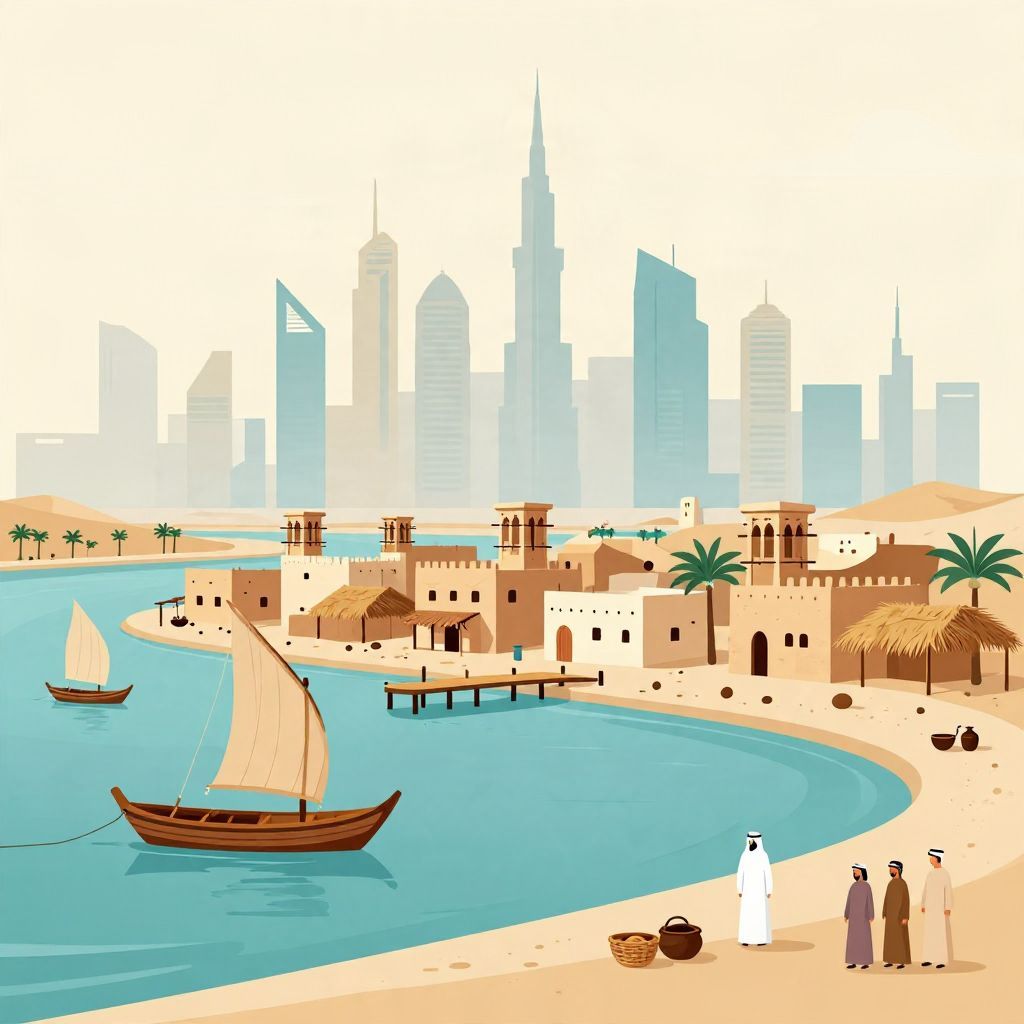
When was Dubai built? The short answer is that Dubai was not “built” all at once. It began as a small settlement by the early 19th century, with the first clear written reference dating to 1822, and it grew from a pearling and trading creek town into a modern city over the next two centuries.
Because Dubai developed gradually, the better historical question is when it first emerged as a recognizable settlement and when it became the city known today. That answer depends on whether you mean the origins of the town, the rise of the ruling dynasty, or the modern metropolis created by oil wealth, trade, and ambitious urban planning.
When Was Dubai Built?
Dubai was not founded on a single exact date. The settlement is documented by at least 1822, and many historians trace its growth from the early 1800s, when the Bani Yas tribe and the Al Maktoum family established themselves there. The modern city, however, was built much later, especially from the 1950s onward.
Dubai’s Early Origins: A Creek Settlement
From coastal village to trading post
Long before skyscrapers and highways, Dubai was a small coastal community on the southern shore of the Persian Gulf. Its location beside a natural creek made it useful for fishing, pearling, and maritime trade. Like many Gulf settlements, it depended on the sea, seasonal movement, and regional commerce rather than large-scale agriculture.
Archaeological evidence shows human activity in the wider Dubai area far earlier than the 19th century, but that does not mean the city itself existed in its modern form. The historical Dubai most people mean today began as a modest settlement that took shape in the early 1800s.
The 1822 reference
The earliest widely cited written reference to Dubai appears in 1822, when British records described it as a small town. This is important because it gives historians a firm date for Dubai’s presence as a known settlement in the historical record, even if people had lived in the area before then.
The Al Maktoum Family and the Making of Dubai
Why 1833 matters
A major turning point came in 1833, when the Al Maktoum family, part of the Bani Yas tribal confederation, moved to Dubai and took control of the settlement. This event is often treated as the beginning of modern Dubai’s political history. The Al Maktoums have ruled Dubai ever since, making the city’s leadership unusually continuous by regional standards.
The family’s arrival did not instantly transform Dubai into a major city. Instead, it provided stable leadership, helped organize trade, and encouraged the creek settlement to expand. In historical terms, 1833 is one of the most important dates in Dubai’s development because it marks the start of the dynasty that shaped its future.
Trade, pearling, and regional connections
During the 19th century, Dubai’s economy rested on pearling, fishing, boatbuilding, and commerce. The creek allowed dhows to anchor and unload goods, linking Dubai to India, Iran, East Africa, and other Gulf ports. This commercial role mattered more than territorial size. Dubai was still small, but it was strategically placed in a wider Indian Ocean trading world.
A Timeline of Dubai’s Growth
Dubai’s history is best understood as a sequence of stages rather than a single founding moment. A simplified timeline looks like this:
- Early 1800s: A small settlement exists on Dubai Creek.
- 1822: Dubai appears in British records as a town.
- 1833: The Al Maktoum family settles in Dubai and begins its rule.
- Late 1800s: Dubai grows as a trading and pearling center.
- 1900s–1930s: Trade expands, though the economy remains vulnerable to fluctuations in pearling and regional markets.
- 1950s: Major infrastructure projects begin, including dredging the creek and improving port facilities.
- 1966: Oil is discovered in commercial quantities, accelerating development.
- 1971: Dubai joins the newly formed United Arab Emirates.
- Late 20th century onward: Dubai becomes a global city built around trade, finance, tourism, aviation, and real estate.
How Dubai Became a Modern City
The creek and the first wave of urban expansion
For much of its early history, Dubai remained compact. The creek was the city’s lifeline, but it also limited growth because larger ships could not easily enter. In the mid-20th century, leaders invested in dredging and port improvements, which made trade easier and encouraged the town to expand beyond its original core.
This was a crucial shift. Dubai’s identity changed from a local Gulf port to a place that could handle larger volumes of commerce. Urban growth followed infrastructure, not the other way around.
Oil and diversification
Oil discovery in 1966 transformed Dubai’s finances, but the city’s development story is more nuanced than “oil made Dubai rich.” Compared with some neighboring emirates, Dubai’s oil reserves were relatively limited. That pushed its rulers to diversify early, investing in ports, aviation, business services, and tourism rather than relying solely on petroleum.
That strategy helped shape modern Dubai. The city became known not just for wealth, but for deliberate planning: free trade, transport links, and large-scale construction projects designed to attract global business.
Joining the United Arab Emirates
In 1971, Dubai became one of the seven emirates that formed the United Arab Emirates. This political change gave the city a new national framework while preserving its local ruling family and commercial orientation. As part of the UAE, Dubai continued to grow rapidly, benefiting from regional stability and rising international visibility.
Was Dubai “Built” by One Ruler or One Event?
No. Dubai was built over time by many forces: tribal migration, maritime trade, local leadership, regional commerce, and modern state planning. It is tempting to look for a single founder or a single construction date, but that would oversimplify the city’s history. The better answer is that Dubai emerged gradually and then expanded dramatically in the 20th century.
The Al Maktoum family played the central political role, but merchants, sailors, laborers, and migrants also shaped the city. Dubai’s growth depended on people from across the Gulf, South Asia, and beyond. In that sense, the city was built not only by rulers but by networks of trade and migration.
Dubai Before the Skyscrapers
What the old town looked like
Before the modern skyline, Dubai was a low-rise settlement of coral-stone buildings, wind towers, narrow lanes, and waterfront activity. The old neighborhoods around the creek reflected practical adaptation to climate and commerce. Shade, ventilation, and access to the water mattered more than height or spectacle.
This older Dubai is still visible in preserved districts and restored heritage areas, which help show how far the city has changed. The contrast between the creekside town and the modern metropolis is one reason the question “When was Dubai built?” can be misleading. The city exists in layers.
Why the question is often asked
People often ask when Dubai was built because the city seems so modern. Its towers, artificial islands, and vast highways can make it feel as if it appeared almost overnight. In reality, the modern skyline is new, but the settlement behind it has a much longer history. Dubai’s rapid rise can obscure its older roots.
Historical Facts About Dubai’s Development
- Dubai’s earliest clear written reference: 1822.
- Al Maktoum family rule begins: 1833.
- Main early economy: Pearling, fishing, and trade.
- Key geographic feature: Dubai Creek, which supported maritime commerce.
- Major modern turning point: Mid-20th-century infrastructure expansion.
- Oil discovery: 1966, followed by diversification.
- UAE formation: 1971.
So, What Is the Best Answer?
If you are asking when Dubai was first established as a settlement, the most defensible answer is the early 19th century, with documentary evidence by 1822. If you are asking when Dubai became the city we recognize today, the answer is mainly the mid-20th century onward, when infrastructure, oil revenue, and long-term planning turned a creek town into a global metropolis.
In other words, Dubai was not built in one year or by one act. It was assembled over generations, first as a trading settlement and later as one of the world’s most recognizable modern cities. For more on major construction milestones, see when the Burj Khalifa was built and, for a much older example of monumental building history, when the Pyramids of Giza were built.