
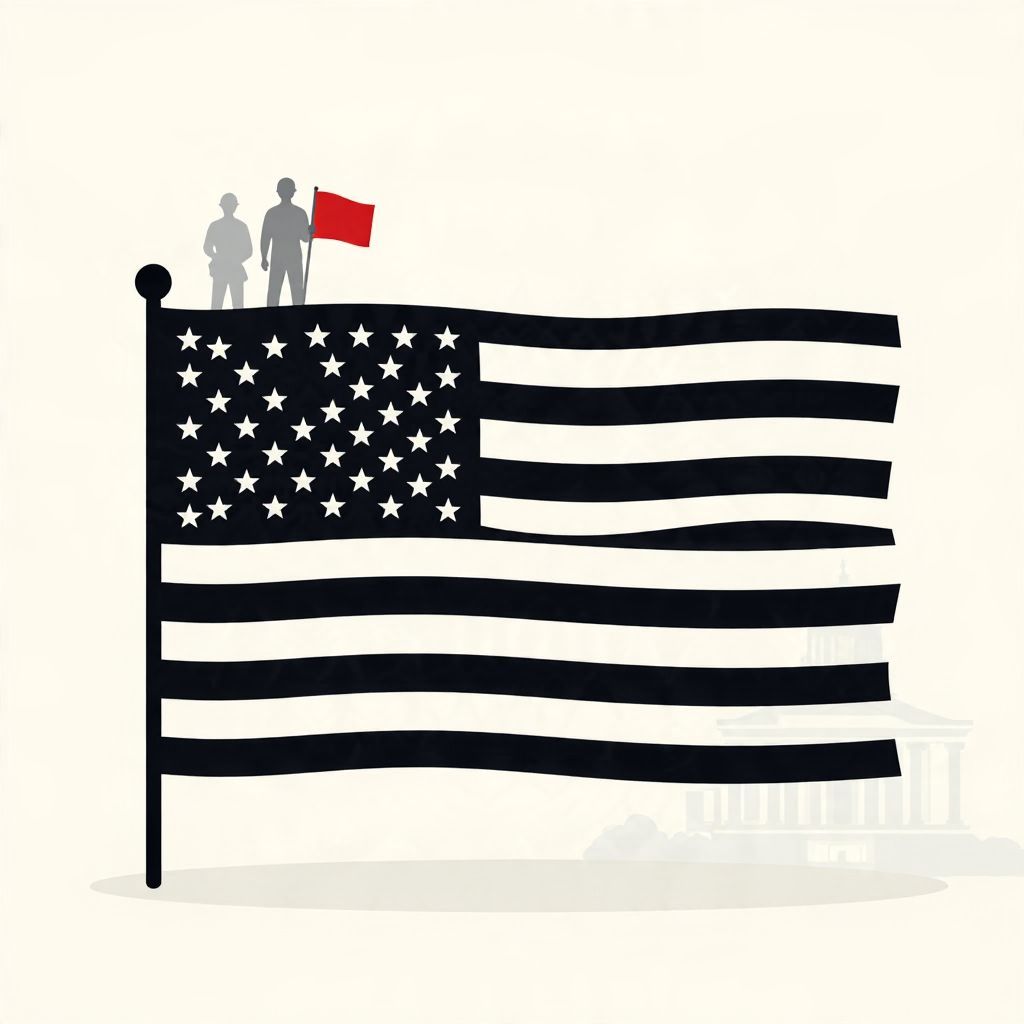
What does a black American flag mean? In most modern use, it is a symbolic version of the U.S. flag that usually signals mourning, remembrance, protest, or a refusal to surrender. Its meaning is not fixed by law or one single historical origin, and it can vary by context, group, and era.
Because the black American flag is a reinterpretation rather than an official national flag, its history is tied to both American wartime culture and later political symbolism. To understand it, you have to look at how black has been used in military, memorial, and activist settings over time.
What does a black American flag mean?
A black American flag most commonly means mourning, memorialization, or defiance. In some settings it honors the dead, especially fallen service members or first responders; in others it expresses protest, resistance, or a “no quarter” attitude. There is no single official meaning, so the message depends on who is flying it and where.
Origins of the black American flag
The black American flag does not come from one official founding moment. Instead, it emerged from older traditions in which black signaled death, loss, and solemn remembrance. Over time, Americans adapted the familiar stars and stripes into darker versions for funerals, memorials, military symbolism, and later political expression.
Black as a symbol of mourning
Long before the modern flag design, black cloth was widely used in Europe and North America as a sign of grief. In the 18th and 19th centuries, black bunting, armbands, and draped fabric often marked death and public mourning. That older custom helped make a black flag legible as a symbol of loss.
Military and wartime associations
Black flags have also had a long military history. In warfare, black could indicate danger, no surrender, or a willingness to fight without mercy. While the black American flag is not the same as a pirate flag or a battlefield banner, those older associations influenced how black came to suggest severity, resistance, and finality.
How the black American flag developed over time
The black American flag became recognizable in the 20th and 21st centuries as Americans increasingly used altered versions of the national flag for memorial and political purposes. Its meaning shifted with each context: remembrance in some cases, rebellion in others, and sometimes a general expression of grief or alienation.
19th century: mourning customs and patriotic display
In the 1800s, the U.S. flag was already being used in funerals, commemorations, and patriotic ceremonies. Black was not yet a standardized version of the flag, but the broader visual language of mourning was well established. Black ribbons, drapery, and crepe often accompanied public grief after wars, assassinations, and national tragedies.
20th century: memorial and protest symbolism
By the 20th century, the black-and-white American flag began appearing more visibly as a symbolic image rather than a formal emblem. It was used in memorial settings, especially to honor the dead, and also in protest culture, where altering the national flag could communicate dissatisfaction with government, war, or social conditions.
21st century: a widely recognized but contested symbol
In recent decades, the black American flag has become especially visible in political and cultural debates. Some people display it to honor military personnel, police officers, or other public servants who died in the line of duty. Others use it to express anger, resistance, or a belief that the nation is in crisis. Because of that, the same flag can mean very different things to different viewers.
Common meanings of the black American flag
The black American flag is best understood as a flexible symbol rather than a single message. Its meaning depends on design, setting, and intent. Here are the most common interpretations:
- Mourning: a sign of grief after death or national tragedy.
- Memorial: honoring soldiers, first responders, or others who died in service.
- Protest: expressing anger at government policy, social injustice, or political leadership.
- Defiance: signaling resistance, toughness, or refusal to submit.
- “No quarter” symbolism: in some military or paramilitary contexts, a harsh wartime message implying no mercy.
Black-and-white versus all-black flags
Not every “black American flag” looks the same. Some are black-and-white versions of the Stars and Stripes, while others are nearly all black with faint stars and stripes. The black-and-white version is often used for memorial or tactical imagery, while an all-black version may carry a stronger sense of protest or aggression.
Historical significance in American culture
The black American flag matters because it shows how national symbols can be reinterpreted in times of grief and conflict. The U.S. flag normally represents unity, citizenship, and state authority. Turning it black changes that message, often replacing celebration with mourning or loyalty with criticism.
Why the symbol is powerful
Flags are potent because they condense identity into a single image. Altering the American flag with black creates a visual contradiction: the familiar national emblem remains recognizable, but its emotional tone changes sharply. That tension is what gives the symbol much of its force.
Why it can be controversial
Because the black American flag has been used in both respectful and confrontational ways, it can be hard to interpret without context. Some viewers see honor and remembrance; others see hostility or political extremism. In public life, that ambiguity is part of the symbol’s history. It has never had one universally accepted meaning.
Black American flag in relation to other flag traditions
The black American flag belongs to a broader historical pattern in which nations and movements alter flags to express grief, rebellion, or solidarity. Similar practices appear around the world: flags flown at half-staff for mourning, black flags used in rebellion or warfare, and modified national flags used by protest movements.
Half-staff and the language of mourning
In the United States, flying the flag at half-staff is the official and traditional way to mark mourning. The black American flag is different because it is not an official protocol. It is a symbolic redesign, which makes it more open to interpretation and more likely to be used in informal or political settings.
From official ritual to personal expression
Half-staff is a state-sanctioned gesture. A black flag is often a personal, local, or movement-based choice. That difference matters historically: one belongs to civic ritual, while the other belongs to cultural expression. The black American flag therefore reflects modern America’s habit of turning national symbols into tools of identity and dissent.
Timeline of the black American flag’s historical development
The exact origin cannot be pinned to a single inventor or date, but the symbol’s development can be traced through broader historical stages:
- 18th–19th centuries: black becomes a standard color of mourning in Western culture.
- 19th century: Americans use black fabric, crepe, and ribbons in memorial settings tied to war and national grief.
- 20th century: altered versions of the American flag appear more often in memorial and protest imagery.
- Late 20th to early 21st century: black-and-white and all-black American flags become widely recognized in military, political, and cultural contexts.
- Present day: the symbol remains contested, with meanings ranging from honor to resistance.
How to interpret a black American flag today
If you see a black American flag, the safest interpretation is to look at context before assuming intent. A flag displayed at a memorial, cemetery, or funeral likely signals mourning or tribute. A flag at a protest, on tactical gear, or in a highly political setting may suggest defiance or opposition.
Questions that help decode the meaning
- Is it being used in a memorial, military, or funeral setting?
- Is it paired with slogans, patches, or political messages?
- Is it all black, black-and-white, or a distressed version of the U.S. flag?
- Is the display official, ceremonial, or personal?
What the black American flag means historically
Historically, the black American flag is best understood as a modern symbolic adaptation of the U.S. flag shaped by older traditions of mourning and wartime severity. It has no single official meaning, but it consistently communicates strong emotion: grief, remembrance, resistance, or refusal. Its power comes from changing a familiar national symbol into something darker and more solemn.
In that sense, the black American flag is not just a design choice. It is a historical statement about how Americans have used symbols to process loss, conflict, and political identity. If you are interested in related flag history, you may also want to explore the history of the American flag at half-staff and the broader evolution of U.S. national symbols.