
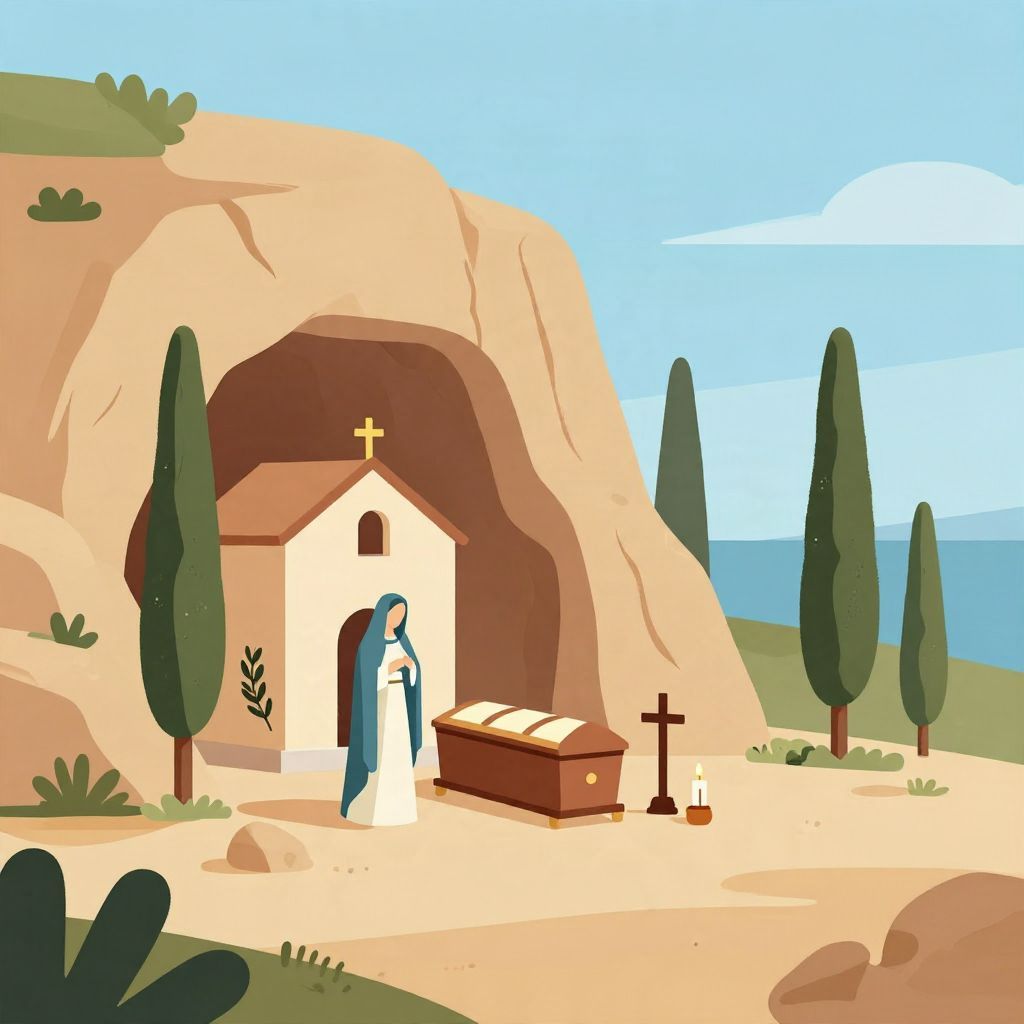
Where is Mary Magdalene buried? The short historical answer is that no burial place can be verified from early evidence. Mary Magdalene, a central figure in the New Testament, belongs to the world of early Christian memory, where history, devotion, and later legend often overlap. Different Christian traditions preserve different claims about her final resting place, but none can be confirmed with certainty.
That uncertainty matters because Mary Magdalene became one of the most important women in Christian tradition. Her burial story is not just about a grave; it is also about how saints’ cults developed, how relics were moved, and how medieval communities shaped sacred geography around revered figures.
Where Is Mary Magdalene Buried?
There is no universally accepted or historically proven burial site for Mary Magdalene. The two best-known traditions place her remains either in Saint-Maximin-la-Sainte-Baume in southern France or, in older Eastern Christian tradition, in or near Ephesus in present-day Turkey. Both claims are rooted more in later devotion than in securely documented first-century evidence.
What the Historical Evidence Actually Says
The New Testament identifies Mary Magdalene as a follower of Jesus, present at the crucifixion and among the first witnesses to the resurrection narratives. However, the biblical texts do not describe her later life, death, or burial. That silence is important: any precise burial claim comes from later tradition rather than from contemporary historical records.
Why historians are cautious
For figures from the first century, burial claims are strongest when they are supported by early texts, continuous local memory, and archaeological context. In Mary Magdalene’s case, those elements do not line up cleanly. The traditions about her grave appear centuries after her lifetime, which makes them valuable for studying Christian devotion but weak as direct historical proof.
The French Tradition: Saint-Maximin-la-Sainte-Baume
The most famous Western claim is that Mary Magdalene’s relics rest at Saint-Maximin-la-Sainte-Baume in Provence, France. According to medieval legend, Mary Magdalene traveled to southern Gaul after the events of the New Testament, lived as a hermit, and was buried there. This story became especially influential in the Middle Ages, when the cult of Mary Magdalene flourished in France.
How the French legend developed
By the medieval period, monasteries and churches across Europe competed to house saints’ relics, which attracted pilgrims and prestige. In Provence, the story of Mary Magdalene’s arrival gave local sacred sites a powerful apostolic connection. The tradition was reinforced by ecclesiastical promotion and pilgrimage culture, not by first-century documentation.
Saint-Maximin and the nearby cave of La Sainte-Baume became linked to her life of penitence and contemplation. The tale fit medieval religious ideals well: Mary Magdalene was imagined as a repentant sinner who withdrew from the world, making her a model of conversion and devotion. That image, however, reflects later Christian interpretation more than historical biography.
What is and is not established
- Established: The site became an important medieval pilgrimage center associated with Mary Magdalene.
- Not established: That Mary Magdalene actually traveled to France or was buried there in the first century.
- Likely historical reality: The relic tradition grew over time and helped shape regional religious identity.
The Eastern Tradition: Ephesus and Constantinople
In Eastern Christian tradition, Mary Magdalene is sometimes connected with Ephesus, where she may have lived near the Virgin Mary and the apostle John. Another tradition says her relics were later transferred to Constantinople. These claims reflect the common Christian practice of moving relics to important churches and capitals, especially in the Byzantine world.
Relics and translation
In medieval Christianity, the movement of holy remains was called a “translation.” Relics were often transferred to enhance a church’s status, strengthen devotional life, or support imperial and ecclesiastical authority. If Mary Magdalene’s relics were ever venerated in Ephesus or Constantinople, that would fit broader patterns of Byzantine relic culture. But again, the evidence is later and not decisive.
Because relic traditions were often layered over centuries, a claim that remains were “moved” does not automatically prove an original burial site. It may indicate only that a community believed it possessed her relics. For historians, that distinction is essential.
Why There Is No Certain Grave
Mary Magdalene lived in the earliest decades of Christianity, a period for which surviving records are limited. Most of what is known about her comes from the Gospels and later Christian writings. Unlike emperors, bishops, or major civic figures, she left no secure administrative trail, tomb inscription, or contemporary biography that identifies a burial place.
Several factors created the uncertainty
- Early Christian silence: The earliest texts do not record her death or burial.
- Legend growth: Later communities expanded her story to serve devotional and local interests.
- Relic culture: Medieval churches often claimed saints’ remains without modern standards of proof.
- Multiple traditions: Different regions developed competing sacred geographies around her name.
This does not mean the traditions are meaningless. They are historically important because they reveal how Christians remembered saints, how pilgrimage networks formed, and how women’s holiness was interpreted across different eras.
Mary Magdalene in Early Christianity
To understand why her burial remains uncertain, it helps to understand who Mary Magdalene was in the earliest sources. She appears as a devoted follower of Jesus, present at key moments in the Passion and Resurrection narratives. In the Gospels, she is especially significant as one of the first witnesses to the empty tomb and, in some accounts, the first to encounter the risen Christ.
Her later reputation
Over time, Mary Magdalene’s image changed. In Western Christianity, she was often merged with other biblical women, especially the unnamed sinner in Luke and Mary of Bethany. This blending shaped her reputation as a penitent figure, which in turn influenced burial legends that emphasized withdrawal, asceticism, and sanctity. Modern scholarship generally separates these figures and reads Mary Magdalene more carefully as a distinct historical disciple.
That shift matters because it shows how a saint’s posthumous identity can be reshaped by theology and culture. The question “Where is Mary Magdalene buried?” is therefore also a question about how memory is formed.
Can Archaeology Prove Her Burial Place?
At present, archaeology has not produced conclusive evidence for Mary Magdalene’s tomb. No authenticated first-century burial site can be linked to her with confidence. Claims associated with churches, crypts, or relics are part of devotional history, but they do not meet the standard of proof historians would require for a secure identification.
What would count as strong evidence?
Historians would look for a combination of early textual testimony, continuous local tradition from the relevant period, and archaeological context that fits the first century. For Mary Magdalene, that combination has not been found. As a result, any specific burial location remains a matter of faith tradition rather than established historical fact.
Why the Question Still Matters
Even without a verified grave, Mary Magdalene’s burial traditions have had a lasting impact. They helped shape pilgrimage routes, inspired churches and monasteries, and gave communities a powerful sacred figure to honor. Her story also reflects the broader history of sainthood, where memory often became as influential as documentary evidence.
In historical terms, the absence of certainty is itself revealing. It shows how the early Christian world was remembered, reimagined, and localized over centuries. Mary Magdalene’s burial site cannot be pinned down with confidence, but the traditions surrounding her remain a rich source for understanding medieval religion and the making of Christian memory.
So, where is Mary Magdalene buried? Historically speaking, we do not know. The strongest traditions point to Saint-Maximin-la-Sainte-Baume in France or to an Eastern relic tradition connected with Ephesus and Constantinople, but neither can be verified as her true grave. For readers interested in other famous burial traditions, see where Moses is buried and where Alexander the Great is buried.