
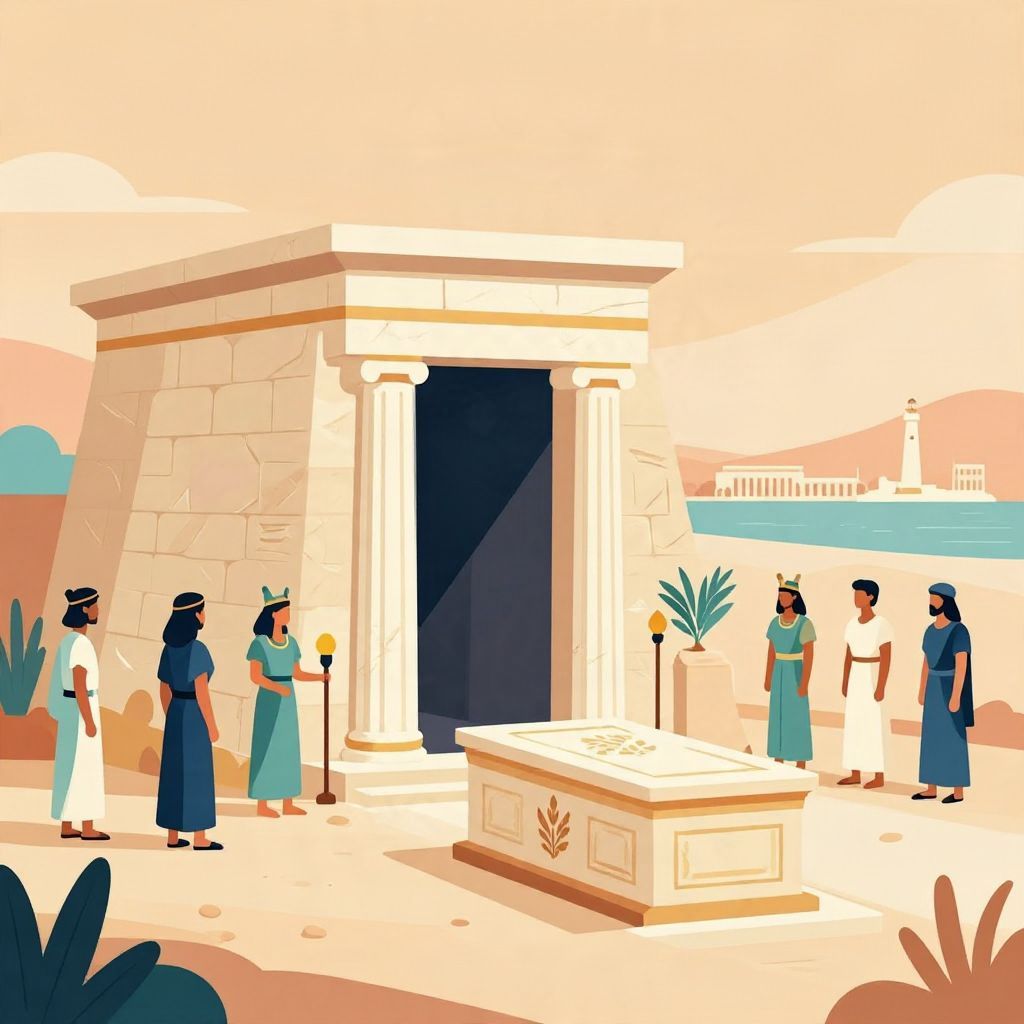
Where is Alexander the Great buried? It is one of the most famous unsolved questions in ancient history. Alexander died in Babylon in 323 BCE, but the exact location of his tomb has been lost to time, political upheaval, and centuries of shifting cities and empires.
What historians can say with confidence is that Alexander’s body was taken to Egypt and that his burial place was once a major monument in Alexandria. After antiquity, however, the tomb disappeared from reliable record, and its present location remains unknown.
Where Is Alexander the Great Buried?
Alexander the Great was most likely buried in Alexandria, Egypt, where ancient sources say his body was displayed in a royal mausoleum known as the Soma or Sema. The tomb’s exact location has not been identified today, and no discovery has been universally accepted by historians or archaeologists.
What Happened to Alexander’s Body After His Death?
Alexander died in Babylon in June 323 BCE, probably at age 32, after a short illness whose cause is still debated. His generals immediately fought over his empire, and even the treatment of his body became politically important. Whoever controlled Alexander’s remains could claim a powerful connection to his legacy.
Ancient writers report that his body was first prepared in Babylon and then sent west. The funeral procession was originally intended for Macedonia, but it was diverted to Egypt by Ptolemy, one of Alexander’s leading generals and later ruler of Egypt. That decision helped turn Alexander’s burial into a symbol of dynastic legitimacy.
Why Egypt?
Ptolemy understood the value of Alexander’s memory. By bringing the body to Egypt, he tied his own rule to the conqueror’s prestige. In the Hellenistic world, possession of a famous corpse could carry enormous political meaning. Alexander was not simply buried; he was transformed into a public emblem of kingship and conquest.
The Tomb in Alexandria
Most ancient testimony places Alexander’s tomb in Alexandria, the city he founded in 331 BCE. The burial monument was reportedly located in the royal quarter and became one of the city’s most visited landmarks. It was known in Greek as the Soma, meaning “body,” though later writers also used related forms such as Sema.
Ancient visitors, including Roman emperors, were said to have viewed the tomb. Accounts describe a glass or golden sarcophagus, though details vary and later retellings may reflect legend as much as fact. Still, the broad outline is clear: for centuries, Alexander’s burial place was famous and visible in Alexandria.
What the ancient sources suggest
- Alexander died in Babylon in 323 BCE.
- His body was transported to Egypt rather than Macedonia.
- A royal tomb or shrine in Alexandria housed the remains.
- The monument was known in antiquity but later lost or destroyed.
Why Is the Tomb Lost Today?
The disappearance of Alexander’s tomb is not unusual for the ancient Mediterranean, where cities were repeatedly damaged by war, earthquakes, rebuilding, and religious change. Alexandria itself was altered many times over the centuries. The royal district where the tomb likely stood changed shape, and the exact site became obscured by later construction.
By late antiquity, references to the tomb become less secure. As the Roman world transformed and Alexandria’s political importance shifted, the monument may have fallen into ruin, been buried under later layers of the city, or been moved, damaged, or repurposed. The historical record does not preserve a definitive explanation.
Common reasons the location became uncertain
- Repeated rebuilding in Alexandria over many centuries.
- Earthquakes and coastal changes that altered the ancient cityscape.
- Religious and political shifts that reduced interest in pagan royal monuments.
- Loss of continuous written records from the late ancient and medieval periods.
Has Alexander’s Tomb Ever Been Found?
No discovery has been accepted as Alexander’s tomb. Over the years, archaeologists and explorers have proposed several possible sites in Alexandria and elsewhere in Egypt, but none has been proven. Claims of a “found tomb” often rely on speculation, incomplete evidence, or later media excitement rather than conclusive archaeological identification.
That uncertainty matters. A burial site is not confirmed simply because it is impressive, ancient, or located in a city associated with Alexander. To identify the tomb, scholars would need strong evidence linking the structure to ancient descriptions, inscriptions, artifacts, and archaeological context. So far, that standard has not been met.
Why scholars remain cautious
Alexander’s fame makes the subject especially vulnerable to rumor. Many sites can be connected to him in popular imagination, but history requires more than association. Without a securely documented chain of evidence, the most responsible answer remains that his burial place is unknown, though ancient tradition places it in Alexandria.
How Alexander’s Burial Became a Historical Mystery
Alexander’s burial is mysterious not because ancient people ignored it, but because they cared about it intensely. His death triggered a struggle over succession, and his body became part of that struggle. The burial site was once known, visited, and politically useful. What vanished was not the original importance of the tomb, but the continuity of memory around it.
This is a common pattern in ancient history. A monument can be famous for centuries and still disappear from modern knowledge if later cities overwrite it. In Alexander’s case, the problem is compounded by the fact that his empire fragmented almost immediately after his death. No single successor had both the power and the long-term stability to preserve his resting place forever.
Alexander’s death and the start of the Hellenistic world
Alexander’s death marked the end of his personal empire and the beginning of the Hellenistic age, when Greek culture spread across the eastern Mediterranean and Near East through successor kingdoms. His burial in Alexandria fit that new political order. The city became a center of learning, trade, and royal power, and the tomb symbolized the transition from conquest to dynasty.
What Ancient Authors Say About the Burial
Our knowledge comes from later ancient writers rather than from Alexander’s own time. Their accounts are not identical, but they broadly agree that his body ended up in Egypt. Some details, especially about the appearance of the tomb and the exact route of the funeral procession, may have been embellished over time.
That does not make the story unreliable in its entirety. Ancient historians often preserved real events alongside dramatic detail. In this case, the strongest shared element is the burial’s Egyptian destination and its association with Alexandria. The precise architecture and final fate of the tomb remain uncertain.
Could the Tomb Still Be Found?
It is possible, though far from guaranteed. Archaeology in Alexandria is difficult because the ancient city lies beneath a modern urban landscape and, in some areas, under water or heavily built-over ground. Even if traces of the tomb survive, they may be fragmented or inaccessible.
A future discovery would need to be matched against ancient descriptions and archaeological evidence. Until then, historians distinguish between what is likely, what is possible, and what is proven. The likely answer is Alexandria; the proven answer is that the tomb has not been securely identified.
Why This Question Still Matters
People continue to ask where Alexander the Great is buried because the question sits at the intersection of biography, empire, and memory. Alexander was one of the most influential figures of antiquity, and his burial reflects how ancient rulers used death as part of political storytelling. The lost tomb is a reminder that even the most powerful names can become archaeological mysteries.
It also shows how history survives unevenly. Some monuments endure, while others vanish beneath later cities, legends, and time. Alexander’s resting place was once known to the ancient world, but modern history has not yet recovered it with certainty.
In short: Alexander the Great was most likely buried in Alexandria, Egypt, in a famous royal tomb that ancient writers called the Soma. The tomb’s exact location is unknown today, and despite many theories, no discovery has been accepted as definitive. For readers interested in Alexander’s image in history, see what Alexander the Great looked like; for another famous burial mystery, compare it with where Genghis Khan is buried.