
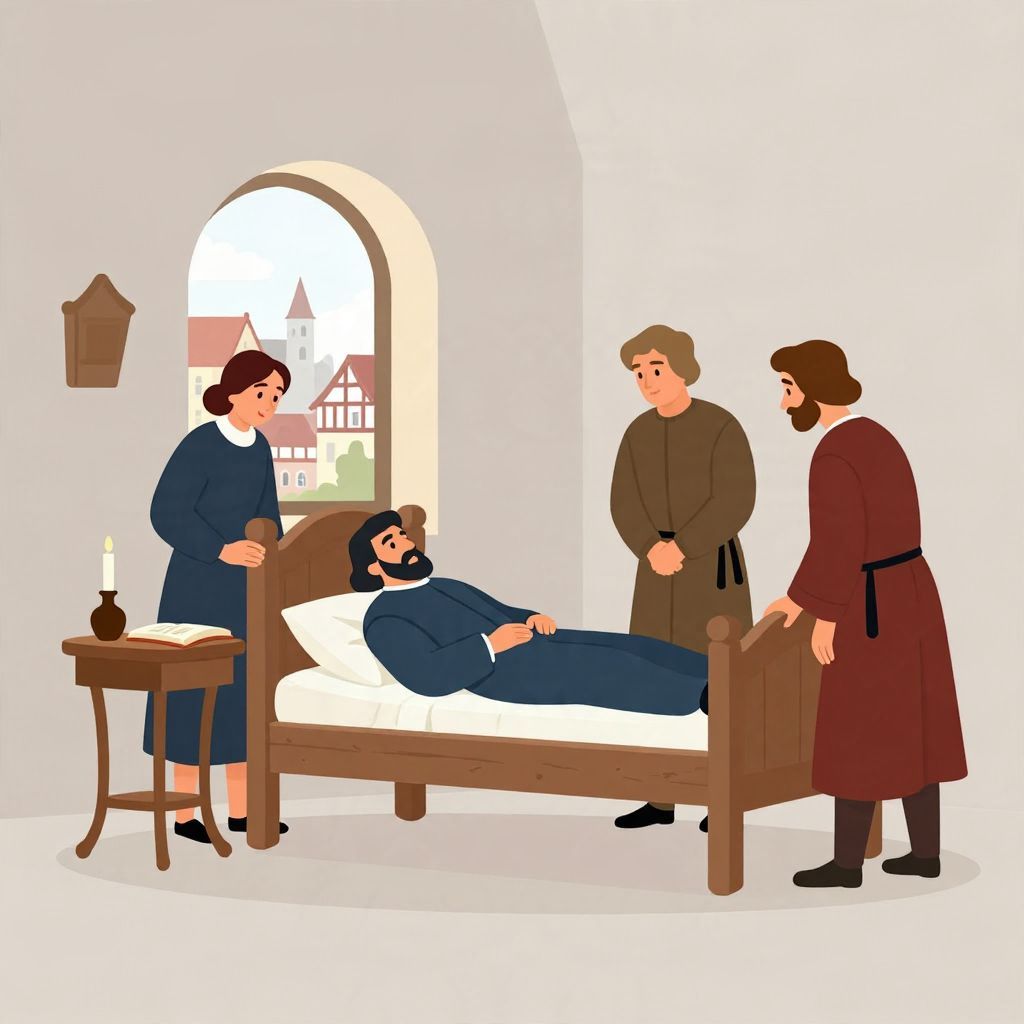
Where did Martin Luther die? The short answer is that he died in Eisleben, in the County of Mansfeld, in central Germany, on 18 February 1546. Although Luther was born in Eisleben, he spent much of his life elsewhere, and he returned there near the end of his life for a matter tied to family and local disputes.
His death took place during a winter journey that had become physically difficult for the aging reformer. The event mattered not only because of where it happened, but because Luther was already one of the most influential religious figures in Europe, and his final days were closely watched by supporters and opponents alike.
Where Did Martin Luther Die?
Martin Luther died in Eisleben, in present-day Saxony-Anhalt, Germany, on 18 February 1546. He passed away in the town where he had been born, while staying there on a final trip to help settle a dispute involving the counts of Mansfeld. He died in a house commonly identified with the place of his death, now preserved as a memorial site.
The Town of Eisleben and Luther’s Final Days
A return to his birthplace
Eisleben was not just any town in Luther’s life; it was his birthplace. He had been born there in 1483, and he returned there in early 1546 as an elderly man in poor health. By then, he was in his early sixties, which was old age by the standards of the sixteenth century. The journey itself was demanding, especially in winter.
Luther’s trip was connected to an effort to resolve a conflict involving the local rulers, the counts of Mansfeld, and matters of mining and administration in the region. He was not traveling as a pilgrim or as a public preacher, but as a respected mediator whose presence might help settle a practical political and economic dispute.
His health and final illness
Historical accounts agree that Luther had long suffered from recurring illnesses, including digestive problems, dizziness, and other ailments. In his final days he became increasingly weak. The exact medical cause of death cannot be known with certainty from modern evidence alone. Historians generally describe it as a natural death after a period of decline, rather than as the result of violence or a dramatic sudden event.
Because sixteenth-century medical records were limited, later writers sometimes speculated about the precise cause. Some have suggested heart failure or another internal illness, but these remain interpretations rather than proven diagnoses. What is clear is that Luther died after becoming ill during his stay in Eisleben.
What Happened on the Day He Died?
The final hours
According to the best-known historical tradition, Luther spent his last hours in Eisleben among companions and local associates. He reportedly remained conscious for part of the time and then died in the early morning hours of 18 February 1546. The broad outline of the event is secure, though some later details were shaped by devotional memory and Protestant storytelling.
After his death, Luther’s body was prepared for burial and later taken back to Wittenberg, the city most closely associated with his reforming work. That transfer mattered symbolically: although he died in Eisleben, Wittenberg became the center of his legacy and the place where many people most strongly connected his name with the Reformation.
The house where he died
The building in Eisleben associated with Luther’s death is now known as the Luther death house or Luther memorial house. Like many historic sites linked to famous figures, its present appearance reflects later preservation and commemoration. The essential historical point is not whether every feature of the building is unchanged from 1546, but that the location is traditionally and historically identified as the place where Luther died.
Why Was Luther in Eisleben?
Luther’s presence in Eisleben at the end of his life was tied to the world of Saxon politics and local lordship. The Mansfeld region, where he had family connections, was economically important because of its mining interests. Luther had long maintained relationships with local nobles, and he was asked to help mediate tensions among them.
This final journey shows that Luther was not only a theologian and church reformer. He also remained deeply involved in the political and social realities of his region. Even near death, he was still being called on as a trusted figure in disputes that could affect land, revenue, and authority.
Martin Luther’s Death in Historical Context
Why his death mattered
Luther’s death was significant because he was the central figure of the early Protestant Reformation in German lands. By 1546, his teachings had already helped reshape Christian life across much of northern Europe. His death did not end the movement he had helped launch, but it marked the close of an era in which his personal authority had been decisive.
After Luther died, the Reformation continued through princes, pastors, theologians, and institutions that had already begun to develop around his ideas. In that sense, his death in Eisleben symbolized a transition: the movement moved from the life of one reformer into a broader and more contested historical process.
Burial and remembrance
Luther’s body was transported to Wittenberg and buried there, in the Castle Church. This burial site became one of the most important memorial places in Protestant history. The journey from Eisleben to Wittenberg linked his birthplace and his reforming center, creating a symbolic arc from beginning to end.
Later generations remembered Luther’s death in ways that reflected their own religious and political concerns. Protestants often treated him as a heroic reformer, while Catholic critics in earlier periods viewed him very differently. Modern historians tend to focus less on legend and more on the documented historical setting: a sick, aging man returning to his birthplace, dying in a small town that had become part of a much larger European transformation.
Common Questions About Luther’s Death
Was Martin Luther killed?
No reliable historical evidence suggests that Luther was murdered or executed. He died naturally in Eisleben after falling ill. Because he was such a controversial figure, rumors and dramatic stories have sometimes circulated, but the historical record supports a natural death.
Was Eisleben also his birthplace?
Yes. Eisleben is notable because it was both Luther’s birthplace and the place of his death. That unusual coincidence has made the town especially important in Reformation memory and in the preservation of Luther-related heritage.
Did Luther die in Wittenberg?
No. Wittenberg was where he carried out much of his reforming work and where he was buried, but he died in Eisleben. This distinction is important because the two places are often associated in popular memory.
Why the Location Still Matters Today
Knowing where Martin Luther died helps place him in the real geography of the Reformation. His final days were not spent in a grand capital or a royal court, but in a modest town in central Germany, among regional political concerns and personal connections. That setting reminds us that major historical change often unfolds through local places and ordinary human circumstances.
Eisleben therefore matters not only as a memorial site, but as a historical clue. It shows how Luther’s life began and ended in the same town, while his influence spread far beyond it. His death there in 1546 closed the life of one man, but not the movement he helped ignite. For more background on the broader setting, see what Germany is known for and, for a different historical figure with a similar name, how Martin Luther King changed the world.