
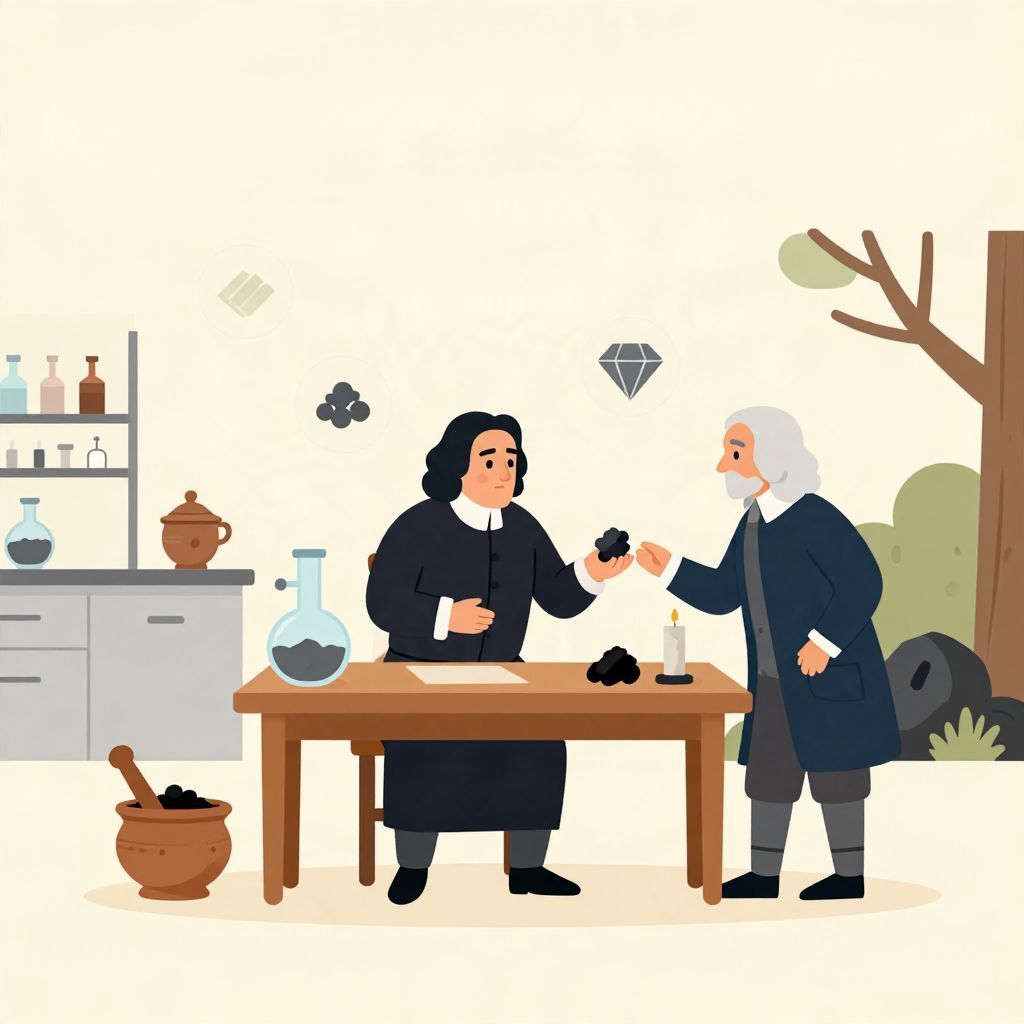
When was carbon discovered? The short answer is that carbon was not “discovered” in a single moment. People have known and used carbon in forms such as charcoal, soot, and graphite since antiquity, but its identity as a distinct chemical element emerged much later, in the scientific revolution of the 18th century.
In historical terms, carbon’s story moves from practical use to scientific understanding. Ancient societies handled carbon-containing materials for fuel, writing, metallurgy, and pigments long before anyone recognized the element itself. The modern discovery of carbon is usually credited to chemists in the late 1700s, especially Antoine Lavoisier, who helped show that charcoal and diamond were related forms of the same substance.
When was carbon discovered?
Carbon was recognized as a chemical element in the late 18th century, especially through the work of Antoine Lavoisier in the 1770s and 1780s. However, humans had used carbon-rich materials for thousands of years before that. So the best historical answer is: carbon was known in practice from ancient times, but scientifically identified as an element around 1772–1789.
Carbon before it was understood as an element
Ancient use of charcoal, soot, and graphite
Long before modern chemistry, people used carbon in everyday life. Charcoal was essential for cooking and metalworking because it burned hotter and cleaner than raw wood. Soot and lampblack were used in inks and pigments. Graphite, a form of carbon, became famous as a writing material and later as the core of pencils.
These uses did not require an understanding of carbon as a distinct substance. Ancient craftsmen and farmers knew its practical value, but they explained materials through experience, not atomic theory. In many early societies, substances were classified by appearance and function rather than by composition.
Early observations in metallurgy and fuel
Carbon played a major role in the rise of metalworking. Charcoal was crucial in smelting copper, iron, and other metals because it produced intense heat and helped remove oxygen from ores. This made carbon one of the most important materials in ancient and medieval technology, even though its chemical nature remained unknown.
In this sense, carbon shaped history long before it was named scientifically. It powered furnaces, supported trade in metal goods, and helped create tools, weapons, and infrastructure across the ancient world.
How scientists discovered carbon as an element
The 18th-century chemical revolution
The discovery of carbon belongs to the broader transformation of chemistry in the 1700s. Earlier alchemical ideas treated substances as mixtures of qualities or principles. By the late 18th century, chemists began using careful experiments, measurement, and combustion analysis to identify elements more precisely.
Antoine Lavoisier was central to this shift. Working in France, he studied combustion and showed that burning substances combine with oxygen. His experiments helped overturn older theories and laid the groundwork for modern chemistry. Within this framework, carbon became identifiable as a distinct element rather than just a property of charcoal or soot.
Lavoisier’s role in identifying carbon
Lavoisier is often credited with establishing carbon as an element around 1789, the year his major chemical treatise was published. He recognized that charcoal, graphite, and diamond were closely related forms of the same basic substance. He also helped explain that when carbon burns, it produces carbon dioxide, a gas that had previously been poorly understood.
It is important to note that Lavoisier did not “invent” carbon. Instead, he helped define it scientifically. His work turned a familiar material into a named element within a new chemical system.
Earlier contributors and related discoveries
Other scientists helped build the path to carbon’s discovery. Joseph Black, in the 1750s, studied “fixed air,” now known as carbon dioxide, and showed that gases could be chemically distinct substances. Later experiments by chemists in Britain and France clarified the relationship between carbon, combustion, and gases.
These developments mattered because carbon was not identified in isolation. It was discovered through a chain of experiments about burning, respiration, acids, and gases. The element became visible only when chemists learned how to separate and measure the products of chemical reactions.
Why carbon was hard to identify
It appears in many forms
One reason carbon took so long to be understood is that it appears in very different forms. Diamond is transparent and hard; graphite is soft and black; charcoal is porous and fuel-like; soot is fine and powdery. To earlier observers, these materials looked unrelated.
Modern chemistry now calls these different forms allotropes, meaning structurally different versions of the same element. That concept did not exist in the 18th century, so it was not obvious that diamond and charcoal shared a common identity.
Combustion hid the evidence
Carbon is also difficult to see because it often disappears during burning. When carbon-rich materials combust, they produce invisible gases such as carbon dioxide. Before the chemistry of gases was understood, this made carbon seem less like a substance and more like a process or residue.
Only after chemists learned to weigh reactants and products carefully did carbon’s role become clear. This is one reason its discovery belongs to the history of scientific method as much as to the history of any one material.
A simple timeline of carbon’s discovery
The history of carbon can be summarized in a few key stages:
- Ancient times: People use charcoal, soot, and graphite for fuel, writing, and metalworking.
- Mid-1700s: Chemists begin studying gases and combustion more systematically.
- 1750s: Joseph Black identifies carbon dioxide as “fixed air.”
- 1770s–1780s: Antoine Lavoisier shows that charcoal and related substances are chemically connected.
- 1789: Carbon is recognized within modern chemistry as an element.
This timeline shows why the question “When was carbon discovered?” has more than one answer. The material was known for millennia, but the element was defined scientifically in the late 18th century.
Carbon in history after its discovery
From chemistry to industry
Once carbon was understood as an element, its importance expanded rapidly. Nineteenth-century science linked carbon to organic chemistry, geology, fuels, and industrial production. Coal, coke, and carbon-based compounds became central to the Industrial Revolution.
Understanding carbon also helped scientists explain life processes. Organic chemistry developed around carbon compounds because carbon can form stable bonds with many other elements. This made it the foundation of the chemistry of living things, plastics, fuels, and countless industrial materials.
Diamond, graphite, and the idea of allotropes
Later research confirmed that diamond and graphite are both pure carbon, even though they look and behave very differently. This was an important scientific insight because it showed that one element could exist in multiple structural forms. That idea became a major part of modern chemistry and materials science.
Carbon’s discovery therefore had consequences far beyond naming a substance. It changed how scientists understood matter itself.
Historical facts about carbon discovery
- Carbon was used in charcoal, soot, and graphite long before it was identified as an element.
- The scientific discovery of carbon is usually dated to the late 18th century.
- Antoine Lavoisier is the key figure associated with carbon’s identification in modern chemistry.
- Joseph Black helped pave the way by studying carbon dioxide, then called “fixed air.”
- Carbon’s many forms made it difficult to recognize as one element.
- The year 1789 is often used as the clearest milestone for carbon’s formal recognition.
So, when was carbon discovered?
Carbon was not discovered all at once. Humans have known carbon-containing materials since ancient times, but carbon was scientifically recognized as an element in the late 18th century, especially through the work of Antoine Lavoisier around 1789. That is the most accurate historical answer.
In other words, carbon is ancient in use but modern in scientific definition. If you’re interested in similar historical timelines, you may also enjoy reading about when gold was discovered or exploring broader chronology in what happened in 2010.