
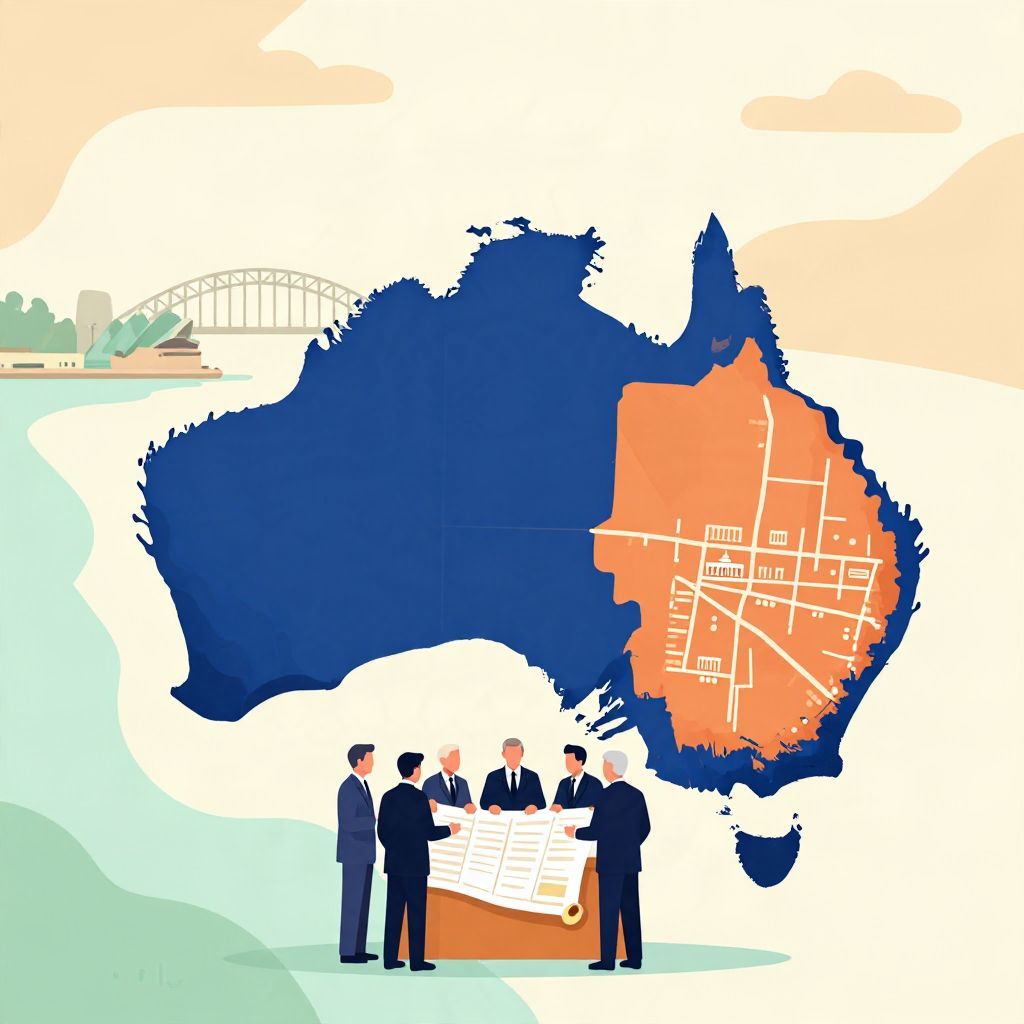
Why is Sydney not the capital of Australia? The short answer is that when Australia federated in 1901, no single colony could easily be chosen over the others. Sydney was the largest and most prominent city, but Melbourne, the other major rival, was also powerful and politically influential. As a compromise, the Constitution required a new capital to be created in New South Wales, but outside Sydney.
That decision reflected colonial rivalry, federal politics, and a desire to avoid giving one city too much dominance. The result was Canberra, a planned city selected and built specifically to serve as the national capital.
Why is Sydney not the capital of Australia?
Sydney is not Australia’s capital because the founders of the federation wanted a neutral compromise between the rival colonies of New South Wales and Victoria. Sydney was too closely associated with one colony’s interests, while Melbourne was the temporary seat of national government after federation. The Constitution ultimately required a new capital in New South Wales, but at least 100 miles from Sydney.
The colonial rivalry that shaped the capital question
Before Australia became a nation, it was made up of separate British colonies, each with its own government, ambitions, and sense of identity. Sydney, founded in 1788, was the oldest and largest settlement, and by the late 19th century it was the commercial heart of New South Wales. But Melbourne, founded in 1835, had grown rapidly during the gold rushes and became a wealthy rival with strong political influence.
When federation was debated in the 1890s, the question of where to place the national capital became a major obstacle. New South Wales and Victoria were the two most populous colonies, and neither wanted the other’s leading city to dominate the new nation. Sydney had the advantage of size and history, but that was exactly why it was politically difficult to accept as the capital.
Why Sydney’s size was a problem, not an advantage
In many countries, the largest city becomes the capital. In Australia, however, federation was built on compromise among colonies that feared centralisation. If Sydney had become the capital, many politicians in other colonies would have seen it as a victory for New South Wales. That would have made the new federal system look unbalanced from the start.
There was also a practical political concern: the capital was meant to symbolise a new national identity, not simply continue the dominance of the largest colonial city. Choosing Sydney would have reinforced older colonial rivalries rather than settling them.
Federation and the constitutional compromise
The Australian Constitution, adopted in 1900 and effective from 1 January 1901, settled the issue in a carefully negotiated way. It stated that the seat of government would be in New South Wales, but not less than 100 miles from Sydney. Until the new capital was ready, the federal parliament would meet in Melbourne.
This compromise was designed to satisfy both major rivals. Sydney did not get the capital because Melbourne could not accept it, and Melbourne did not get it because New South Wales would not accept that either. A new site was the only solution that preserved the federation.
Key points of the constitutional settlement
- The capital had to be in New South Wales.
- It had to be at least 100 miles from Sydney.
- The federal parliament first met in Melbourne after federation.
- A new planned city would eventually be built for the national government.
Why Canberra was chosen instead
Canberra was selected because it offered a neutral location between the two great rivals and could be designed from scratch as a federal capital. After years of debate over possible sites, the chosen area lay in the inland south-east of New South Wales, far enough from Sydney to avoid favouring it, but still within the state as required by the Constitution.
The site was officially chosen in 1908. An international design competition followed, and the American architect Walter Burley Griffin won with a plan for a carefully ordered garden city. Canberra was not simply a random alternative to Sydney; it was a deliberate political and architectural answer to the problem of rivalry.
Why a planned capital mattered
A planned capital allowed Australia to create a city that represented the federation rather than one colony’s past. The idea was to separate national government from the commercial pressures of Sydney and the state politics of Melbourne. Canberra was meant to embody national unity, administrative order, and a fresh start.
That does not mean Sydney was unimportant. On the contrary, Sydney remained Australia’s largest city, a major port, and a cultural and economic powerhouse. But capitals are chosen for politics as much as for size, and in Australia politics mattered more than urban scale.
The role of Melbourne in keeping Sydney out
Melbourne’s presence in the capital debate is essential to understanding why Sydney lost out. In the late 19th century, Melbourne was a major financial and cultural centre and, for a time, the largest city in Australia. It had strong institutions and a confident political class. If Sydney had been chosen, Victorian leaders would have seen it as a defeat in the struggle for influence within the new federation.
Because neither city could be accepted as the capital by the other side, the compromise was to create a new one. In that sense, Sydney was not rejected because it lacked importance. It was rejected because it was too important to one side and too threatening to the balance of the federation.
How the capital question unfolded after federation
The choice of Canberra did not happen overnight. It took years of debate, site selection, planning, and construction before the new capital could function properly. Parliament continued to sit in Melbourne for decades while Canberra was developed. The move of the federal parliament to Canberra in 1927 marked the city’s real emergence as the national seat of government.
This long transition shows that the capital question was not only about symbolism. It was also about logistics, infrastructure, and the challenge of building a national city in a sparsely populated inland region. Sydney had everything a capital might need already in place, but that convenience was outweighed by the politics of federation.
Chronology of the capital decision
- 1788 – Sydney is founded as the first British settlement in Australia.
- 1835 – Melbourne is founded and later grows into a major rival.
- 1890s – Federation debates intensify, including the capital question.
- 1901 – Australia becomes a federation; parliament meets in Melbourne.
- 1908 – Canberra’s site is officially selected.
- 1913 – Canberra is formally named and development begins in earnest.
- 1927 – Federal parliament moves to Canberra.
Was Sydney ever seriously considered?
Yes, Sydney was seriously considered in the broader sense that it was the obvious candidate by population, history, and prominence. But it was never politically easy. The closer federation came, the clearer it became that Sydney’s advantages were also its liabilities. It was too associated with one colony, too dominant economically, and too likely to provoke opposition from Victoria and other colonies.
In historical terms, Sydney was the “natural” capital only if one ignores the politics of federation. Once those politics are taken seriously, a neutral compromise becomes much more likely. That is why Canberra, not Sydney, became the answer.
Common misconceptions about Sydney and Canberra
One common myth is that Canberra was chosen because Sydney was somehow unsuitable as a city. That is not accurate. Sydney was, and remains, one of the most successful cities in the Southern Hemisphere. The issue was not urban quality but political balance.
Another misconception is that Canberra was built simply because the government wanted a remote capital. In fact, the location had to satisfy constitutional requirements and political bargaining. Canberra was chosen because it was neither Sydney nor Melbourne, while still being within New South Wales.
What the decision tells us about Australian nationhood
The capital compromise reveals a great deal about how Australia was formed. Federation was not a sudden break from the past; it was a negotiated union of colonies with strong local loyalties. The new nation needed a capital that could stand above those rivalries. Sydney’s exclusion was therefore not a sign of weakness, but evidence that the founders were trying to build a balanced federal system.
In that sense, Canberra is a monument to compromise. It exists because the colonies could not agree to let Sydney, or Melbourne, dominate the new nation.
Conclusion
Sydney is not the capital of Australia because federation required a compromise between powerful colonial rivals, especially New South Wales and Victoria. Sydney was too dominant to be accepted by the others, so the Constitution called for a new capital in New South Wales but away from Sydney. That compromise produced Canberra, the planned national capital that still reflects Australia’s federal origins.