
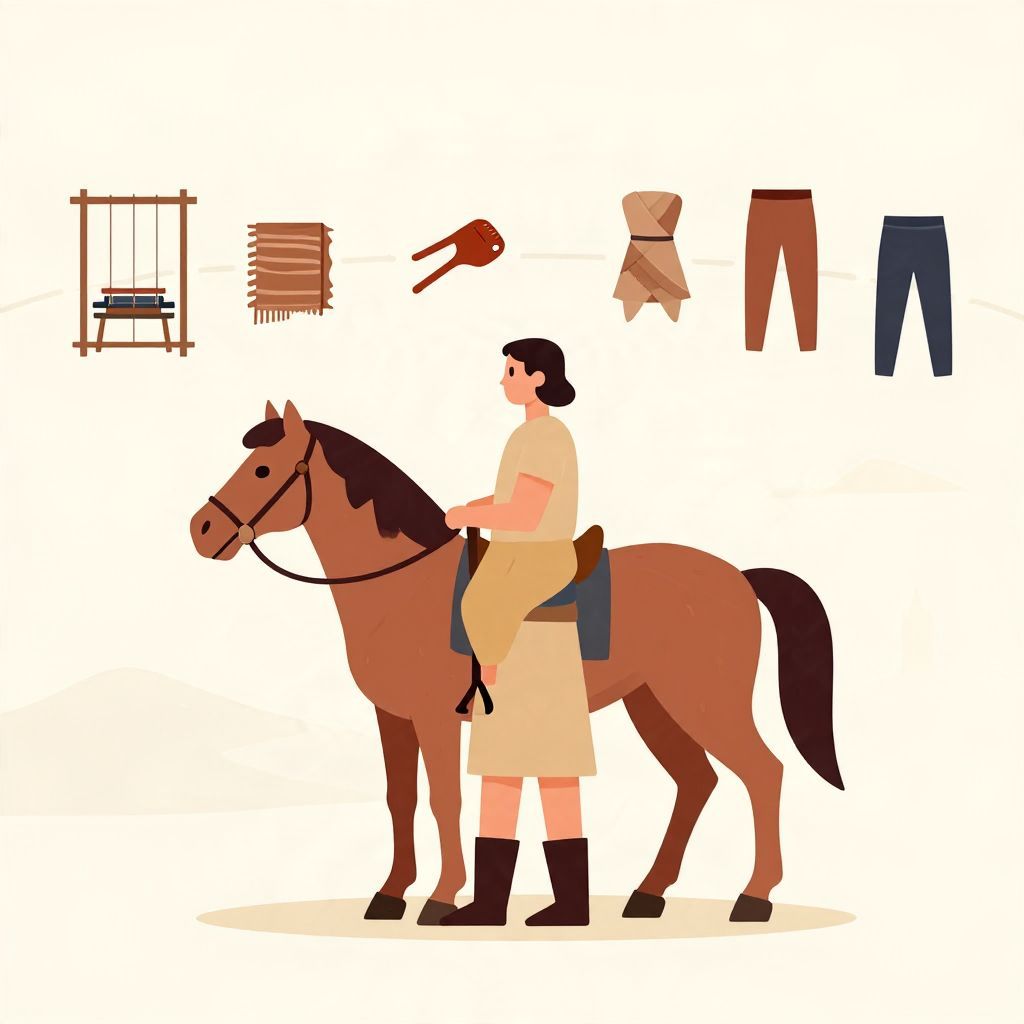
When were pants invented? The short answer is that no single person “invented” pants. They emerged gradually, likely in the ancient Eurasian steppe, and by around the 1st millennium BCE they were clearly in use among mounted peoples. Archaeological finds and art suggest that trousers were already established by roughly 1000–500 BCE, with some of the oldest surviving examples dating to about the 13th to 10th centuries BCE.
Pants became important because they solved a practical problem: they made riding, traveling, and working on horseback more comfortable and safer. Over time, they spread from nomadic horse cultures into many other societies, eventually becoming one of the most common garments in the world.
When were pants invented?
Pants were probably developed sometime in the Bronze Age, most likely among horse-riding peoples of Central Asia and the Eurasian steppe, with firm evidence by about 1000 BCE and surviving examples from roughly 1300–1000 BCE. Historians cannot name a single inventor, but the garment seems to have arisen as a practical response to riding horses and living in colder, mobile communities.
The earliest evidence for pants
The oldest known trousers come from archaeological finds in western China and Central Asia, especially burial sites associated with steppe cultures. One famous pair, found in the Yanghai cemetery near Turpan in Xinjiang, is often dated to around the 13th to 10th centuries BCE. These wool trousers show that pants were already a developed garment, not a brand-new experiment.
Why archaeologists think pants appeared then
Textiles rarely survive for long in most environments, so the history of pants depends on a combination of preserved garments, burial evidence, and images in ancient art. Because horse riding became increasingly important in the Bronze Age, historians and archaeologists think pants likely spread alongside mounted warfare, herding, and long-distance mobility.
What counted as “pants” in the ancient world?
Ancient trousers were not always tailored like modern jeans or slacks. Early versions could be loose, tied at the waist, and sometimes integrated with boots or leg coverings. In other words, “pants” in historical terms usually means a bifurcated garment that separates the legs, even if the cut and style differed greatly from modern clothing.
Why pants appeared in the first place
The invention of pants was closely tied to practical life. Skirts, robes, and tunics work well for many settings, but they are less convenient for riding horses, fighting from the saddle, or traveling in cold, windy climates. Pants helped protect the body, reduce chafing, and allow freer movement on horseback.
Horse culture and mobility
Many scholars connect the rise of trousers to steppe societies where horses were central to daily life. Riding long distances while managing herds or engaging in warfare made a split-leg garment especially useful. Pants were therefore not just a fashion choice; they were a technological adaptation to a new way of life.
Climate also mattered
In colder regions, pants offered warmth and protection better than many loose garments. This does not mean they were invented only because of weather, but climate likely reinforced their usefulness. The spread of trousers across Eurasia reflects both practical mobility and environmental demands.
Who wore the earliest pants?
The earliest trousers are associated with ancient peoples of the Eurasian steppe, including groups often identified in scholarship with early Iranian-speaking or related nomadic cultures. However, because the archaeological record is incomplete, it is safer to say that multiple horse-riding communities across Central Asia were probably using pants early on rather than naming one “first people” with certainty.
Men, women, and pants in antiquity
Modern assumptions can distort the past. In many ancient societies, both men and women may have worn leg coverings depending on region, labor, and custom. The association of pants with masculinity became especially strong in some later cultures, but that was a historical development, not an original universal rule.
Pants in ancient civilizations
As trousers spread, they often met resistance in civilizations that already favored robes, tunics, or draped garments. In the Mediterranean world, for example, Greeks and Romans often viewed trousers as foreign clothing associated with northern or eastern peoples. That judgment was cultural, not practical: the garment itself was highly effective.
Greek and Roman attitudes
Classical writers sometimes treated trousers as a marker of “barbarian” identity, meaning non-Greek or non-Roman. This tells us less about the quality of pants than about ancient ideas of civilization, masculinity, and identity. Romans eventually adopted trousers for some military and cold-weather uses, especially in frontier regions.
Steppe influence on dress
As empires expanded and trade networks widened, clothing styles moved with people, armies, and merchants. Trousers spread through contact, conquest, and imitation. What began as a regional adaptation in Eurasia gradually became a garment known across much of the ancient world.
A brief timeline of pants history
The history of pants is best understood as a long evolution rather than a single invention date. The following timeline shows the major stages:
- Before 1500 BCE: Many societies wear tunics, robes, skirts, or wrapped garments; no clear evidence yet for standardized trousers.
- c. 1300–1000 BCE: Some of the oldest surviving trousers appear in Central Asia, showing that pants are already established.
- 1st millennium BCE: Trousers spread more widely among steppe peoples and neighboring regions.
- Classical antiquity: Greeks and Romans know trousers but often regard them as foreign dress.
- Late antiquity and the medieval period: Pants become common across many parts of Europe and Asia, especially for horseback riding and labor.
- Modern era: Trousers become a standard garment for men in many societies, and later for women as well.
How pants changed over time
Early trousers were functional, but later centuries transformed them into a wide variety of styles. Pants evolved in response to changing technologies, class distinctions, military needs, and fashion. The basic idea remained the same, but the cut, fabric, and social meaning changed dramatically.
From practical wear to social symbol
In many societies, clothing signals rank and identity. Pants could indicate occupation, ethnicity, gender norms, or social status. At different times, fitted trousers, breeches, leggings, and loose pants all carried different meanings. What began as practical riding gear eventually became a major part of everyday dress.
The rise of tailored trousers
As tailoring advanced, trousers became more shaped to the body. Buttons, seams, belts, and later zippers changed how pants were made and worn. Industrial textile production also made them cheaper and more widely available, helping trousers become a global standard garment.
Did one civilization invent pants?
It is more accurate to say that pants emerged within a broad cultural zone rather than being invented by one named civilization. The strongest evidence points to the Eurasian steppe and nearby regions, where horse culture created a strong need for leg coverings. Because clothing leaves limited archaeological traces, the exact origin remains approximate.
Why origin stories can be hard to pin down
Clothing is one of the most difficult things to study historically. Fabric decays, styles change quickly, and people rarely wrote detailed records about everyday garments. As a result, historians rely on preserved textiles, burial finds, and visual depictions. That means the “when” of pants is best answered with a range, not a single exact year.
Why the invention of pants mattered
The invention of pants mattered because it helped shape mobility, warfare, labor, and identity. Trousers made horseback travel easier and safer, especially in cold or rugged environments. They also changed how societies thought about dress, eventually becoming one of the most universal garments in human history.
Military and travel advantages
Armies and riders benefited from pants because they reduced friction and improved movement in the saddle. In many eras, military effectiveness and clothing technology were closely linked. Pants were therefore part of a broader history of adaptation, not just fashion.
A garment with lasting cultural impact
Over time, trousers crossed from specialized wear into mainstream clothing. Today they are so common that it is easy to forget how innovative they once were. Their history shows how a simple design can reshape daily life across continents and centuries.
So, when were pants invented?
Pants were invented gradually, not all at once, most likely in the ancient Eurasian steppe during the Bronze Age. The best evidence places them in use by about 1000 BCE, with some surviving examples dating to around 1300–1000 BCE. Their rise was driven by horse riding, mobility, and climate, and their spread changed clothing history permanently.
If you are interested in how clothing reflects culture and identity, you may also enjoy reading about the history of the kilt or the history of the sari. Pants may have begun as practical riding gear, but their long evolution shows how everyday clothing can become a powerful historical marker.