
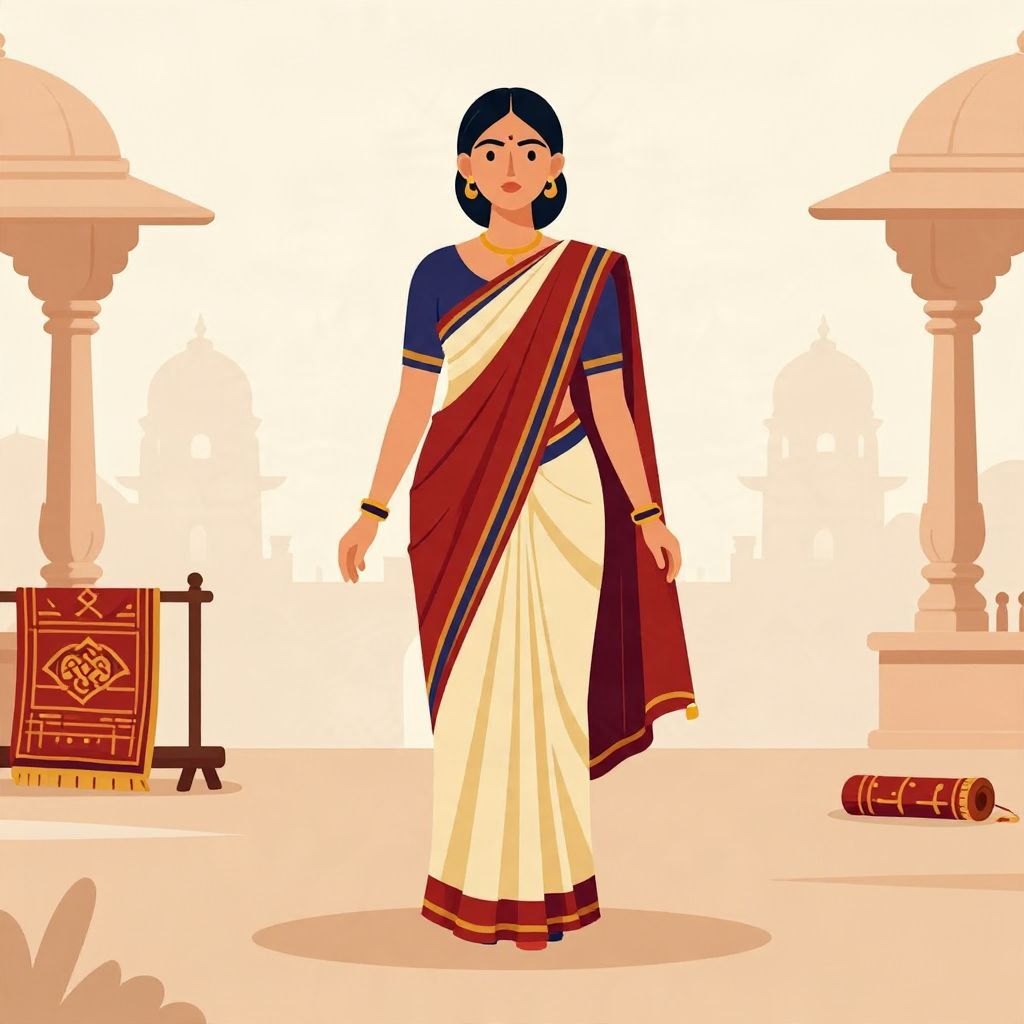
What is a sari? It is one of South Asia’s most recognizable garments: a long, unstitched piece of cloth, usually draped around the body in a way that creates both everyday practicality and ceremonial elegance. Worn especially by women across the Indian subcontinent, the sari is not a single fixed style but a family of draping traditions shaped by region, class, religion, and occasion.
Its history reaches deep into the past. The sari is both a living item of dress and a historical record of changing textiles, trade, social customs, and ideas about modesty, status, and beauty in South Asian societies.
What Is A Sari?
A sari is a length of cloth, typically about 5 to 9 yards long, wrapped and draped over the body without being cut or tailored into separate pieces. It is usually worn with a fitted blouse and an underskirt in many modern styles, though these accompaniments developed over time. The sari’s form is defined less by sewing than by draping, which gives it remarkable flexibility across climates and communities.
The Origins of the Sari
The sari’s exact origin cannot be pinned to a single inventor, date, or place. Historians generally see it as the product of ancient South Asian clothing traditions, especially the use of unstitched cloth in warm climates. Evidence from sculpture, paintings, and literary references suggests that draped garments were common in the Indian subcontinent for many centuries before the modern sari took shape.
Ancient clothing and draped dress
In the ancient and early historic periods, people in South Asia often wore garments made from cloth wrapped around the body rather than tailored clothing. This made practical sense in a region where cotton production flourished and where loose draped dress suited the climate. Early images from Indian art show men and women in garments that resemble later draped forms, though not always the sari in its modern sense.
Scholars usually avoid claiming that the sari existed in exactly the same form in antiquity. Instead, they describe a long evolution from earlier draped clothing into the recognizable sari tradition. That evolution was gradual, not a sudden invention.
Textiles, cotton, and trade
South Asia became famous early for fine cotton textiles. The growth of spinning, weaving, dyeing, and trade helped make cloth central to dress and status. As textile production expanded, so did the variety of fabrics available for draped garments. Lightweight cottons were ideal for daily wear, while silk and decorated cloths became associated with wealth, ritual, and courtly life.
How the Sari Developed Over Time
The sari changed with political power, regional custom, and fashion. What people wore in the Mauryan, Gupta, medieval, Mughal, and colonial periods was not identical, but each era helped shape the garment’s later forms. The sari’s history is therefore also the history of South Asian textile culture.
Early and classical periods
Ancient Indian art and literature refer to garments such as the antariya, a lower-body cloth, and the uttariya, a shoulder or upper-body cloth. These layered draped pieces are often discussed as ancestors of later sari styles. Over time, the separate cloths used for different parts of the body seem to have been combined in more integrated draping methods.
By the classical period, draped dress had become a well-established norm among many women in South Asia. But regional variation remained strong, and there was no single “correct” way to wear such clothing.
Medieval and early modern change
Between roughly the 12th and 18th centuries, courtly culture, regional kingdoms, and expanding textile production encouraged new fabrics and styles. Silk weaving centers, embroidery traditions, and trade networks brought richer materials into circulation. In many regions, the sari became more closely associated with women’s dress, though the details of how it was worn still varied widely.
During this period, the blouse and petticoat became more common in some settings, especially under the influence of changing ideas about modesty and the practical demands of certain drapes. These additions were not timeless features of the sari; they reflect historical change.
Colonial era and standardization
Under British colonial rule, South Asian clothing was increasingly categorized and described through European eyes. Colonial observers often treated the sari as a fixed “native” costume, even though it remained highly diverse in practice. At the same time, urban middle-class women in the 19th and early 20th centuries helped standardize certain sari styles, especially in cities and among educated elites.
Print culture, photography, nationalist politics, and reform movements all influenced dress. The sari came to be seen not only as everyday clothing but also as a symbol of Indian womanhood and cultural identity. This symbolic role became especially important in the late colonial period.
What Does the Sari Symbolize?
The sari has never meant only one thing. Depending on time and place, it can signal marriage, adulthood, regional identity, religious observance, social rank, or political nationalism. It can also simply be practical clothing. Its meanings are layered because the garment itself is layered in how it is worn.
Identity and status
Different fabrics and draping styles have long communicated status. Fine silk, gold thread, handwoven cloth, and elaborate borders often indicated wealth or special occasion wear. In some communities, particular colors or weaves were linked to life-cycle events such as weddings or festivals. In others, the sari was a marker of everyday respectability rather than luxury.
Religion and ritual
The sari appears in many religious contexts across Hindu, Jain, Sikh, and Muslim communities in South Asia, though the forms and meanings differ. It may be worn in temples, at weddings, during festivals, or in rites of passage. Because it is unstitched, some traditions regard it as especially suitable for ritual purity, though beliefs vary widely and should not be generalized too simplistically.
National and cultural identity
In the 19th and 20th centuries, the sari became a powerful emblem in debates about tradition and modernity. Nationalist leaders and cultural reformers sometimes promoted it as a distinctly Indian garment, while women also adapted it to new public roles, education, and work. In this sense, the sari was not frozen in the past; it was actively reshaped in modern history.
Regional Styles of the Sari
There is no single sari style. Different regions developed distinct drapes, fabrics, and aesthetic preferences, often reflecting local weaving traditions and social customs. These variations are one of the strongest signs that the sari is a historical family of garments rather than one uniform design.
- Nivi style – common in much of modern India, with the pleats tucked at the waist and the pallu draped over the shoulder.
- Bengali style – often draped without front pleats in the same way as the nivi, with a distinctive shoulder arrangement.
- Gujarati style – the pallu is often brought over the right shoulder and across the front.
- Maharashtrian style – historically associated with a more dhoti-like drape.
- Madisar – a traditional Tamil Brahmin style with a distinctive wrapping method.
These are only a few examples. Many local communities have their own ways of draping the sari, and fashion continues to evolve.
Materials, Weaving, and Craft Traditions
The history of the sari is inseparable from the history of South Asian weaving. Famous textile centers produced cottons, silks, and brocades that shaped how saris looked and felt. A sari is not just clothing; it is often the visible result of a long chain of labor involving spinners, dyers, weavers, embroiderers, and traders.
Famous textile traditions
India and neighboring regions developed renowned weaving traditions such as Banarasi silk, Kanchipuram silk, Chanderi, Jamdani, and many others. Each reflects local technique and patronage. Some saris are prized for their handwoven borders, others for their motifs, and others for the skill required to produce very fine cloth.
Because the sari is a length of fabric rather than a tailored garment, the textile itself often carries the full artistic burden. Pattern, border, color, and texture matter enormously.
The Sari in Modern History
In the 20th and 21st centuries, the sari has remained both traditional and adaptable. Women wear it in formal settings, workplaces, religious ceremonies, political events, and daily life. It has also become a global symbol of South Asian heritage, worn by diaspora communities far from the subcontinent.
From everyday wear to formal dress
In many urban areas, especially after the mid-20th century, Western-style clothing became more common for some forms of daily wear. Yet the sari did not disappear. Instead, it often shifted toward ceremonial, professional, or identity-based use. In some places it remained everyday clothing; in others it became reserved for special occasions.
Fashion, cinema, and reinvention
Film, advertising, and fashion design helped popularize new sari looks in the modern era. Designers experimented with fabrics, blouse cuts, draping styles, and embellishments. At the same time, many women continued to wear older regional styles, showing that the sari’s history is not a straight line from past to present but a coexistence of old and new.
Why the Sari Still Matters
The sari endures because it is both practical and expressive. It can be simple or elaborate, local or cosmopolitan, sacred or secular. Its long history reveals how clothing can preserve memory while also changing with society. Few garments have carried so much cultural meaning for so long while remaining in everyday use.
So, what is a sari? Historically, it is an ancient and evolving South Asian draped garment whose meaning has been shaped by textiles, trade, ritual, region, and modern identity. It is not merely a piece of cloth, but a living tradition that connects the present to centuries of South Asian history.