
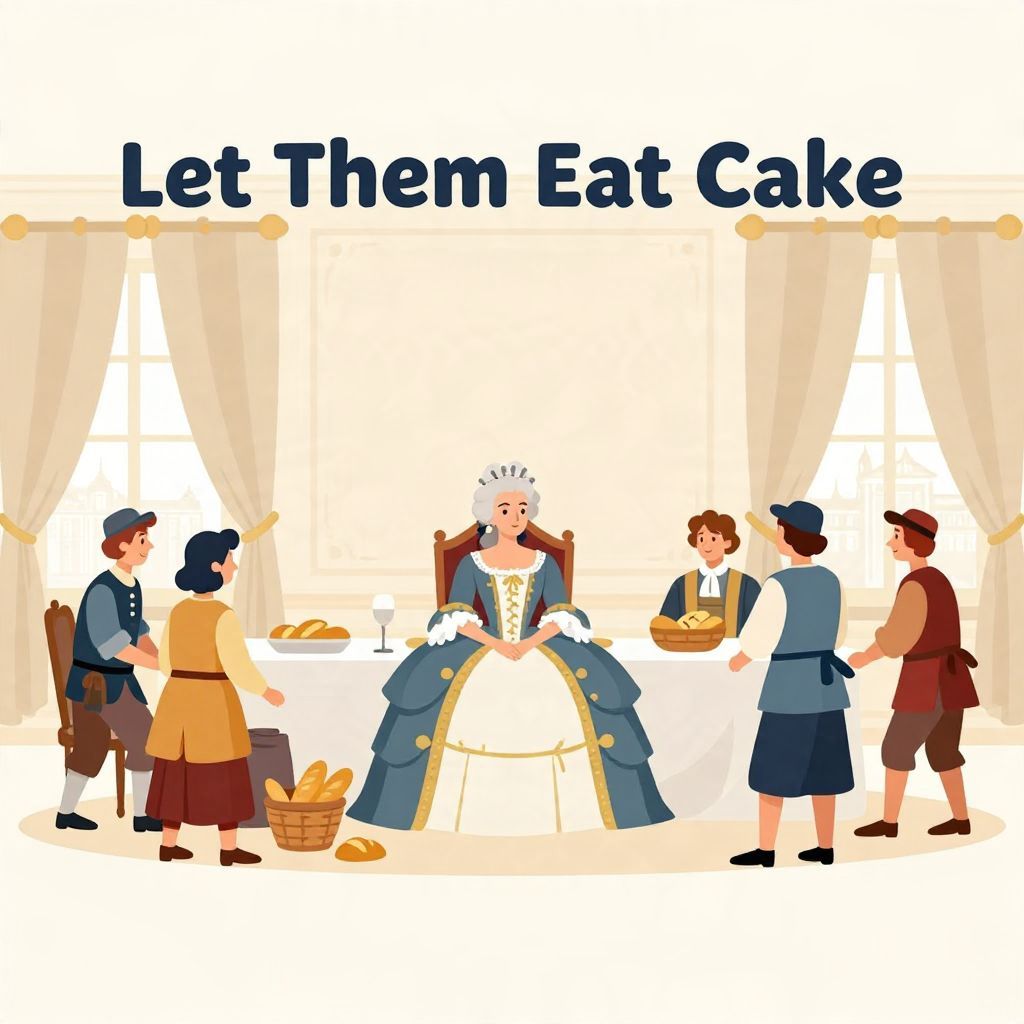
“Let them eat cake” is one of the most famous phrases in history, usually linked to Marie Antoinette and the French Revolution. But what does it actually mean? In modern usage, it suggests a cruelly out-of-touch response from a ruler or elite person to the suffering of ordinary people.
Historically, however, the phrase is almost certainly not something Marie Antoinette said. It became famous because it captured revolutionary anger about inequality, privilege, and royal indifference in late 18th-century France.
What does “Let them eat cake” mean?
“Let them eat cake” means, in effect, “If people cannot afford bread, let them eat something else instead,” though the phrase is best understood as a symbol of elite ignorance rather than a reliable quotation. It is associated with aristocratic detachment, especially in the context of France before the Revolution, but the historical evidence does not support Marie Antoinette as the speaker.
Where did the phrase come from?
The phrase predates Marie Antoinette and appears in older European traditions about kings, queens, and the wealthy being oblivious to poverty. The best-known French version is Qu’ils mangent de la brioche, often translated as “Let them eat cake,” though brioche is a rich bread rather than a cake in the modern sense. The wording circulated in literature before it became attached to Marie Antoinette.
Earlier literary roots
One important source is Jean-Jacques Rousseau’s Confessions, written in the 1760s and published later. Rousseau recounts a story about “a great princess” who, hearing that peasants had no bread, supposedly said they should eat brioche. He does not name Marie Antoinette. Since Rousseau’s anecdote was written before the French queen became a public target of revolutionary propaganda, historians generally treat it as evidence that the story was already in circulation, not as proof of her authorship.
Why the phrase changed in English
“Cake” became the standard English rendering because it sounded sharper and more memorable than “brioche.” Over time, the translation helped turn the phrase into a compact moral lesson: the rich are so disconnected from hunger that they imagine substitutes for bread solve the problem. That is why the line has endured far beyond its original French setting.
Did Marie Antoinette really say it?
No reliable historical evidence shows that Marie Antoinette said “Let them eat cake.” The phrase was linked to her after the fact, especially during the French Revolution, when pamphlets and political satire portrayed her as extravagant, frivolous, and indifferent to suffering. The attribution is widely regarded by historians as false or at least unproven.
Why she became the target
Marie Antoinette, the Austrian-born queen of France, was an easy symbol for critics of the monarchy. She was foreign, wealthy, and visible at court, and she became the subject of hostile rumors about spending, fashion, and moral behavior. In a society facing fiscal crisis, bread shortages, and political tension, a phrase about eating cake fit perfectly into revolutionary propaganda.
Propaganda and reputation
Revolutionary-era political culture relied heavily on pamphlets, cartoons, songs, and rumors. These were powerful tools for shaping public opinion, and they often exaggerated or invented stories about royal behavior. The “cake” quote survived because it condensed a larger accusation: that the monarchy did not understand the daily reality of hunger and hardship.
What was happening in France at the time?
The phrase gained force because France in the late 18th century was under severe strain. The kingdom faced debt, tax inequality, poor harvests, and rising bread prices. Bread was a staple food for most people, so even small price increases could cause real suffering. Against that backdrop, any story suggesting royal indifference would resonate strongly.
Bread and survival in pre-revolutionary France
For many ordinary French people, bread was not symbolic; it was essential. When harvests failed or prices rose, families could be pushed into hunger quickly. This made bread central to political unrest. A remark about cake or brioche, whether real or invented, would have sounded like the ultimate insult because it implied that the poor should simply replace necessity with luxury.
The political climate before 1789
By the 1780s, France’s financial crisis and social inequalities had become impossible to ignore. The monarchy struggled to reform taxation, and public trust was collapsing. The French Revolution that began in 1789 was not caused by one phrase, of course, but the phrase became a useful shorthand for the broader resentment that helped fuel revolutionary change.
Timeline of the phrase’s history
The story of “Let them eat cake” is less a single event than a long process of rumor, literary reuse, and political mythmaking. A brief timeline helps show how the phrase developed and why it stuck.
- Mid-18th century: Similar stories about elite indifference circulate in European culture.
- 1760s: Rousseau writes about a “great princess” who suggests brioche when told the poor have no bread.
- Late 1780s: Public anger over food shortages and royal privilege intensifies in France.
- 1789 onward: Marie Antoinette becomes a major target of revolutionary criticism and rumor.
- 19th century: The phrase becomes firmly attached to Marie Antoinette in popular memory.
- Modern era: It becomes a general expression for tone-deaf privilege and class blindness.
What is the historical significance of the phrase?
The phrase matters because it shows how historical memory can simplify complex events into a single vivid image. “Let them eat cake” is not just about Marie Antoinette; it is about the politics of blame, the power of propaganda, and the way revolutionary movements create memorable symbols to express social anger.
A symbol of inequality
Even though the quotation is probably false, it remains historically significant because it captures a real social divide. Elites in ancien régime France did live very differently from peasants and urban workers. The phrase endures because it expresses, in a few words, the sense that rulers were insulated from the consequences of their own power.
A lesson in historical myth
The story is also a cautionary example of how myths spread. A memorable line can outlive the evidence behind it, especially when it serves a political purpose. Once attached to Marie Antoinette, the phrase became part of her public image and has remained there ever since, even in contexts far removed from the French Revolution.
How historians interpret the phrase today
Most historians treat “Let them eat cake” as a myth or at least as an unverified attribution. They generally agree that Marie Antoinette did not originate the line and that its popularity owes more to revolutionary hostility and later retellings than to any documented statement by the queen herself.
Why the myth persists
The phrase survives because it is easy to remember and emotionally satisfying. It neatly dramatizes class conflict: the hungry poor on one side, the careless rich on the other. That simplicity makes it powerful in journalism, political speech, and popular culture, even when the historical details are wrong.
What to say instead
If you want the historically careful version, it is better to say that “Let them eat cake” is a phrase wrongly associated with Marie Antoinette and used to symbolize elite indifference to poverty. That wording preserves the meaning people usually intend while avoiding the false claim that the queen actually said it.
Why the phrase still matters
“Let them eat cake” remains relevant because it still describes a recognizable kind of political failure: leaders who seem unable or unwilling to understand ordinary hardship. The phrase has outlived its original setting because it names a recurring problem in history—distance between rulers and the ruled.
In historical terms, the phrase is less a record of what Marie Antoinette said than a window into how revolutionary France remembered and condemned privilege. Its lasting power comes from that symbolic force. If you are interested in the wider world of the French Revolution, you may also want to read about Marie Antoinette and the French Revolution.