
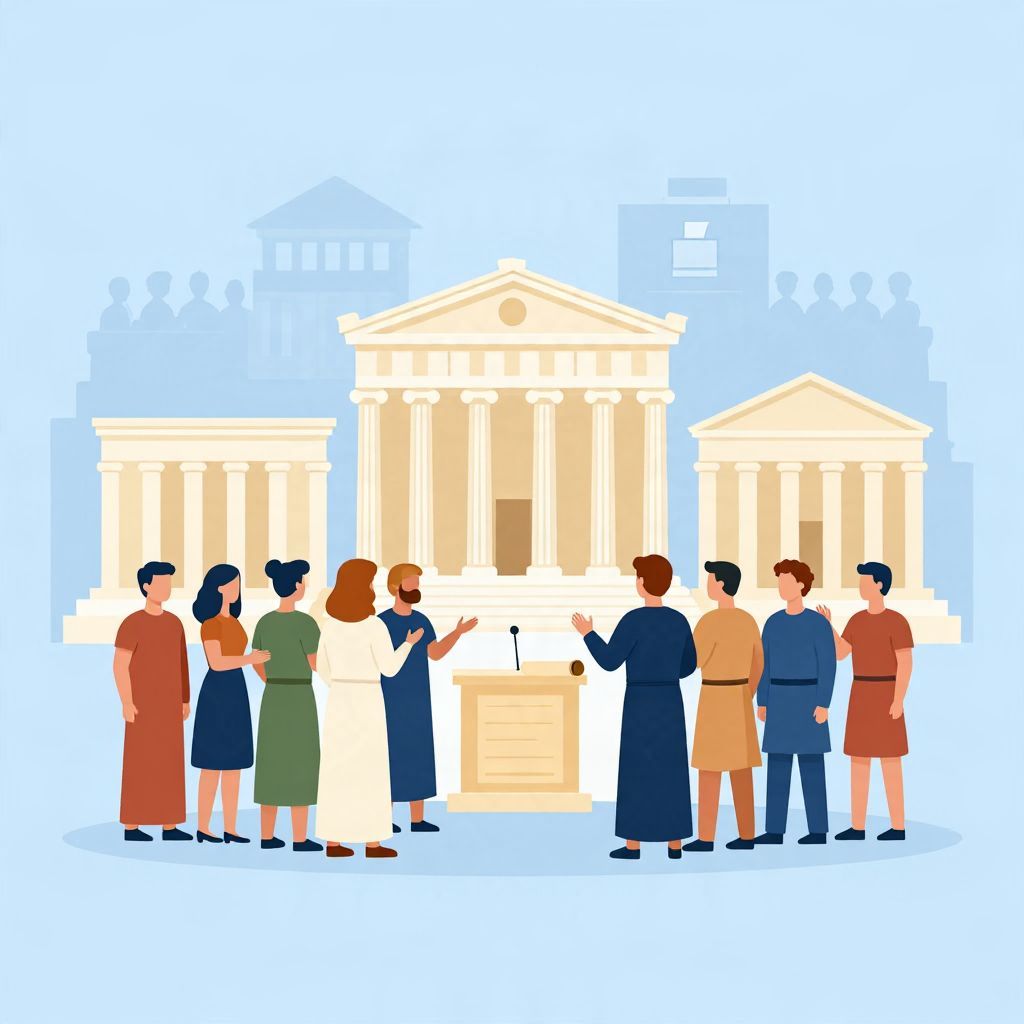
What is political engagement? At its simplest, it is the ways people try to influence public power: voting, protesting, joining parties, petitioning rulers, debating issues, organizing communities, and shaping laws. The idea is older than modern democracies, but the forms it takes have changed dramatically over time.
Across history, political engagement has reflected who was allowed to participate, what counted as legitimate action, and how governments responded to pressure from below. From ancient assemblies to modern mass elections, it has been a central part of the struggle over authority, rights, and citizenship.
What Is Political Engagement?
Political engagement is participation in public life aimed at influencing government, policy, or collective decisions. It includes formal acts such as voting and holding office, but also informal actions like demonstrations, lobbying, civil disobedience, and public debate. Historically, its meaning has expanded as more people gained rights and access to power.
The Historical Meaning of Political Engagement
Political engagement did not begin with modern elections. In many early societies, it meant direct participation by a limited group of elites, citizens, or clan leaders in making decisions for the community. Over time, the term came to include broader forms of public involvement, especially as ideas about representation, rights, and popular sovereignty developed.
Ancient roots: participation for the few
In ancient Athens, free male citizens could speak and vote in the assembly, making direct participation a defining feature of politics. But this was not universal democracy: women, enslaved people, and foreigners were excluded. In the Roman Republic, political engagement also existed through assemblies, elections, and public speech, though power remained heavily shaped by class and patronage.
These early examples show an important historical pattern: political engagement was often celebrated as civic duty, but only for a narrow portion of society. The idea that ordinary people should have a voice was present, yet limited by status, gender, and slavery.
Medieval and early modern politics: petition, loyalty, and privilege
In medieval Europe, political engagement usually took the form of loyalty to rulers, negotiation by nobles or towns, and petitioning for privileges. Most people did not vote in the modern sense. Instead, they might appeal to kings, local lords, city councils, or church authorities. In many societies, political action was collective and hierarchical rather than individual and equal.
As states grew stronger in the early modern period, subjects increasingly used petitions, pamphlets, sermons, and local assemblies to press for change. The printing press, expanding literacy, and religious conflict all helped create a more public political culture. Engagement became less confined to courts and councils and more visible in streets, churches, and coffeehouses.
How Political Engagement Changed in the Modern Era
The modern history of political engagement is closely tied to revolutions, constitutional government, and mass politics. From the late 18th century onward, more people began demanding representation, civil liberties, and the right to influence lawmaking. Political engagement gradually shifted from elite participation to broader public involvement, though this process was uneven and often contested.
Revolution and citizenship
The American and French Revolutions helped transform political engagement into a language of rights and popular sovereignty. In these revolutions, people argued that legitimate government should rest on the consent of the governed. That idea did not immediately create equal participation, but it changed the standard by which governments were judged.
During the 19th century, reform movements pushed voting rights outward to more men, and later to women in many countries. Workers’ movements, abolitionism, nationalist campaigns, and suffrage organizations showed that political engagement could be organized through clubs, unions, newspapers, marches, and mass petitions. Politics was no longer only the business of rulers.
Mass democracy and organized participation
By the late 19th and early 20th centuries, political parties, trade unions, and civic associations became major channels of engagement. Mass elections made voting a central civic act in many states, while campaigns, rallies, and party membership gave ordinary citizens more structured ways to participate. At the same time, many governments still restricted participation through race, gender, property, literacy, or colonial rule.
In this period, political engagement also became more strategic. Citizens did not only express opinions; they joined organizations to influence legislation, labor conditions, imperial policy, and national identity. The rise of mass media made public opinion more visible, and governments increasingly tried to manage it.
Forms of Political Engagement Across History
Political engagement has taken many forms, depending on the era and political system. Some forms are peaceful and institutional; others are confrontational or even illegal. Historically, the meaning of “engagement” has depended on whether power was open to persuasion, pressured by protest, or guarded by force.
- Voting and elections: choosing representatives or leaders where electoral systems existed.
- Petitions and appeals: formally asking rulers or institutions for change.
- Public debate: speeches, pamphlets, newspapers, and later broadcasts or online discussion.
- Protest and demonstration: marches, strikes, boycotts, and rallies.
- Party and union activity: organizing people around shared political goals.
- Civil disobedience: deliberately breaking laws to challenge injustice.
- Officeholding and administration: serving in government or local institutions.
Who was excluded?
A history of political engagement is also a history of exclusion. For much of human history, most people had little formal access to decision-making. Women, enslaved people, colonized populations, religious minorities, the poor, and racialized groups were often denied the vote or the right to organize freely. In many places, engagement was possible only through indirect channels such as family influence, local protest, or informal networks.
This exclusion matters because political engagement has never been only about willingness to participate. It has also depended on whether institutions allowed participation at all. Expanding engagement usually required struggle, not simply civic interest.
Political Engagement and the Rise of Citizenship
Modern political engagement is closely linked to citizenship, the idea that members of a political community have rights and responsibilities. In older monarchies, people were often subjects; in modern constitutional states, they increasingly became citizens. That shift changed political engagement from obedience and petition toward participation and accountability.
Citizenship also introduced the expectation that people should know public issues, vote, and sometimes serve on juries, in militias, or in local government. Yet citizenship was often unevenly distributed. Many states expanded political rights gradually, and some did so only after intense conflict, war, or social movement pressure.
Reform, resistance, and expansion
Political engagement expanded through repeated struggles. Abolitionists challenged slavery, labor activists demanded workplace rights, women’s suffrage movements sought the vote, and anti-colonial leaders fought imperial rule. In each case, engagement meant more than participation in an existing system; it also meant challenging the boundaries of who could participate.
In the 20th century, decolonization, civil rights movements, and democratic reforms widened political participation in many parts of the world. But authoritarian regimes also developed new ways to limit engagement through censorship, surveillance, intimidation, and controlled elections. Political engagement therefore remained both a right and a battleground.
Political Engagement in the Contemporary World
Today, political engagement includes traditional acts like voting and campaigning, but also digital activism, fundraising, community organizing, and issue-based advocacy. Social media has made it easier to spread political messages quickly, though not always more effectively. Online engagement can amplify voices, but it can also fragment debate, spread misinformation, or reward outrage over deliberation.
Modern political engagement is often measured by turnout, membership, protest activity, and public discussion, but those measures do not capture everything. A person may engage through local volunteering, school boards, neighborhood associations, religious groups, or advocacy networks. In historical terms, this broad range reflects a long shift from narrow elite participation to wider civic involvement.
Why it still matters
Political engagement matters because it shapes who gets heard, which issues receive attention, and how power is held accountable. Historically, societies with broader participation have often had stronger traditions of public debate and reform, though not always greater stability. Engagement can support democracy, but it can also be used to defend exclusionary or authoritarian goals. Its moral value depends on the causes it serves and the institutions it influences.
Conclusion: A Long History of Participation and Power
Political engagement is the human effort to influence collective power, and its history is the history of expanding — and contesting — access to that power. From ancient assemblies to mass democracy and digital activism, the forms have changed, but the central question has remained the same: who gets to decide, and how? For related reading, see the history of self-government and what political ideology means.